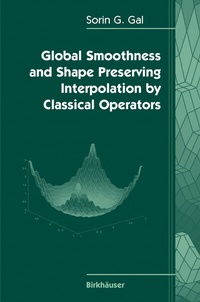
Global Smoothness and Shape Preserving Interpolation by Classical Operators
Description

This monograph examines and develops the Global Smoothness Preservation Property (GSPP) and the Shape Preservation Property (SPP) in the field of interpolation of functions. The study is developed for the univariate and bivariate cases using well-known classical interpolation operators of Lagrange, Grünwald, Hermite-Fejér and Shepard type. One of the first books on the subject, it presents interesting new results alongwith an excellent survey of past research.
Key features include:
- potential applications to data fitting, fluid dynamics, curves and surfaces, engineering, and computer-aided geometric design
- presents recent work featuring many new interesting results as well as an excellent survey of past research
- many interesting open problems for future research presented throughout the text
- includes 20 very suggestive figures of nine types of Shepard surfaces concerning their shape preservation property
- generic techniques of the proofs allow for easy application to obtaining similar results for other interpolation operators
This unique, well-written text is best suited to graduate students and researchers in mathematical analysis, interpolation of functions, pure and applied mathematicians in numerical analysis, approximation theory, data fitting, computer-aided geometric design, fluid mechanics, and engineering researchers.
Reviews / Votes
From the reviews:
"One of the main features of the book is the systematic treatment of both the univariate case in the first two chapters and the bivariate case in the last two chapters.. Many results have been obtained by the author himself in collaboration with other mathematicians.. Every chapter ends with some bibliographical remarks and a discussion of open problems, which may be very helpful for researchers and specialists in the fields of approximation theory and numerical analysis." -Mathematical Reviews
"Many of the presented results are published in this monograph for the first time.. This book is written for researchers in approximation theory, and it contains a large number of results, presented in a concise way." -SIAM Book Reviews
"This research monograph is a systematic treatment of the global smoothness preservation and the shape preservation properties for classical univariate and bivariate interpolation operators of Lagrange, Grünwald, Hermite-Fejér and Shepard type. Written in a clear and concise style, with numerous open problems supplementing each chapter and up to date references, this book constitutes a valuable tool for graduate students and researchers in approximation theory and its applications."(ZENTRALBLATT MATH)
More details
Other editions
Additional editions