

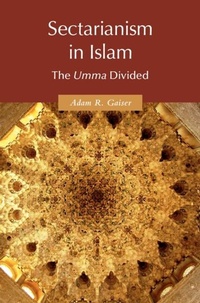
Sectarianism in Islam
The <EM>Umma</EM> Divided
Published on 23. November 2022
978-1-009-32504-2 (ISBN)
Description

Sectarian divisions within the Islamic world have long been misunderstood and misconstrued by the media and the general public. In this book, Adam R. Gaiser offers an accessible introduction to the main Muslim sects and schools, returning to the roots of the sectarian divide in the Medieval period. Beginning with the death of Muhammed and the ensuing debate over who would succeed him, Gaiser outlines how the umma (Muslim community) came to be divided. He traces the history of the main Muslim sects and schools - the Sunnis, Shi'ites, Kharijites, Mu'tazila and Murji'a - and shows how they emerged, developed, and diverged from one another. Exploring how medieval Muslims understood the idea of 'sect', Gaiser challenges readers to consider the usefulness and scope of the concept of 'sectarianism' in this historical context. Providing an overview of the main Muslim sects while problematising the assumptions of previous scholarship, this is a valuable resource for both new and experienced readers of Islamic history.
Reviews / Votes
'This is an enlightening, comprehensive analysis of how Muslims forged and re-forged their identities and sense of belonging to different sects and schools of thought. Through the lenses of belief, narrative, and memory, this volume outfits the reader with a new way of understanding 'Islamic sectarianism' from its origins at the dawn of Islam up to its reverberations today.' Ersilia Francesca, University of Naples L'Orientale 'This is a concise, instructive introduction to a complex topic that skilfully draws the broad outline without overlooking the necessary nuances. Adam Gaiser alerts the reader to the relevant terminological issues, the limits and ambiguities of sectarian affiliations, and the contextual nature of sectarian permeability and strife throughout the centuries of Islamic history.' Maribel Fierro, Spanish National Research Council 'Professor Gaiser's book is a brilliant history of Islamic sectarianism. Islamic history in its richness and complexity is presented in a sophisticated theoretical framework that will set a new standard in how we treat Islamic religious history. This is one of the best works to appear in recent years, and it is beautifully written.' Walid Saleh, University of Toronto 'The diversity within Islam and among its followers and their different rituals, beliefs, and experiences throughout history constitute a complex, multifaceted topic. Adam Gaiser's book provides a solid conceptual framework to understand notions such as 'sects' and 'schools' within the Islamic context and discusses some of the major strands within and beyond Sunnism. A fascinating read for specialists and non-specialists alike.' Sabine Schmidtke, Institute for Advanced Study, Princeton NJ '... Gaiser's book makes a good addition to the studies of Islamic sects and sectarianism. The introduction and chapter seven also constitute useful material for teaching early Islamic history or Islamic sects/schools, which can potentially guide undergraduate students to think critically about the mainstay discourses about Muslim groups in the past and present.' I-Wen Su, JAOS 'Combining rich and varied historical documentation with a thoughtful theoretical approach, this book constitutes an excellent introduction to the pluralization of Islam, which can be offered to undergraduate students, as well as journalists and political decision-makers who, through intellectual laziness or ideological bias, are often quick to reduce Muslim groups to outdated stereotypes.' Jason Dean , Revue d'histoire et de philosophie religieusesMore details
Series
Language
English
Place of publication
Cambridge
United Kingdom
Illustrations
Worked examples or Exercises
File size
3,76 MB
ISBN-13
978-1-009-32504-2 (9781009325042)
Copyright in bibliographic data and cover images is held by Nielsen Book Services Limited or by the publishers or by their respective licensors: all rights reserved.
Schweitzer Classification
Other editions
Additional editions
Book
11/2022
Cambridge University Press
€32.00
Shipment within 15-20 days
Book
11/2022
Cambridge University Press
€93.00
Shipment within 15-20 days
Person
Adam R. Gaiser is Professor of Religion at Florida State University. He has previously published two books on the early Kharijites and Ibadiyya: Muslims, Scholars, Soldiers: The Origin and Elaboration of the Iba?i Imamate Traditions (2010) and Shurat Legends, Iba?i Identities: Martyrdom, Asceticism and the Making of an Early Islamic Community (2016).
Content
List of maps, charts, and figures; Preface; Notes on transliteration, dates, and Qur'anic citations; 1. Introduction; 2. History of sects and schools; 3. Kharijites and Ibadis; 4. Shi?ites; 5. Murji'ites and Mu?tazilites; 6. Sunnis; 7. Sectarian ambiguities and relations; 8. Conclusions; Glossary; Bibliography; Index.
