

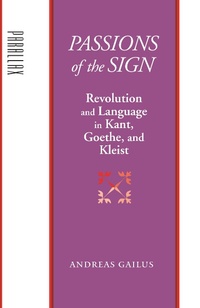
Passions of the Sign
Revolution and Language in Kant, Goethe, and Kleist
Published on 18. May 2006
240 pages
978-0-8018-8904-2 (ISBN)
Description

Passions of the Sign traces the impact of the French Revolution on Enlightenment thought in Germany as evidenced in the work of three major figures around the turn of the nineteenth century: Immanuel Kant, Johann Wolfgang von Goethe, and Heinrich von Kleist. Andreas Gailus examines a largely overlooked strand in the philosophical and literary reception of the French Revolution, one which finds in the historical occurrence of revolution the expression of a fundamental mechanism of political, conceptual, and aesthetic practice.
With a close reading of a critical essay by Kleist, an in-depth discussion of Kant's philosophical writing, and new readings of the novella form as employed by both Goethe and Kleist, Gailus demonstrates how these writers set forth an energetic model of language and subjectivity whose unstable nature reverberates within the very foundations of society. Unfolding in the medium of energetic signs, human activity is shown to be subject to the counter-symbolic force that lies within and beyond it. History is subject to contingency and is understood not as a progressive narrative but as an expanse of revolutionary possibilities; language is subject to the extra-linguistic context of utterance and is conceived primarily not in semantic but in pragmatic terms; and the
individual is subject to impersonal affect and is figured not as the locus of self-determination but as the site of passions that exceed the self and its pleasure principle.
At once a historical and a conceptual study, this volume moves between literature and philosophy, and between textual analysis and theoretical speculation, engaging with recent discussions on the status of sovereignty, the significance of performative language in politics and art, and the presence of the impersonal, even inhuman, within the economy of the self.
With a close reading of a critical essay by Kleist, an in-depth discussion of Kant's philosophical writing, and new readings of the novella form as employed by both Goethe and Kleist, Gailus demonstrates how these writers set forth an energetic model of language and subjectivity whose unstable nature reverberates within the very foundations of society. Unfolding in the medium of energetic signs, human activity is shown to be subject to the counter-symbolic force that lies within and beyond it. History is subject to contingency and is understood not as a progressive narrative but as an expanse of revolutionary possibilities; language is subject to the extra-linguistic context of utterance and is conceived primarily not in semantic but in pragmatic terms; and the
individual is subject to impersonal affect and is figured not as the locus of self-determination but as the site of passions that exceed the self and its pleasure principle.
At once a historical and a conceptual study, this volume moves between literature and philosophy, and between textual analysis and theoretical speculation, engaging with recent discussions on the status of sovereignty, the significance of performative language in politics and art, and the presence of the impersonal, even inhuman, within the economy of the self.
More details
Series
Language
English
Place of publication
Baltimore
United States
Target group
Professional and scholarly
File size
1,93 MB
ISBN-13
978-0-8018-8904-2 (9780801889042)
DOI
10.1353/book.3247
Copyright in bibliographic data and cover images is held by Nielsen Book Services Limited or by the publishers or by their respective licensors: all rights reserved.
Schweitzer Classification
Other editions
Additional editions
Book
05/2006
Johns Hopkins University Press
€66.00
Article not available for order
Person
Andreas Gailus is an associate professor of German at the University of Minnesota.
Content
List of Abbreviations
Preface
Introduction: Energetic Signs: Autonomy and Novelty in the Age of Revolution
1. Revealing Freedom: Crisis and Enthusiasm in Kant's Philosophy of History
2. The Poetics of Containment: Goethe's Conversations of German Refugees and the Crisis of Communication
3. Border Narratives: Kleist's Michael Kohlhaas
Conclusion: The Big Either
Notes
References
Index
Preface
Introduction: Energetic Signs: Autonomy and Novelty in the Age of Revolution
1. Revealing Freedom: Crisis and Enthusiasm in Kant's Philosophy of History
2. The Poetics of Containment: Goethe's Conversations of German Refugees and the Crisis of Communication
3. Border Narratives: Kleist's Michael Kohlhaas
Conclusion: The Big Either
Notes
References
Index
