

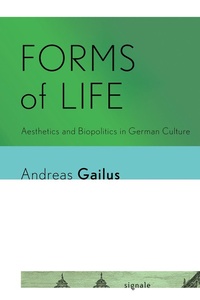
Forms of Life
Aesthetics and Biopolitics in German Culture
Published on 1. August 2020
408 pages
978-1-5017-4996-4 (ISBN)
Description

In Forms of Life, Andreas Gailus argues that the neglect of aesthetics in most contemporary theories of biopolitics has resulted in an overly restricted conception of life. He insists we need a more flexible notion of life: one attuned to the interplay and conflict between its many dimensions and forms. Forms of Life develops such a notion through the meticulous study of works by Kant, Goethe, Kleist, Nietzsche, Wittgenstein, Benn, Musil, and others.
Gailus shows that the modern conception of "life" as a generative, organizing force internal to living beings emerged in the last decades of the eighteenth century in biological thought. At the core of this vitalist strand of thought, Gailus maintains, lies a persistent emphasis on the dynamics of formation and deformation, and thus on an intrinsically aesthetic dimension of life.
Forms of Life brings this older discourse into critical conversation with contemporary discussions of biopolitics and vitalism, while also developing a rich conception of life that highlights, rather than suppresses, its protean character. Gailus demonstrates that life unfolds in the open-ended interweaving of the myriad forms and modalities of biological, ethical, political, psychical, aesthetic, and biographical systems.
Gailus shows that the modern conception of "life" as a generative, organizing force internal to living beings emerged in the last decades of the eighteenth century in biological thought. At the core of this vitalist strand of thought, Gailus maintains, lies a persistent emphasis on the dynamics of formation and deformation, and thus on an intrinsically aesthetic dimension of life.
Forms of Life brings this older discourse into critical conversation with contemporary discussions of biopolitics and vitalism, while also developing a rich conception of life that highlights, rather than suppresses, its protean character. Gailus demonstrates that life unfolds in the open-ended interweaving of the myriad forms and modalities of biological, ethical, political, psychical, aesthetic, and biographical systems.
Reviews / Votes
A critical study of this kind-reading modern German philosophy and literary masterpieces in the context of twentieth-century biopolitics and other scientific-reductive definitions of "life"-has been long overdue in German studies, yet Gailus's marvelous book was worth the wait! In lucid prose and pointed arguments, Gailus introduces his readers to the philosophical history of vital materialism, he provides superb readings of canonical literary texts that demonstrate the continued relevance of the German tradition in scientific debates. * Goethe Yearbook * "[...] Gailus' commanding study offers unique historical and systematic insights. It is in response to an evident lack in contemporary conceptualizations of life that the book finds its proper ground. And it is precisely here that it develops generous and original ways of reading canonical literature that will orient scholarship for some time to come * German Studies Review *More details
Series
Language
English
Place of publication
Ithaca
United States
Publishing group
Cornell University Press
File size
1,05 MB
ISBN-13
978-1-5017-4996-4 (9781501749964)
Copyright in bibliographic data and cover images is held by Nielsen Book Services Limited or by the publishers or by their respective licensors: all rights reserved.
Schweitzer Classification
Other editions
Additional editions
Book
09/2020
Cornell University Press and Cornell University Library
€178.27
Shipment within 15-20 days
Book
09/2020
Cornell University Press and Cornell University Library
€55.89
Shipment within 15-20 days
Person
Andreas Gailus is Professor and Chair of the Department of Germanic Languages and Literatures at the University of Michigan, and author of Passions of the Sign.
Content
Introduction
Part I: Life as Formation
1. The Life of Cognition and the Cognition of Life (Kant)
2. Metamorphoses of Form (Goethe)
Part II: The Conflict of Forms
3. Enter the Hybrid (Kleist)
4. Life as Will (Nietzsche)
Part III: Deformation
5. Brains (Benn)
6. The Infinite Specificity of Life (Musil)
Epilogue
Part I: Life as Formation
1. The Life of Cognition and the Cognition of Life (Kant)
2. Metamorphoses of Form (Goethe)
Part II: The Conflict of Forms
3. Enter the Hybrid (Kleist)
4. Life as Will (Nietzsche)
Part III: Deformation
5. Brains (Benn)
6. The Infinite Specificity of Life (Musil)
Epilogue
