

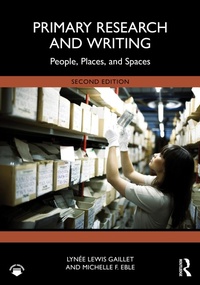
Primary Research and Writing
People, Places, and Spaces
2nd Edition
Published on 9. April 2026
402 pages
978-1-040-57887-2 (ISBN)
Description

Developed for emerging academic writers, this new edition offers a thoroughly updated approach for incorporating archival and primary materials into the writing process.
Encouraging students to write about topics that resonate with their community memberships, personal interests, and positionality, this textbook emphasizes the importance of expanding writing and research skills and abilities to include material culture. The book includes a pedagogical approach that makes archival and primary research interesting, urgent, and relevant to emerging writers. Students assess multiple ways of analyzing their findings and presenting results to their intended readers. With in-text features to aid students in understanding primary research and its role in their writing, chapters include elements such as profiles of primary researchers, communities in context, and student writing examples. This new edition explores the impact of Artificial Intelligence, as well as multimodality, document design, visual elements and citation practices.
Primary Research and Writing is an engaging textbook developed for undergraduate students in the beginning stages of their academic writing careers and prepares its readers for a lifetime of research and writing.
Online resources, including sample syllabi and course designs, sample class projects/assignment descriptions, activities, and discussion questions are available at www.routledge.com/9781041025825.
Encouraging students to write about topics that resonate with their community memberships, personal interests, and positionality, this textbook emphasizes the importance of expanding writing and research skills and abilities to include material culture. The book includes a pedagogical approach that makes archival and primary research interesting, urgent, and relevant to emerging writers. Students assess multiple ways of analyzing their findings and presenting results to their intended readers. With in-text features to aid students in understanding primary research and its role in their writing, chapters include elements such as profiles of primary researchers, communities in context, and student writing examples. This new edition explores the impact of Artificial Intelligence, as well as multimodality, document design, visual elements and citation practices.
Primary Research and Writing is an engaging textbook developed for undergraduate students in the beginning stages of their academic writing careers and prepares its readers for a lifetime of research and writing.
Online resources, including sample syllabi and course designs, sample class projects/assignment descriptions, activities, and discussion questions are available at www.routledge.com/9781041025825.
Reviews / Votes
Praise from the 1st Edition"Primary Research and Writing transformed the way I teach first year composition. When students become researchers, they become passionate about research and writing. My students saw research, writing, and critical analysis as relevant and even necessary activities. As a result, my classroom became a community of scholars immersed in examining the world around them, and I haven't looked back since."
Candace Nadon, Fort Lewis College, USA
"Teaching writing via communities and primary research truly enlivens and enriches the first-year classroom. Primary Research and Writing: People, Places, and Spaces is an incredibly useful text for exploring how to gather and write up firsthand data in the twenty-first century. Filled with wide-ranging contemporary examples, the text connects research and writing methods with various local and global communities in a manner that students find helpful and accessible."
Matthew Sansbury, Georgia State University, USA
"Revitalize and recharge your composition or expository writing or history or service-learning class! This approach energized my students, who took off running to investigate a community of their choice using primary sources in the archives and in the world around them. I had the joy of seeing them take ownership of their writing."
Amanda C. Gable, Georgia State University, USA
More details
Edition
2nd edition
Language
English
Place of publication
London
United Kingdom
Publishing group
Taylor & Francis Ltd
Target group
College/higher education
Illustrations
3 Tables, color; 8 Line drawings, color; 73 Halftones, color; 81 Illustrations, color
File size
57,54 MB
ISBN-13
978-1-040-57887-2 (9781040578872)
Copyright in bibliographic data and cover images is held by Nielsen Book Services Limited or by the publishers or by their respective licensors: all rights reserved.
Schweitzer Classification
Other editions
Additional editions
Book
approx. 03/2026
2nd Edition
Routledge
€259.50
Not yet published
Book
approx. 03/2026
2nd Edition
Routledge
€65.00
Not yet published
Persons
Lynee Lewis Gaillet is Distinguished University Professor in the English department at Georgia State University, USA.
Michelle F. Eble is a Professor in the Department of English at East Carolina University (ECU), USA. In addition to serving as PhD Coordinator, she supervises the graduate teaching instructors teaching undergraduate professional writing courses, serves as the Chair of ECU's Behavioral and Social Sciences Institutional Review Board, and is a Past President of the Association of Teachers of Technical Writing (ATTW).
Michelle F. Eble is a Professor in the Department of English at East Carolina University (ECU), USA. In addition to serving as PhD Coordinator, she supervises the graduate teaching instructors teaching undergraduate professional writing courses, serves as the Chair of ECU's Behavioral and Social Sciences Institutional Review Board, and is a Past President of the Association of Teachers of Technical Writing (ATTW).
Content
PART I PRIMARY RESEARCH AND RHETORICAL TOOLS 1. Introduction to Primary Research 2. Defining and Engaging with Communities 3. Identifying a Research Topic and Thinking Like a Researcher 4. Becoming an Authority on a Topic PART II METHODS FOR INQUIRY AND CONDUCTING ARCHIVAL RESEARCH 5. Beginning Archival Research: A Practical Guide 6. Fieldwork and Ethnographic Observation 7. Interviews: Researching People 8. Surveys: Researching Beliefs, Opinions, and Attitudes PART III WRITING AND DELIVERING YOUR RESEARCH 9. A Rhetorical Approach to Research and Writing 10. Preparing your Research for Delivery
