

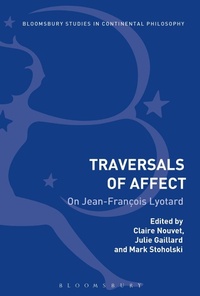
Traversals of Affect
On Jean-FrancOis Lyotard
1st Edition
Published on 21. April 2016
304 pages
978-1-4742-5790-9 (ISBN)
Description

This volume traces the topic of affect across Lyotard's corpus and accounts for Lyotard's crucial and original contribution to the thinking of affect. Highlighting the importance of affect in Lyotard's philosophy, this work offers a unique contribution to both affect theory and the reception of Lyotard.
Affect indeed traverses Lyotard's philosophical corpus in various ways and under various names: "figure" or "the figural" in Discourse, Figure, "unbound intensities" in his "libidinal" writings, "the feeling of the différend" in The Differend, "affect" and "infantia" in his later writings. Across the span of his work, Lyotard insisted on the intractability of affect, on what he would later call the "differend" between affect and articulation. The singular awakening of sensibility, affect both traverses and escapes articulation, discourse, and representation. Lyotard devoted much of his attention to the analysis of this traversal of affect in and through articulation, its transpositions, translations, and transfers. This volume explores Lyotard's account of affect as it traverses the different fields encompassed by his writings (philosophy, the visual arts, the performing arts, literature, music, politics, psychoanalysis as well as technology and post-human studies).
Affect indeed traverses Lyotard's philosophical corpus in various ways and under various names: "figure" or "the figural" in Discourse, Figure, "unbound intensities" in his "libidinal" writings, "the feeling of the différend" in The Differend, "affect" and "infantia" in his later writings. Across the span of his work, Lyotard insisted on the intractability of affect, on what he would later call the "differend" between affect and articulation. The singular awakening of sensibility, affect both traverses and escapes articulation, discourse, and representation. Lyotard devoted much of his attention to the analysis of this traversal of affect in and through articulation, its transpositions, translations, and transfers. This volume explores Lyotard's account of affect as it traverses the different fields encompassed by his writings (philosophy, the visual arts, the performing arts, literature, music, politics, psychoanalysis as well as technology and post-human studies).
More details
Edition
1. Auflage
Language
English
Place of publication
London
United Kingdom
Publishing group
Bloomsbury Publishing PLC
Target group
College/higher education
ISBN-13
978-1-4742-5790-9 (9781474257909)
Copyright in bibliographic data and cover images is held by Nielsen Book Services Limited or by the publishers or by their respective licensors: all rights reserved.
Schweitzer Classification
Other editions
Additional editions
Book
04/2016
Bloomsbury Academic
€179.30
Shipment within 15-20 days
Persons
Julie Gaillard is a doctoral candidate in the Department of French and Italian at Emory University, and an Andrew W. Mellon Graduate Teaching Fellow at Morehouse College. She is preparing a dissertation on proper names, referentiality and mediality in French literature and arts at the turn of the twenty-first century.
Claire Nouvet is associate professor in the Department of French and Italian at Emory University. She is the co-editor of Minima Memoria: In the Wake of Jean-François Lyotard (Stanford, 2007), the author of Enfances Narcisse (Galilée, 2009), Abélard et Héloïse: la passion de la maîtrise (Presses Universitaires du Septentrion, 2009), and the editor of Literature and the Ethical Question (Yale French Studies, 1991).
Mark Stoholski is a Mellon/ACLS dissertation completion fellow in the Department of Comparative Literature at Emory University and a candidate at the Emory University Psychoanalytic Institute. He is preparing a dissertation on affect via the ancient sophists and their reception in modern literature and psychoanalysis.
Claire Nouvet is associate professor in the Department of French and Italian at Emory University. She is the co-editor of Minima Memoria: In the Wake of Jean-François Lyotard (Stanford, 2007), the author of Enfances Narcisse (Galilée, 2009), Abélard et Héloïse: la passion de la maîtrise (Presses Universitaires du Septentrion, 2009), and the editor of Literature and the Ethical Question (Yale French Studies, 1991).
Mark Stoholski is a Mellon/ACLS dissertation completion fellow in the Department of Comparative Literature at Emory University and a candidate at the Emory University Psychoanalytic Institute. He is preparing a dissertation on affect via the ancient sophists and their reception in modern literature and psychoanalysis.
Content
List of Contributors
Introduction
Claire Nouvet, Julie Gaillard, & Mark Stoholski
1. Affect: An Unarticulated Phrase
Apathemata, Mark Stoholski
For "Emma" , Claire Nouvet
2. Affect in the Work of Art and in Commentary
Pragmatics and Affect in Art and Commentary, Ashley Woodward
Anamnesis, Anne Tomiche
Lyotard's Gesture, Kas Saghafi
No Place for Complacency: The Resistance of Gesture, Kiff Bamford
3. Affect as Figure
Introduction. Before Affect: Elaborating The Figural, Julie Gaillard
Following Lyotard's Lines: Affect and Figure in Guillermo Kuitca's Acoustic Mass VI and Mozart Da-Ponte VIII, Heidi Bickis
Philip Guston's Piles, Jana V. Schmidt
4. Affect and the Sublime in the Age of New Technologies
Gods, Angels and Puppets: Lyotard's Lessons on Listening, Kirsten Locke
Autoaffection and Lyotard's Cinematic Sublime, Erin Obodiac
5. Affect in Postmodern Politics
A New Kind of Sublime: Lyotard's Affect-Phrase and the 'Begebenheit of Our Time'
Peter Milne
Lyotard on Affect and Media: Or the Postmodern-Version 2.0 Explained by Orwell's 1984
Kent Still
6. Affect and the Task of Thinking
The Task of Thinking (in) The Postmodern Space of "The Zone", Julie Gaillard
Coups de Grâce, Mark Stoholski
Impious Thinking, an Interview with Geoffrey Bennington
Bibliography
Index
Introduction
Claire Nouvet, Julie Gaillard, & Mark Stoholski
1. Affect: An Unarticulated Phrase
Apathemata, Mark Stoholski
For "Emma" , Claire Nouvet
2. Affect in the Work of Art and in Commentary
Pragmatics and Affect in Art and Commentary, Ashley Woodward
Anamnesis, Anne Tomiche
Lyotard's Gesture, Kas Saghafi
No Place for Complacency: The Resistance of Gesture, Kiff Bamford
3. Affect as Figure
Introduction. Before Affect: Elaborating The Figural, Julie Gaillard
Following Lyotard's Lines: Affect and Figure in Guillermo Kuitca's Acoustic Mass VI and Mozart Da-Ponte VIII, Heidi Bickis
Philip Guston's Piles, Jana V. Schmidt
4. Affect and the Sublime in the Age of New Technologies
Gods, Angels and Puppets: Lyotard's Lessons on Listening, Kirsten Locke
Autoaffection and Lyotard's Cinematic Sublime, Erin Obodiac
5. Affect in Postmodern Politics
A New Kind of Sublime: Lyotard's Affect-Phrase and the 'Begebenheit of Our Time'
Peter Milne
Lyotard on Affect and Media: Or the Postmodern-Version 2.0 Explained by Orwell's 1984
Kent Still
6. Affect and the Task of Thinking
The Task of Thinking (in) The Postmodern Space of "The Zone", Julie Gaillard
Coups de Grâce, Mark Stoholski
Impious Thinking, an Interview with Geoffrey Bennington
Bibliography
Index
