

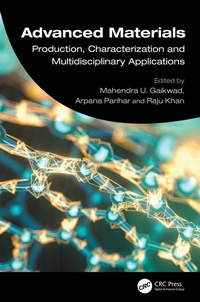
Advanced Materials
Production, Characterization and Multidisciplinary Applications
1st Edition
Published on 6. December 2024
264 pages
978-1-040-19334-1 (ISBN)
Description

Advanced materials are engineered to exhibit novel properties that confer superior performance in comparison with conventional materials. The performance of advanced materials is associated with toughness, hardness, and durability that can be used for high technological applications such as semiconductors, biomaterials, smart materials, or nanomaterials.
Advanced Materials: Production, Characterization and Multidisciplinary Applications is focused on novel approaches for production of graphene and other 2D materials along with characterization techniques, discussing a wide range of applications in multidisciplinary areas of science and engineering. It provides a guiding light in the production, synthesis, and characterization of advanced materials by implementing appropriate techniques. The book has a multidisciplinary approach covering applications in electronics (sensors), engineering, biotechnology, medical (e.g., cancer treatment, drug delivery, cellular imaging), and biomedical (smart implants, drug delivery, and DIY health testing kits) fields. The authors cover the primary information of advanced and other 2D materials related to their production or synthesis via various methods, ranging from conventional to non-conventional - such as lithography, photolithography (computer chips), electron beam lithography, etching, atomic layer deposition, chemical vapor deposition, hydrothermal process, and electrospinning, along with some comparative investigations. It also covers a comparison study over the current and future perspectives of advanced and other 2D materials.
This book is aimed at researchers, academics, and professionals who are interested in understanding the novel approaches for synthesis of advanced materials.
Advanced Materials: Production, Characterization and Multidisciplinary Applications is focused on novel approaches for production of graphene and other 2D materials along with characterization techniques, discussing a wide range of applications in multidisciplinary areas of science and engineering. It provides a guiding light in the production, synthesis, and characterization of advanced materials by implementing appropriate techniques. The book has a multidisciplinary approach covering applications in electronics (sensors), engineering, biotechnology, medical (e.g., cancer treatment, drug delivery, cellular imaging), and biomedical (smart implants, drug delivery, and DIY health testing kits) fields. The authors cover the primary information of advanced and other 2D materials related to their production or synthesis via various methods, ranging from conventional to non-conventional - such as lithography, photolithography (computer chips), electron beam lithography, etching, atomic layer deposition, chemical vapor deposition, hydrothermal process, and electrospinning, along with some comparative investigations. It also covers a comparison study over the current and future perspectives of advanced and other 2D materials.
This book is aimed at researchers, academics, and professionals who are interested in understanding the novel approaches for synthesis of advanced materials.
More details
Edition
1. Auflage
Language
English
Place of publication
London
United Kingdom
Publishing group
Taylor & Francis Ltd
Target group
Professional and scholarly
Illustrations
19 Tables, black and white; 40 Line drawings, color; 2 Line drawings, black and white; 46 Halftones, color; 86 Illustrations, color; 2 Illustrations, black and white
ISBN-13
978-1-040-19334-1 (9781040193341)
Copyright in bibliographic data and cover images is held by Nielsen Book Services Limited or by the publishers or by their respective licensors: all rights reserved.
Schweitzer Classification
Other editions
Additional editions
Mahendra U. Gaikwad | Arpana Parihar | Raju Khan
Advanced Materials
Production, Characterization and Multidisciplinary Applications
Book
approx. 07/2026
1st Edition
CRC Press
€66.00
Not yet published
Mahendra U. Gaikwad | Arpana Parihar | Raju Khan
Advanced Materials
Production, Characterization and Multidisciplinary Applications
Book
12/2024
1st Edition
CRC Press
€191.60
Shipment within 10-20 days
Persons
Dr. Mahendra U. Gaikwad is currently working as an Assistant Professor in the Department of Mechanical Engineering, Veermata Jijabai Technological Institute (VJTI), Mumbai. He has more than 11 years of teaching experience at UG & PG level. He obtained his B.E. in Mechanical Engineering and M.E. in Mechanical Design Engineering from the Walchand Institute of Technology, Solapur, Maharashtra, India, and Ph.D. in Mechanical Engineering from the Sathyabama Institute of Science and Technology, Chennai, Tamil Nadu, India. His current research interests include material characterization, surface integrity, advanced manufacturing process, and machining of smart material alloys.
Arpana Parihar is currently working as a research associate at the Department of Translational Medicine, All India Institute of Medical Sciences Bhopal, MP, India. She did her Ph.D. at the Raja Ramanna Centre for Advanced Technology, Indore, under the aegis of HBNI, Mumbai. Her doctoral research involves the evaluation of the tumor selectivity and photodynamic therapy (PDT) efficacy of chlorin p6 through receptor-mediated targeted drug delivery. She has more than 9 years of research and teaching experience at prestigious institutes including BARC, RRCAT, IITD, AND CSIR-AMPRI. She has been awarded many prestigious fellowships including DSTWOS- B, DBT-RA, CSIR-NET, and GATE. Her current research interests include 3D bioprinting, micro/nano fabrications of biosensors for early diagnosis of diseases, infectious diseases, stem cell biology, tissue engineering, photodynamic therapy of cancer, receptor-mediated targeting of tumors, 3D cell culture, expression of receptors and cytokines, molecular docking, molecular dynamic simulations, and immunoinformatics. She has published over 50 articles, 30 book chapters, and edited 11 books with renowned publishers.
Raju Khan is a Senior Principal Scientist & Professor at CSIR-AMPRI, Bhopal, MP, India. He has a background of Chemistry, obtaining his M.Sc.and Ph.D. in Chemistry from Jamia Millia Islamia, India. He has experience as a Post Doctorate at the University of the Western Cape, South Africa; as a Young Scientist at CSIR-NPL, New Delhi, India; more than 10 years of working as a Scientist at CSIR-NEIST, Jorhat, Assam; and as Visiting Scientist at the University of Texas & San Antonio, UTSA, USA. He is a Fellow of Royal Society of Chemistry (FRSC) and has also been awarded a reputed BOYSCAST Fellowship, by the DST, Govt of India. He has gained many other prestigious achievements, such as being a member of FSSAI, Govt. of India and Associate Dean of Chemical Sciences at AcSIR. His research group focuses on nanomaterials-based biosensors and point-of-care (POC) diagnostics for biomedical applications.
Arpana Parihar is currently working as a research associate at the Department of Translational Medicine, All India Institute of Medical Sciences Bhopal, MP, India. She did her Ph.D. at the Raja Ramanna Centre for Advanced Technology, Indore, under the aegis of HBNI, Mumbai. Her doctoral research involves the evaluation of the tumor selectivity and photodynamic therapy (PDT) efficacy of chlorin p6 through receptor-mediated targeted drug delivery. She has more than 9 years of research and teaching experience at prestigious institutes including BARC, RRCAT, IITD, AND CSIR-AMPRI. She has been awarded many prestigious fellowships including DSTWOS- B, DBT-RA, CSIR-NET, and GATE. Her current research interests include 3D bioprinting, micro/nano fabrications of biosensors for early diagnosis of diseases, infectious diseases, stem cell biology, tissue engineering, photodynamic therapy of cancer, receptor-mediated targeting of tumors, 3D cell culture, expression of receptors and cytokines, molecular docking, molecular dynamic simulations, and immunoinformatics. She has published over 50 articles, 30 book chapters, and edited 11 books with renowned publishers.
Raju Khan is a Senior Principal Scientist & Professor at CSIR-AMPRI, Bhopal, MP, India. He has a background of Chemistry, obtaining his M.Sc.and Ph.D. in Chemistry from Jamia Millia Islamia, India. He has experience as a Post Doctorate at the University of the Western Cape, South Africa; as a Young Scientist at CSIR-NPL, New Delhi, India; more than 10 years of working as a Scientist at CSIR-NEIST, Jorhat, Assam; and as Visiting Scientist at the University of Texas & San Antonio, UTSA, USA. He is a Fellow of Royal Society of Chemistry (FRSC) and has also been awarded a reputed BOYSCAST Fellowship, by the DST, Govt of India. He has gained many other prestigious achievements, such as being a member of FSSAI, Govt. of India and Associate Dean of Chemical Sciences at AcSIR. His research group focuses on nanomaterials-based biosensors and point-of-care (POC) diagnostics for biomedical applications.
Content
1. Introduction (Overview) to Advanced 2D Materials Used in Industry. 2. Advanced Material and Other 2D Materials a Comparative Investigation. 3. Confirmation of Non-Debye character in SmFeO3 doped PbTiO3 characterizing by CIS technique. 4. Characterization techniques used for advanced materials describing physical, mechanical, thermal & biocompatibility properties. 5. Characterization techniques associated with investigation of fundamental properties of advanced material and other 2D materials. 6. Characterization of Non-Debye Behavior and Hopping Mechanism in PbTiO3-NdFeO3 Multiferroic Using Complex Impedance Spectroscopy. 7. Nanoscale Design and Probing of Advanced Materials. 8. Investigation associated with graphene oxide related to biotechnology and medicine for cancer treatment. 9. Advanced 2D Material-based Miniaturized Devices for Biomedical Applications. 10. Advanced Materials Synthesis by Top-Down Approach and Bottom-Up Approaches. 11. Challenges and Advances in 2d Materials Production and Its Characterization.
