

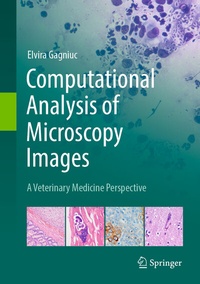
Computational Analysis of Microscopy Images
Description

This application-based guide fills a unique niche in the veterinary medical field by merging advanced computational techniques with the practical needs of veterinary pathology.
With increasing prevalence of digital pathology, there is a burgeoning requirement to navigate veterinary professionals in the utilization of computational methods and the enhancement of diagnostic accuracy. This book caters to this demand, presenting the material in an accessible way to novices, technologists, and pathologists. Written from the perspective of a seasoned veterinary pathologist, it ensures that the techniques described are relevant and directly usable.
Beginning with an exploration of microscopy fundamentals, the first part includes sample preparation, staining, and slide digitization. Subsequent chapters introduce readers to computational image analysis and the basics of image processing, tools, software, and successful integration of computational analysis into veterinary practice. Moreover, the book covers advanced topics such as image enhancement, reconstruction, quantitative analysis, and the application of machine learning and AI in microscopy image analysis. It provides insight into state-of-the-art imaging techniques like fluorescence and confocal microscopy, electron microscopy, and explores the innovations from nano to macro scales.
The incorporation of case studies and sample workflows allows this work to demonstrate the practical benefits of computational image analysis in veterinary medicine, with improvements in diagnostic accuracy and workflow efficiency. It serves as a learning resource for continuous professional development, helping veterinary pathologists stay abreast of technological advances in image analysis. Serving veterinary professionals, pathologists, researchers, and computational biologists alike, this book is an essential resource for anyone looking to harness the power of computational tools and AI in veterinary medicine.
More details
Other editions
Additional editions
Person
Elvira Gagniuc is coordinator of Pathological Anatomy (French section), teaching general and specialized Pathological Anatomy courses at the Faculty of Veterinary Medicine in Bucharest, University of Agronomic Sciences and Veterinary Medicine of Bucharest . She provides histopathological and cytopathological diagnostics for biopsies from both companion animals and farm animals. Dr. Gagniuc has participated in numerous specialization courses in Belgium, Ireland, and Romania, and is a member of various national and international professional societies, including the Charles Louis DVM Foundation for the Advancement of Veterinary & Comparative Pathology , the European Society of Veterinary Pathology (ESVP), and AGMVR. Dr. Gagniuc has published over 80 scientific works in various specialized journals. Additionally, she has received 6 awards for the results of her published research. Her areas of interest include histopathological, cytopathological, and immunohistochemical oncologic diagnostics in veterinary medicine, respiratory and digestive pathology in livestock animals, toxicologic pathology, and fundamental science research in the field of comparative medicine.
Content
Chapter 1. Computational Analysis in Veterinary Medicine.- Chapter 2. Fundamentals of Microscopy in Veterinary Pathology.- Chapter 3. Computational Image Analysis.- Chapter 4. Image Preprocessing Techniques.- Chapter 5. Image Segmentation and Feature Extraction.- Chapter 6. Quantitative Image Analysis in Veterinary Medicine.- Chapter 7. Machine Learning and AI in Microscopy Image Analysis.
