

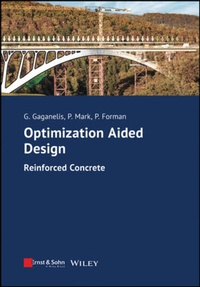
Optimization Aided Design
Reinforced Concrete
1st Edition
Published on 5. January 2022
XXVI, 184 pages
978-3-433-61071-8 (ISBN)
Description

Optimization Aided Design provides novel methods to use reinforced concrete in a particularly efficient way. Mathematical optimization is applied to the practical problems of concrete design. The aim is to employ the world's most widely used building material in the most economical way and thus substantially reduce CO2 emissions from cement and steel production as well as resource consumption of gravel, sand and water.
Three topics are addressed. First, the identification of the structure. This means the question of the right outer shape such that slender load-bearing designs develop following the flux of forces. In line with the stress affinity of the material, the structures are predominantly subjected to compression. Second, the reinforcement layout, which is oriented to the stress trajectories. Advantages arise particularly for walls, voluminous structural components, load introduction areas and cut-outs. Clear strut-and-tie models emerge that are directly convertible into reinforcement layouts. Third, the treatment of cross-sections. They are optimized in their shape and designed in their reinforcement. This also applies to sophisticated loading conditions (biaxial bending) and virtually arbitrary geometrical configurations. Parameterization allows the transfer to general cross-section types.
The optimization aided methods are described extensively and in an illustrative manner. They are universally applicable and independent of standards, concrete types and reinforcements. They apply to normal strength to ultra-high performance concretes, to reinforcements made of steel, carbon or glass fibers, and to rebars as well as reinforcing fibers. Numerous illustrations and computation examples demonstrate their application. Moreover, practical applications are presented, including ultra-light concrete-steel beams, slender concrete solar collectors, and improved reinforcement layouts for tunnel lining. The book addresses students, researchers, and practitioners alike.
Three topics are addressed. First, the identification of the structure. This means the question of the right outer shape such that slender load-bearing designs develop following the flux of forces. In line with the stress affinity of the material, the structures are predominantly subjected to compression. Second, the reinforcement layout, which is oriented to the stress trajectories. Advantages arise particularly for walls, voluminous structural components, load introduction areas and cut-outs. Clear strut-and-tie models emerge that are directly convertible into reinforcement layouts. Third, the treatment of cross-sections. They are optimized in their shape and designed in their reinforcement. This also applies to sophisticated loading conditions (biaxial bending) and virtually arbitrary geometrical configurations. Parameterization allows the transfer to general cross-section types.
The optimization aided methods are described extensively and in an illustrative manner. They are universally applicable and independent of standards, concrete types and reinforcements. They apply to normal strength to ultra-high performance concretes, to reinforcements made of steel, carbon or glass fibers, and to rebars as well as reinforcing fibers. Numerous illustrations and computation examples demonstrate their application. Moreover, practical applications are presented, including ultra-light concrete-steel beams, slender concrete solar collectors, and improved reinforcement layouts for tunnel lining. The book addresses students, researchers, and practitioners alike.
Reviews / Votes
There is hardly a topic among building professionals that is discussed more intensively than sustainable construction. (?) In view of the continuing increase in the world's population, we will not build less, but more. Contrary to this, we need to radically limit resource consumption and CO2 emissions. It is obvious that in the future, building will have to be completely different, not just marginally, but fundamentally. (?)The methods, procedures and calculations described in this book represent an important step towards a kind of building that has little to do with the way we know it today. And this is a good thing.
(Prof. Dr.-Ing. Dr.-Ing. E. h. Manfred Curbach in his foreword.)
The introduction of state-of-the-art optimization methods [to concrete design] and the resulting minimum-material component shapes, which also have a minimized need for reinforcing steel (?), promote construction with concrete that is characterized by considerable material savings and thus considerable emission savings for the same utility value and durability. Supported by clearly understandable descriptions and a large number of examples, readers will find their way around quickly and easily. This makes it much easier to understand the subject matter, which is not always simple.
This book provides a significant contribution to establishing a new foundation for building with concrete, this wonderful building material for everyone and for almost everything.
(Prof. em. Dr. Dr. E. h. Dr. h. c. Werner Sobek in his foreword.)
More details
Other editions
Additional editions
Georgios Gaganelis | Peter Mark | Patrick Forman
Optimization Aided Design - Reinforced Concrete
Software
07/2022
Ernst & Sohn
€99.30
No shipping information available
Georgios Gaganelis | Peter Mark | Patrick Forman
Optimization Aided Design
Reinforced Concrete (incl. ebook as PDF)
Book
03/2022
1st Edition
Ernst & Sohn
€99.00
Shipment within 5-7 days
Book
02/2022
1st Edition
Ernst & Sohn
€69.00
Available immediately
Complete work / Part of the work
Georgios Gaganelis | Peter Mark | Patrick Forman
Optimization Aided Design
Reinforced Concrete (incl. ebook as PDF)
Book
03/2022
1st Edition
Ernst & Sohn
€99.00
Shipment within 5-7 days
Persons
Georgios Gaganelis is a structural designer for civil engineering structures and a freelance consultant in structural optimization. 2020 he received his PhD at the Ruhr University Bochum, Germany in the field of optimization strategies for concrete and steel-concrete-composite structures. His research interest focus on topology optimization and material driven steering. A special focus lies on ultra-light structures requiring minimal material efforts.
Peter Mark is a full professor for Structural Concrete at the Ruhr University Bochum, Germany. He is researching on applied optimization methods and lightweight concrete structures since 20 years. He received his PhD in 1994 and the post-doctoral degree in 2006. He is Consultant Engineer and Independent Checking Engineer since 2008 and involved in several bridge, tunnel and building construction projects.
Patrick Forman is a post-doctoral research fellow at the Institute of Concrete Structures at Ruhr University Bochum, Germany. He received his PhD in 2016. More than 10 years he is researching on lightweight shell and beam structures made of high-performance materials using various structural optimization techniques. Currently, he is technical and managing director of an interdisciplinary research centre on adaptive modularized construction methods.
Peter Mark is a full professor for Structural Concrete at the Ruhr University Bochum, Germany. He is researching on applied optimization methods and lightweight concrete structures since 20 years. He received his PhD in 1994 and the post-doctoral degree in 2006. He is Consultant Engineer and Independent Checking Engineer since 2008 and involved in several bridge, tunnel and building construction projects.
Patrick Forman is a post-doctoral research fellow at the Institute of Concrete Structures at Ruhr University Bochum, Germany. He received his PhD in 2016. More than 10 years he is researching on lightweight shell and beam structures made of high-performance materials using various structural optimization techniques. Currently, he is technical and managing director of an interdisciplinary research centre on adaptive modularized construction methods.
Content
Foreword by Manfred Curbach
Foreword by Werner Sobek
Preface
Acknowledgments
Acronyms
1 INTRODUCTION
2 FUNDAMENTALS OF REINFORCED CONCRETE DESIGN
2.1 Basic Principles
2.2. Verification Concept
2.3 Safety Concept
2.4 Materials
2.5 Load-bearing Behavior
3 FUNDAMENTALS OF STRUCTURAL OPTIMIZATION
3.1 Structural Optimization Approaches
3.2 Problem Statement
3.3 Lagrange Function
3.4 Sensitivity Analysis
3.5 Solution Methods
4 IDENTIFICATION OF STRUCTURES
4.1 One-material Structures
4.2 One-material Stress-biased Structures
4.3 Bi-material Structures
4.4 Examples
4.5 Applications
5 INTERNAL FORCE FLOW
5.1 Preliminaries
5.2 Continuum Topology Optimization (CTO) Approach
5.3 Truss Topology Optimization (TTO) Approach
5.4 Continuum-Truss Topology Optimization (CTTO) Approach
5.5 Examples
5.6 Applications
6 DESIGN OF CROSS-SECTIONS
6.1 Problem Statement
6.2 Equilibrium Iteration
6.3 Sectional Optimization
6.4 Solving
6.5 Parameterization
6.6 Examples
BIBLIOGRAPHY
LIST OF EXAMPLES
Variation of volume fraction
Variation of the filter radius
Variation of material parameters
Form finding of bridge pylons 1
Form finding of bridge pylons 2
Conceptual bridge design 1
Conceptual bridge design 2
Multi-span girder
Multiple load cases
Two load cases
Material steering
Material variation in bi-material design
Filter radius with bi-material design
Bi-material multi-span girder
Bi-material girder with stepped support
Bi-material arch bridge
Deep beam 1
Wall with block-outs
Corbel
Cantilever beam
Shear transfer at joints
Deep beam 2
Frame corner
Wall with eccentric block-out
Corbel with horizontal force
Stiening core with openings
Deep beam 3
Deep beam 4
Deep beam 5
Strain plane of an unsymmetric RC section
Footing with gapping joint
Parameterized T-section
Parameterized uniaxial bending
Shape design of a RC I-section
Shape optimization of a footing
Foreword by Werner Sobek
Preface
Acknowledgments
Acronyms
1 INTRODUCTION
2 FUNDAMENTALS OF REINFORCED CONCRETE DESIGN
2.1 Basic Principles
2.2. Verification Concept
2.3 Safety Concept
2.4 Materials
2.5 Load-bearing Behavior
3 FUNDAMENTALS OF STRUCTURAL OPTIMIZATION
3.1 Structural Optimization Approaches
3.2 Problem Statement
3.3 Lagrange Function
3.4 Sensitivity Analysis
3.5 Solution Methods
4 IDENTIFICATION OF STRUCTURES
4.1 One-material Structures
4.2 One-material Stress-biased Structures
4.3 Bi-material Structures
4.4 Examples
4.5 Applications
5 INTERNAL FORCE FLOW
5.1 Preliminaries
5.2 Continuum Topology Optimization (CTO) Approach
5.3 Truss Topology Optimization (TTO) Approach
5.4 Continuum-Truss Topology Optimization (CTTO) Approach
5.5 Examples
5.6 Applications
6 DESIGN OF CROSS-SECTIONS
6.1 Problem Statement
6.2 Equilibrium Iteration
6.3 Sectional Optimization
6.4 Solving
6.5 Parameterization
6.6 Examples
BIBLIOGRAPHY
LIST OF EXAMPLES
Variation of volume fraction
Variation of the filter radius
Variation of material parameters
Form finding of bridge pylons 1
Form finding of bridge pylons 2
Conceptual bridge design 1
Conceptual bridge design 2
Multi-span girder
Multiple load cases
Two load cases
Material steering
Material variation in bi-material design
Filter radius with bi-material design
Bi-material multi-span girder
Bi-material girder with stepped support
Bi-material arch bridge
Deep beam 1
Wall with block-outs
Corbel
Cantilever beam
Shear transfer at joints
Deep beam 2
Frame corner
Wall with eccentric block-out
Corbel with horizontal force
Stiening core with openings
Deep beam 3
Deep beam 4
Deep beam 5
Strain plane of an unsymmetric RC section
Footing with gapping joint
Parameterized T-section
Parameterized uniaxial bending
Shape design of a RC I-section
Shape optimization of a footing
