

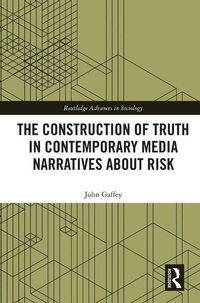
The Construction of Truth in Contemporary Media Narratives about Risk
1st Edition
Published on 22. April 2021
172 pages
978-1-000-38704-9 (ISBN)
Description

The Construction of Truth in Contemporary Media Narratives about Risk provides a theoretical framework for how, in a post-truth era, media audiences are able to understand and navigate everyday risk. The book examines media risk narratives and explores forms of truth, experiential knowledge, and authority.
Using the concept of parrhesia to show how we invest trust in various types of knowledge in a changing media environment, the book demonstrates how we choose between expert and non-expert information when navigating a seemingly risky world. It considers how news media formats have previously engaged audiences through risk narratives and examines how experiential knowledge has come to hold a valuable place for individuals navigating what we are often told is an increasingly risky and uncertain world. The book also examines the increasingly precarious position of expert knowledge and examines how contemporary truth-games play out between experts and non-experts, and considers how this extends into the world of online and social media.
This book will be of interest to those researching or teaching in the areas of criminology, sociology, media and cultural studies, and of interest to readers in professional areas such as journalism and politics.
Using the concept of parrhesia to show how we invest trust in various types of knowledge in a changing media environment, the book demonstrates how we choose between expert and non-expert information when navigating a seemingly risky world. It considers how news media formats have previously engaged audiences through risk narratives and examines how experiential knowledge has come to hold a valuable place for individuals navigating what we are often told is an increasingly risky and uncertain world. The book also examines the increasingly precarious position of expert knowledge and examines how contemporary truth-games play out between experts and non-experts, and considers how this extends into the world of online and social media.
This book will be of interest to those researching or teaching in the areas of criminology, sociology, media and cultural studies, and of interest to readers in professional areas such as journalism and politics.
More details
Series
Edition
1. Auflage
Language
English
Place of publication
London
United Kingdom
Publishing group
Taylor & Francis Ltd
Target group
College/higher education
Illustrations
4 Tables, black and white; 5 Line drawings, black and white; 3 Halftones, black and white; 8 Illustrations, black and white
ISBN-13
978-1-000-38704-9 (9781000387049)
Copyright in bibliographic data and cover images is held by Nielsen Book Services Limited or by the publishers or by their respective licensors: all rights reserved.
Schweitzer Classification
Other editions
Additional editions
Book
01/2023
1st Edition
Routledge
€62.80
Shipment within 15-20 days
Book
05/2021
1st Edition
Routledge
€205.90
Shipment within 15-20 days
Book
04/2021
Routledge
Unfortunately, price unknown
Available (delivery time upon request)
Person
John Gaffey BSocSci (Hons), PhD is a lecturer in Criminology in the Centre for Law and Justice at Charles Sturt University. Dr Gaffey is also Justice Studies Discipline Coordinator in the Centre for Law and Justice's Bachelor of Criminal Justice and Bachelor of Public Safety and Security.
Content
Introduction
Part I: The Current Landscape of Risk Communication: Media and Narrative
1. Contextualising Risk, Media, and Theory
2. Understanding Risk and how it's Communicated
3. Foucault, Parrhesia, and the Self-constituting Subject
4. Narratives of Risk in the News Media
Part II: Informing the Future Landscape of Risk, Media, and Narrative
5. How Media Audiences Consume Risk
6. Media Audiences and Risk Communication: Experience versus Expertise
7. Old and New Connections between the Audience and Experiential Risk Knowledge
8. Risk, Governance, and Experiential Knowledge Online
9. Concluding Thoughts and Future Directions
Bibliography
Index
Part I: The Current Landscape of Risk Communication: Media and Narrative
1. Contextualising Risk, Media, and Theory
2. Understanding Risk and how it's Communicated
3. Foucault, Parrhesia, and the Self-constituting Subject
4. Narratives of Risk in the News Media
Part II: Informing the Future Landscape of Risk, Media, and Narrative
5. How Media Audiences Consume Risk
6. Media Audiences and Risk Communication: Experience versus Expertise
7. Old and New Connections between the Audience and Experiential Risk Knowledge
8. Risk, Governance, and Experiential Knowledge Online
9. Concluding Thoughts and Future Directions
Bibliography
Index
