

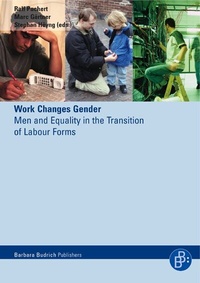
Work Changes Gender
Men and Equality in the Transition of Labour Forms
1st Edition
Published on 17. May 2005
202 pages
978-3-8474-1271-7 (ISBN)
Description

Changes in the work sphere and the "vanishing" of standard work may end the old breadwinner type of masculinity. But where "new men" try to balance work and life or show caring activities, they face obstacles - in organisations as well as on playgrounds. The book explains the ongoing changes in detail, shows ways how men deal with them and gives recommendations how to achieve gender equality by including a perspective on men.
More details
Other editions
Additional editions

Ralf Puchert | Marc Gärtner | Stephan Höyng
Work Changes Gender
Men and Equality in the Transition of Labour Forms
Book
06/2005
Verlag Barbara Budrich
€39.90
Article exhausted; check for reprint
Ralf Puchert | Marc Gärtner | Stephan Höyng
Work Changes Gender
Men and Equality in the Transition of Labour Forms
Book
05/2005
1st Edition
Verlag Barbara Budrich
€19.90
No shipping information available
Persons
Content
- Cover
- Work Changes Gender. Men and Equality in the Transition of Labour Forms
- Contents
- Preface (Michael Kimmel)
- Editors' Preface (Ralf Puchert, Marc Gärtner and Stephan Höyng)
- 1. Introduction (Marc Gärtner and Stephan Höyng)
- 1.1 Basic Ideas and Objectives
- 1.2 Current State of Research on Masculinities
- 1.3 Structure of the Project
- 2. Labour Market Changes and Gender (Stephan Höyng, Ralf Puchert, Øystein Gullvåg Holter and Margareta Kreimer)
- 2.1 Trends in European Labour Markets
- 2.2 Labour Market Participation: Non-active Population and Unemployment
- 2.3 Changes in Forms of Employment
- 2.4 Gender Segregation
- 3. "We don't have anything like that here!" - Organisations, Men and Gender Equality (Øystein Gullvåg Holter, Vera Riesenfeld and Elli Scambor)
- 3.1 Gender and Organisations
- 3.2 Design and Method
- 3.3 Results: An Overview
- 3.4 Organisational Change
- 3.5 The Status of Domestic Work
- 3.6 The Costs of Equality
- 3.7 Concluding Remarks
- 4. Male Job and Life Patterns: A Correspondence Analysis (Sigtona Halrynjo and Øystein Gullvåg Holter With Vera Riesenfeld, Klaus Schwerma, Elli Scambor and Christian Scambor)
- 4.1 Profile
- 4.2 The Contexts of Work Reduction
- 4.3 Four Adaptations
- 5. Towards a New Positioning of Men (Christian Scambor, Klaus Schwerma and Paco Abril With Yair Amichai-Hamburger, Margarita Atanassova, MarcGärtner, Sigtona Halrynjo, Øystein Gullvåg Holter, Stephan Höyng, Margareta Kreimer, Selma Therese Lyng, Ralf Puchert, Vera Riesenfeld, Elli Scambor and Violeta Velkova)
- 5.1 Introduction
- 5.2 Theories and Concepts
- 5.3 The Study: Overview
- 5.4 Models of Change
- 5.5 Diversity
- 5.6 Men and Caring: The Misplacement Model
- 5.7 General Models of Self-concept Change: SEMO and PROMO
- 5.8 Men and Changes
- 6. Men are Gendered, not Standard: Scientific and Political Implications of the Results (Marc Gärtner With Margarita Atanassova, Vera Riesenfeld,Christian Scambor and Klaus Schwerma)
- 6.1 Ways to Changes
- 6.2 Equality in Gender Relations and Masculinity Models
- 6.3 Closing Remarks
- References
