

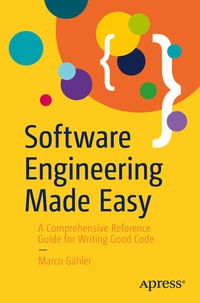
Software Engineering Made Easy
Description

Learn how to write good code for humans. This user-friendly book is a comprehensive guide to writing clear and bug-free code. It integrates established programming principles and outlines expert-driven rules to prevent you from over-complicating your code.
You'll take a practical approach to programming, applicable to any programming language and explore useful advice and concrete examples in a concise and compact form. Sections on Single Responsibility Principle, naming, levels of abstraction, testing, logic (if/else), interfaces, and more, reinforce how to effectively write low-complexity code. While many of the principles addressed in this book are well-established, it offers you a single resource.
Software Engineering Made Easy modernizes classic software programming principles with quick tips relevant to real-world applications. Most importantly, it is written with a keen awareness of how humans think. The end-result is human-readable code that improves maintenance, collaboration, and debugging-critical for software engineers working together to make purposeful impacts in the world.
What You Will Learn
- Understand the essence of software engineering.
- Simplify your code using expert techniques across multiple languages.
- See how to structure classes.
- Manage the complexity of your code by using level abstractions.
- Review test functions and explore various types of testing.
Who This Book Is For
Intermediate programmers who have a basic understanding of coding but are relatively new to the workforce. Applicable to any programming language, but proficiency in C++ or Python is preferred. Advanced programmers may also benefit from learning how to deprogram bad habits and de-complicate their code.
More details
Other editions
Additional editions
Person
Marco Gähler began his career studying physics at ETH Zurich before transitioning to software engineering. In 2018, he joined Zurich Instruments, where he developed electronic devices used in quantum computing. Throughout his career, Marco has observed the pitfalls in code written by self-taught developers, for example PhD students, and recognized the need for clear, practical guidance on simple programming practices. This book reflects his preference for clear, short functions, and minimal class usage, aiming to make good programming practices accessible to all.
Content
Chapter 1: Fundamentals of Software Engineering.- Chapter 2: Components of Code.- Chapter 3: Classes.- Chapter 4:Testing.- Chapter 5: Design Principles.- Chapter 6: Programming.- Chapter 7: High-Level Design.- Chapter 8: Refactoring.- Chapter 9: Other Common Topics.- Chapter 10: Collaborating.- Glossary.
