

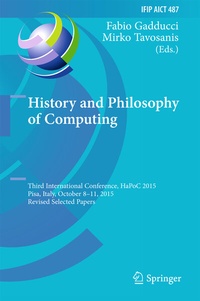
History and Philosophy of Computing
Third International Conference, HaPoC 2015, Pisa, Italy, October 8-11, 2015, Revised Selected Papers
Published on 5. October 2016
XVIII, 321 pages
978-3-319-47286-7 (ISBN)
Description

This volume constitutes the refereed post-conference proceedings of the Third International Conference on the History and Philosophy of Computing, held in Pisa, Italy in October 2015.
The 18 full papers included in this volume were carefully reviewed and selected from the 30 papers presented at the conference. They cover topics ranging from the world history of computing to the role of computing in the humanities and the arts.
The 18 full papers included in this volume were carefully reviewed and selected from the 30 papers presented at the conference. They cover topics ranging from the world history of computing to the role of computing in the humanities and the arts.
More details
Series
Edition
1st ed. 2016
Language
English
Place of publication
Cham
Switzerland
Publishing group
Springer International Publishing
Target group
Professional and scholarly
Product notice
Reflowable
Illustrations
XVIII, 321 p. 39 illus.
ISBN-13
978-3-319-47286-7 (9783319472867)
DOI
10.1007/978-3-319-47286-7
Schweitzer Classification
Other editions
Additional editions
Fabio Gadducci | Mirko Tavosanis
History and Philosophy of Computing
Third International Conference, HaPoC 2015, Pisa, Italy, October 8-11, 2015, Revised Selected Papers
Book
10/2016
Springer
€53.49
Shipment within 10-15 days
Content
- Intro
- Preface
- Organization
- Abstracts of Invited Talks
- Alan Turing and the Other Theory of Computation
- Walter Shewhart and the Philosophical Foundations of Software Engineering
- Wherefore Art Thou \ldots Semantics of Computation?
- Logic, Formal Linguistics and Computing in France: From Non-reception to Progressive Convergence
- Interactive Spatial Sound Intervention: A Case Study
- Contents
- Invited Talks
- Wherefore Art Thou ? Semantics of Computation?
- 1 Introduction
- 2 Some Intriguing, as Well as Distressing, Issues
- 2.1 The Pythagorean Dream and the Original Sin
- 2.2 The Myth of Formal Reasoning
- 2.3 Demystifying the Myth of Formal Reasoning
- 3 Semantics as a ``Partita Doppia''
- 3.1 Initial and Final Semantics
- 3.2 Denotational Semantics
- 4 Games and Strategies
- 5 Conclusion
- References
- Logic, Formal Linguistics and Computing in France: From Non-reception to Progressive Convergence
- Abstract
- 1 Introduction
- 2 The Mid-1950s: A Revival of Mathematical Logic
- 3 The 1960s: A Convergence with Computer Science
- 4 Conclusion
- References
- Interactive Spatial Sound Intervention: A Case Study
- Abstract
- 1 Introduction
- 2 Intervention Art Tasks
- 3 Sonic Space #05: A Case-Study
- 3.1 Description of Audience Experience
- 3.2 Motivation and Aesthetic Ideas
- 3.3 Design Plan and Actual Achievement
- 3.3.1 Physical Implementation
- 3.3.2 Sonic Interaction Design
- 3.3.3 Interactive Sonic Genesis
- 4 Evaluation
- 5 Conclusions and Future Works
- 6 Media Documentation
- Acknowledgments
- References
- Regular Submissions
- Theory of Knowing Machines: Revisiting Gödel and the Mechanistic Thesis
- 1 Introduction
- 2 Epistemic Arithmetic
- 2.1 Knowing Entities and Machines
- 3 Properties of Knowing Machines
- 4 Conclusion
- References
- Algorithmic in the 12th Century: The Carmen de Algorismo by Alexander de Villa Dei
- Abstract
- 1 What is an Algorismus?
- 2 The Carmen de Algorismo
- 2.1 The Title
- 2.2 The Content
- 2.3 Commentaries
- 3 Calculation Techniques
- 3.1 Addition, Subtraction, and Doubling
- 3.2 Halving, Multiplication, and Division
- 3.3 Square and Cubic Root Extraction
- 3.4 Progression
- 3.5 Mental Calculation
- 4 The Spread of the Work Manuscripts
- 5 The Source Question
- 5.1 Al-Khwarizmi
- 5.2 Contamination of Traditions
- 5.3 A New Arithmetic, Far from Universities
- 6 The Carmen Influence
- 6.1 Sacrobosco
- 6.2 Vernacular Translations
- 7 The Author
- 7.1 Life and Works
- 7.2 A Mathematician?
- 8 Conclusion
- References
- From Close to Distant and Back: How to Read with the Help of Machines
- 1 Introduction
- 2 Text Mining Methods in Humanities Research
- 3 From Close to Distant and Back
- 4 Deep Reading
- 5 A New Humanist
- 5.1 A Generation of Humanists - Machine Learning Experienced Users
- 5.2 Complementarity Is the Key
- 6 Conclusions
- References
- Computing, Design, Art: Reflections on an Innovative Moment in History
- Abstract
- 1 Introduction
- 2 Bruce Archer
- 2.1 Archer's 1968 Doctoral Thesis
- 2.2 From Linearity to Cybernetics
- 3 John Lansdown
- 3.1 Lansdown's Early Mathematical Studies
- 3.2 Lansdown's Experiments in Art
- 4 Questions of Computing and Art and Design
- Acknowledgements
- References
- From Cells as Computation to Cells as Apps
- 1 Introduction
- 2 Cells as Computation
- 3 Towards Programmable Cells
- 3.1 Synthetic Biology: Top-Down and Bottom-Up Approaches
- 3.2 Semi-synthetic Minimal Cells (SSMCs)
- 4 Bio Apps: What Computation?
- 4.1 Emergent Behaviour
- 4.2 Embodiment
- 4.3 A Turing Test for Communicating Cells
- 5 Future Perspectives
- 5.1 Towards Synthetic Cells 2.0
- 5.2 Programming Brain Processes
- 6 Concluding Remarks
- References
- «Omnia Numerorum Videntur Ratione Formata». A 'Computable World' Theory in Early Medieval Philosophy
- Abstract
- 1 Introduction
- 2 Abbo of Fleury
- 3 Gerbert of Aurillac
- 4 Concluding Remarks
- Acknowledgements
- References
- From urelements to Computation
- 1 Introduction
- 2 Urelements and the Axiom of Choice
- 3 Abstract Syntax in FM-sets
- 4 Program Semantics in FM-sets
- 5 Automata Theory in FM-sets
- 6 Category Theory as a Unifying Framework
- 7 Beyond Pure Names
- References
- The Contribution of Carl Adam Petri to Our Understanding of 'Computing'
- Abstract
- 1 Introduction
- 2 Modeling
- 3 Concurrency
- 4 Petri Nets
- 5 Communication Disciplines
- 6 Conclusion
- Acknowledgements
- References
- Frege's Habilitationsschrift: Magnitude, Number and the Problems of Computability
- 1 Introduction
- 2 Mathematics as of 1874
- 3 Frege's Elaboration of the Problem of Magnitudes
- 3.1 Philosophical Insight: The Non-intuitive Nature of Quantities
- 3.2 Conceptual Construction: From Addition as Fundamental Principle to Functions as Expressive Means
- 3.3 Mathematical Specification: Functional Iteration
- 4 The Solution: An Embryonic Recursion Schema
- 5 Concluding Remarks
- References
- Trente ans ou la Vie d´un scientifique
- Abstract
- 1 Introduction
- 2 First Proposals
- 3 Two Decades of Miscommunication
- 4 Last Warnings
- 5 Conclusion
- A Appendix
- B Appendix
- C Appendix
- References
- From Information to Perception
- 1 Introduction
- 2 Computers Design Through Time
- 2.1 ``Previous'' Computers' Design
- 2.2 The New Computers' Design
- 3 Phenomenology into Play
- 3.1 On ``Transparency''
- 4 Conclusions
- References
- Several Types of Types in Programming Languages
- 1 Introduction
- 2 From Types to ``Types''
- 3 Data Types and Abstractions
- 4 Classifying Values
- References
- Playfulness and the Advent of Computerization in Spain: The National Club of ZX81 Users
- Abstract
- 1 Introduction
- 2 The Early Personal Computers and Micros Begin to Enter Household Spaces: The Significance of Playf ...
- 3 The Creation and First Steps of the NZXU and Its Fanzine
- 4 Description of the NZXU's Affiliates Beyond the Traditional 'Cult of Celebrity'
- 5 The Values of Playfulness When Programming a Personal Computer
- 6 Concluding Remarks
- Acknowledgements
- References
- Impact of Informatics on Mathematics and Its Teaching
- 1 Introduction
- 2 The Need for Epistemological Analysis of Interactions Between Informatics and Mathematics to Feed Didactical Research
- 2.1 On the Links Between Epistemology and Didactics of Sciences
- 2.2 The Specific Case of the Relation Between Mathematics and Informatics
- 3 Approaches and Examples
- 3.1 Proof and Algorithm
- 3.2 Language in Mathematics and Informatics
- 3.3 Algorithmic Thinking and Mathematical Thinking
- 3.4 Experimental Mathematics, Role of the Computer and New Objects
- 4 Conclusion and Perspectives
- References
- Epistemic Opacity, Confirmation Holism and Technical Debt: Computer Simulation in the Light of Empir ...
- Abstract
- 1 Introduction
- 1.1 Structure of the Paper
- 2 Software
- 2.1 Opaque Models as Superior Epistemic Authorities
- 2.2 Theory of Software-Based Instruments
- 2.3 Implications of Empirical Software Engineering for the Epistemic Opacity Doctrine
- 3 Managing the Limits of Epistemic Trust
- 4 Conclusions
- Acknowledgements
- References
- The Brain in Silicon: History, and Skepticism
- 1 Introduction
- 2 A Short Historical Account
- 2.1 First Ideas and Realization
- 2.2 The Artificial Neural Networks Period
- 2.3 The Brain ``reverse-Engineering'' Challenge
- 3 Computational Secrets of the Brain
- 3.1 Evolution Is Not Design
- 3.2 What Should Be Copied from the Brain?
- 3.3 Power from Flexibility
- 4 Conclusions
- References
- The Role of Computers in Visual Art
- 1 Introduction
- 2 Computer Art: New Works, Old Controversies
- 2.1 The Dawn of Computer Art
- 2.2 Criticism and Contradictions
- 3 Randomness and Authorship
- 3.1 The Compromise on Randomness
- 3.2 A New Kind of Authorship?
- 4 Interaction and Technological Evolution
- 4.1 The Boundaries of Interactivity
- 4.2 The Necessary Evolution
- 5 Conclusions
- References
- In Search of the Roots of Formal Computation
- 1 Introduction
- 2 First Steps in Formal Arithmetic
- 3 Recurrence in Combinatorics
- 4 Grassmann's Formalization of Calculation
- 5 Peano: The Logic of Grassmann's Formal Proofs
- 6 Skolem's Recursive Arithmetic
- 7 Computation Turned into Deduction
- References
- Author Index
