

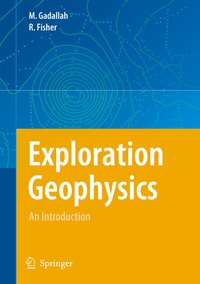
Exploration Geophysics
Description

Many text books have been written on the subject "Exploration Geophysics". The majority of these texts focus on the theory and the mathematical treatment of the subject matter but lack treatment of practical aspects of geophysical exploration. This text is written in simple English to explain the physical meaning of jargon, or terms used in the industry. It describes how seismic data is acquired in 2-D and 3-D, how they are processed to convert the raw data to seismic vertical and horizontal cross sections, that are geologically meaningful, and how these and other data are interpreted to delineate a prospect. Workshops are included after each chapter and are designed to reinforce learning of the concepts presented.
Key Features:
Written in simple easy to understand language
Heavily illustrated to aid in understanding the text
End of chapter "Key words and workshop"
The text includes several appendices and answers for the selected workshop problems
Reviews / Votes
From the reviews:"Exploration Geophysics focuses primarily on seismic reflection techniques as applied to petroleum exploration . . the book covers data acquisition and processing, migration, and interpretation of seismic data. . Gadallah and Fisher have extensive experience in petroleum exploration, and this book reflects the type of work they regularly perform. Summing Up: Recommended. Upper-division undergraduate through professional collections." (M. S. Field, Choice, Vol. 46 (9), May, 2009)"The authors with their extensive experience in petroleum exploration have written a book 'at a level that anyone can understand without difficulty' . . The potential reader will enjoy a book about science of exploration geophysics . . this book recommendable to late undergraduates who are about to use seismic data or are interested in economic geology, and all members of a petroleum/mineral exploration team (e.g., support staff and managers) who want to better understand the concepts, techniques and technologies involved." (Thibaut Perol, Pure and Applied Geophysics, September, 2012)More details
Other editions
Additional editions
Persons
Mamdouh has been involved in the petroleum industry for nearly 40 years as a reservoir engineer and a geophysicist. He has had extensive experience in both seismic data acquisition and processing. He has been an independent consultant in all phases of seismic exploration as well as providing training and development expertise for several years. Mamdouh also is the author of the textbook Reservoir Seismology, published by PennWell Books in 1994.
Ray has more than 40 years experience in geophysics. Thirty years of that experience was in training both professionals and non-professionals in seismic acquisition and processing. Much of that time was spent in developing training material for both in-house and client training
