

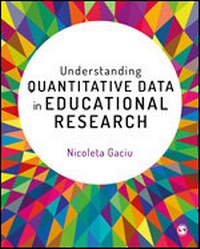
Understanding Quantitative Data in Educational Research
1st Edition
Published on 11. November 2020
376 pages
978-1-5297-4393-7 (ISBN)
Description

This book is designed to help you gain confidence in analysing and interpreting quantitative data and using appropriate statistical tests, by exploring, in plain language, a variety of data analysis methods.
Highly practical, each chapter includes step-by-step instructions on how to run specific statistical tests using R, practical tips on how to interpret results correctly and exercises to put into practice what you have learned.
It also includes guidance on how to use R and RStudio, how to visualise quantitative data, and the fundamentals of inferential statistics, estimations and hypothesis testing.
Highly practical, each chapter includes step-by-step instructions on how to run specific statistical tests using R, practical tips on how to interpret results correctly and exercises to put into practice what you have learned.
It also includes guidance on how to use R and RStudio, how to visualise quantitative data, and the fundamentals of inferential statistics, estimations and hypothesis testing.
More details
Language
English
Place of publication
London
United Kingdom
Publishing group
Sage Publications Ltd (Digital)
Target group
College/higher education
ISBN-13
978-1-5297-4393-7 (9781529743937)
Copyright in bibliographic data and cover images is held by Nielsen Book Services Limited or by the publishers or by their respective licensors: all rights reserved.
Schweitzer Classification
Other editions
Additional editions
Nicoleta Gaciu
Understanding Quantitative Data in Educational Research
Book
12/2020
1st Edition
SAGE Publications Ltd
€72.70
Shipment within 15-20 days
Nicoleta Gaciu
Understanding Quantitative Data in Educational Research
Book
11/2020
1st Edition
SAGE Publications Ltd
€136.10
Shipment within 15-20 days
Person
Dr Nicoleta Gaciu is Senior Lecturer in Education at Oxford Brookes University, UK. Her academic and research specialisations in disciplines such as physics, statistics, computer sciences, research methods and business have given her the best opportunities to make connections across disciplines, to view real-life phenomena through different lenses and to take different perspectives, knowledge, logical and methodological approaches for interdisciplinary research.
Content
Part 1: Understanding quantitative data and R
1. Introduction to information, knowledge and quantitative data
2. An introduction to R and RStudio
Part 2: Data visualisation
3. Graphical representation of data
Part 3: Providing information about data
4. Descriptive statistics
5. Measures of dispersion and distributions
6. Normal distribution and standardised scores
Part 4: Making estimations and predictions from the data
7. Fundamentals of inferential statistics
8. Estimations and hypothesis testing
Part 5: From sample to population
9. One-sample tests
10. Differences between the independent or dependent two samples
11. Difference between more than two independent samples
12. Difference between more than two dependent samples
Part 6: Relationships and predictions
13. Relationship between variables
14. Predictions for independent and dependent variables
1. Introduction to information, knowledge and quantitative data
2. An introduction to R and RStudio
Part 2: Data visualisation
3. Graphical representation of data
Part 3: Providing information about data
4. Descriptive statistics
5. Measures of dispersion and distributions
6. Normal distribution and standardised scores
Part 4: Making estimations and predictions from the data
7. Fundamentals of inferential statistics
8. Estimations and hypothesis testing
Part 5: From sample to population
9. One-sample tests
10. Differences between the independent or dependent two samples
11. Difference between more than two independent samples
12. Difference between more than two dependent samples
Part 6: Relationships and predictions
13. Relationship between variables
14. Predictions for independent and dependent variables
