

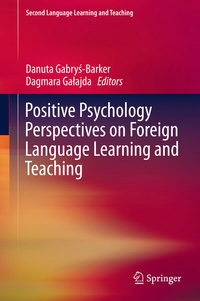
Positive Psychology Perspectives on Foreign Language Learning and Teaching
Description

This book introduces readers to the principles of a fairly new branch of psychology - positive psychology - and demonstrates how they can be applied in the context of second language acquisition in a natural environment and in instructed foreign language (FL) learning. It focuses both on the well-being and success of the learner and the professional and personal well-being of the teacher. Further, the book stresses the importance of the positive emotions and character strengths of those involved in the process of language learning and teaching, as well as the significant role played by enabling institutions such as school and, at the micro-level, individual FL classes.
More details
Other editions
Additional editions
Persons
Dagmara Galajda received her Ph.D. degree in linguistics from the University of Silesia, where she works as assistant professor. The research area of her doctoral thesis concentrated on willingness to communicate (WTC) in L1 and L2 and on other related communication variables like communication apprehension (CA) and self-perceived communicative competence. Apart from communication studies, her research interests focus on teacher's action zone in facilitating group dynamics, affect in language learning, individual learner differences in SLA / FLL and reflective teaching. Recent publications include: Teacher's Action Zone in Facilitating Group Dynamics in M. Pinto (ed.) (2012) Linguarum Arena Vol. 3, Anxiety and perceived communication competence as predictors of willingness to communicate in ESL/FL classroom in D. Gabrys-Barker, J. Bielska (eds) (2013) The Affective Dimension in Second Language Acquisition. Clevedon: Multilingual Matters, Communication apprehension and self-perceived communication competence as variables underlying willingness to communicate in K. Piatkowska, E. Koscialkowska-Okonska (eds) (2013) Correspondences and Contrasts in Foreign Language Pedagogy and Translation Studies. Berlin: Springer-Verlag. Currently she is co-editing Young Scholars on Theoretical and Applied Linguistics: Research Projects Oficyna Wydawnicza - Wyzsza Szkola Humanitas (together with Maria Wysocka, Artur Kijak and Pawel Zakrajewski).
Content
So Far So Good: An Overview of Positive Psychology and Its Contributions to SLA.- Powerfully Positive: Searching for a Model of Language Learner Well-Being.- Difficulty and Coping Strategies in Language Education: Is Positive Psychology Misrepresented in SLA/FLT?.- The Positive Broadening Power of a Focus on Well-Being in the Language Classroom.- Activating Character Strengths Through Poetic Encounters in a Foreign Language - A Case Study.- Pedagogical Implications of Positive Psychology: Positive Emotions and Human Strengths in Vocabulary Strategy Training.
