

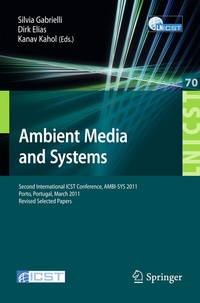
Ambient Media and Systems
Second International ICST Conference, AMBI-SYS 2011, Porto, Portugal, March 24-25, 2011, Revised Selected Papers
Published on 19. October 2011
X, 110 pages
978-3-642-23902-1 (ISBN)
Description

This book constitutes the thoroughly refereed post-conference proceedings of the Second International ICST Conference on Ambient Systems and Media, AMBI-SYS 2011, held in Porto, Portugal in March 2011. The 10 revised full papers presented were carefully reviewed and selected and cover a wide range of topics as innovative solutions in the field of ambient assisted living, providing a new physical basis for ambient intelligence by also leveraging on contributions offered by interaction design methods and approaches.
More details
Other editions
Additional editions
Silvia Gabrielli | Dirk Elias | Kanav Kahol
Ambient Media and Systems
Second International ICST Conference, AMBI-SYS 2011, Porto, Portugal, March 24-25, 2011, Revised Selected Papers
Book
09/2011
Springer
€53.49
Shipment within 7-9 days
Content
- Title Page
- Preface
- Organization
- Table of Contents
- Session 1
- A Physical Basis for Ambient IntelligenceThe Convergence of Biology, Polymers and Electronics Enabling New Design Approaches to Assistive Living
- Introduction
- Disruptive Technologies and the Emergence of AmI Environments
- Ambient Intelligence Origins
- Ambient Intelligence Development
- System + Social + Cognitive Intelligence
- Materials Intelligence and the Rise of Electro and Photo Active Conductive Polymers
- New Research Perspectives
- Ambient Control (AmC)
- Sensory Experiences
- New e-Inclusion
- Ethical Concerns
- Northumbria University School of Design / Royal College of Art Activities
- Design: STEM Explorations in Physical Ambient Intelligence Environments
- An 'Active' Materials for Living Platform [AMfL]
- Conclusions and Final Remarks
- References
- Service Composition and Advanced UserInterfaces in the Home of Tomorrow: The SM4All Approach
- Introduction
- Relevant Work
- The SM4All Architecture
- The User Interface
- Composition
- Concluding Remarks
- References
- Session 2
- Wireless Sensor Network Deployment for Building Environmental Monitoring and Control
- Introduction
- WSN Node Design
- Sensors Selection
- Adopted Wireless Sensor Network (WSN)
- WSN System Architecture
- ERI Data Storage and Representation
- Conclusions
- References
- Design and Evaluation of a Fall Detection Algorithm on Mobile Phone Platform
- Introduction
- Why a Mobile Phone
- Major Differences When Doing It on a Mobile Phone
- Objectives
- Structure
- State of the Art and Related Work
- Mobile Phone Fall Detection
- The Algorithm
- Implementation
- Results of Fall Detection Algorithm
- Evaluation Method
- Data Analysis
- Conclusion and Future Work
- References
- Session 3
- System Performance of an LTE MIMO Downlink in Various Fading Environments
- Introduction
- The FDD MIMO LTE Simulation Model
- Results and Discussion
- Conclusion
- References
- Development of Computer Vision Algorithm for Surgical Skill Assessment
- Introduction
- Related Work
- The Proposed Approach
- Data Capture Setup
- Methodology
- Data Analysis
- Experimental Analysis/Results
- Conclusion and Future Work
- References
- Open Architecture to Raise Awareness of Energy Consumption on the Home Environment
- Introduction
- Related Work
- Requirements and Use Cases
- System Architecture
- Electricity Meter
- Gateway and Collection Point
- Backoffice
- User Interface
- Conclusions and Future Work
- References
- Session 4
- RFID-Based System for Tracking People: Approaches toTagging Demented Patients
- Introduction
- System Setup
- Evaluation of the Approaches
- Conclusion
- References
- Processing Location Data for Ambient Intelligence Applications
- Introduction
- Data Processing Requirements
- Data Processing Tools
- Conclusions and Future Work
- References
- Interactive Haptic Virtual Collaborative Training Simulator to Retain CPR Skills
- Introduction
- Related Work
- System Design
- Methodology
- Experimental Design
- Results and Discussion
- Conclusion and Future Work
- References
- Session 5
- Future User Centric Media: Research Challenges and the Road Ahead
- Introduction
- User Centric Media Services in the Extended Home
- State of the Art
- Gaps and Constraints
- Research Challenges
- Business Cases / Use Cases
- Potential Research Themes
- Personalised Access to Media Systems
- State of the Art
- Gaps and Constraints
- Research Challenges
- Business Cases/Use Cases
- 3D Content Generation Leveraging Emerging Acquisition Channels
- Future Research Challenges
- Immersive Multimedia Experiences
- Future Research Challenges
- Multimedia, Multimodal and Deformable Object Search
- Future Research Challenges
- Content with Memory and Behaviour
- Future Research Challenges
- New Application Areas
- Conclusion
- References
- Author Index
