

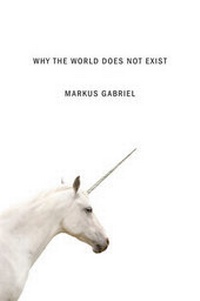
Why the World Does Not Exist
Description

In this highly original new book, the philosopher Markus Gabrielchallenges our notion of what exists and what it means to exist. Hequestions the idea that there is a world that encompasseseverything like a container life, the universe, and everythingelse. This all-inclusive being does not exist and cannot exist. Forthe world itself is not found in the world. And even when we thinkabout the world, the world about which we think is obviously notidentical with the world in which we think. For, as we are thinkingabout the world, this is only a very small event in the world.Besides this, there are still innumerable other objects and events:rain showers, toothaches and the World Cup. Drawing on the recenthistory of philosophy, Gabriel asserts that the world cannot existat all, because it is not found in the world. Yet with theexception of the world, everything else exists; even unicornson the far side of the moon wearing police uniforms.
Revelling in witty thought experiments, word play, and thecourage of provocation, Markus Gabriel demonstrates the necessityof a questioning mind and the role that humour can play in comingto terms with the abyss of human existence.
More details
Other editions
Additional editions
Persons
Content
Appearance and Being 2
New Realism 5
The Plurality of Worlds 8
Less than Nothing 11
I What is this Actually: the World? 16
You and the Universe 21
Materialism 28
"The World is Everything that is the Case" 32
Constructivism 38
Philosophers and Physicists 44
II What is Existence? 50
The Super-Object 53
Monism, Dualism, Pluralism 56
Absolute and Relative Differences 61
Fields of Sense 65
III Why the World Does Not Exist 73
The Super-Thought 78
Nihilism and Non-Existence 81
The External and the Internal World 91
Why the World Does Not Exist
IV The Worldview of Natural Science 99
Naturalism 106
Monism 111
The Book of the World 115
Subjective Truths 126
Holzwege 131
Science and Art 137
V The Meaning of Religion 146
Fetishism 154
The Infinite 162
Religion and the Search for Meaning 168
The Function of God 178
VI The Meaning of Art 184
Ambivalences 186
On Sense and Reference 190
The Demon of Analogy 194
Reflexivity 197
Diversity 204
VII Closing Credits: Television 209
A Show about Nothing 212
The Senses . . . 215
. . . and the Meaning of Life 220
Notes 222
Glossary 231
Index of Names 237
Thinking Philosophy Anew
Life, the universe, and everything else . presumably everyone has asked themselves what it all means. Where do we find ourselves? Are we only an aggregation of elementary particles in a gigantic world receptacle? Or do our thoughts, wishes, and hopes have a distinct reality - and, if so, what? How can we understand our existence or even existence in general? And how far does our knowledge extend?
In this book I will develop the outlines of a new philosophy, which follows from a simple, basic thought, namely the idea that the world does not exist. As you will see, this does not mean that nothing exists at all. There are planets, my dreams, evolution, the toilet flush, hair loss, hopes, elementary particles, and even unicorns on the far side of the moon, to mention only a few examples. The principle that the world does not exist entails that everything else exists. For this reason, I can already announce that I will claim, as my first principle, that everything exists except one thing: the world.
The second principle of this book is NEW REALISM. New realism describes a philosophical stance that designates the era after so-called postmodernity (which I heralded in the summer of 2011 - strictly speaking, on 23 June 2011 around 1:30 p.m. - during a lunch in Naples with the Italian philosopher Maurizio Ferraris).1 In the first instance, then, new realism is nothing more than the name for the age after postmodernity.
Postmodernity was the radical attempt to start afresh after all of humanity's great promises had failed: from religion to modern science and all the way to the excessively radical ideas of left- and right-wing totalitarianism. Postmodernity wanted to consummate the break with tradition altogether and free us from the illusion that life has a specific meaning1 after which we should all strive. In order to free us from this illusion, however, it merely fabricated new illusions - in particular the illusion that we are to a certain extent transfixed by our illusions. Postmodernity wanted to make us believe that, since prehistory, humanity has suffered from a gigantic collective hallucination - metaphysics.
Appearance and Being
One can define METAPHYSICS as the attempt to develop a theory of the world as such. Its aim is to describe how the world really is, not how the world seems to be or how it appears to us. In this way, metaphysics, to a certain extent, invented the world in the first place. When we speak about "the world," we mean everything that actually is the case, or, put differently: actuality. At this point, it is tempting to eliminate human beings from the equation "the world = everything that is actually the case." For one assumes that there is a difference between things as they appear to us and how they actually are. Thus, in order to find out how they really are, one must, so to speak, remove everything that is added by man in the process of knowing.
Metaphysics has been criticized and rejected by many thinkers over the last centuries. The most recent and radical attempt to get rid of it in one stroke was postmodernism - that is, essentially, the idea that we live in an entirely post-metaphysical age, an age defined by the alleged fact that we have given up believing in the idea of a reality hidden behind the appearances. One could say that postmodernism's objection against metaphysics was that things exist only insofar as they appear to us. Accordingly, there is absolutely nothing further behind the appearances, no world or actuality in itself. Some less radical postmodernists, such as the American philosopher Richard Rorty, thought that there might in fact still be something behind the world as it appears to us. However, he thought that this could play no role for us as human beings, so he instead suggested that we increase solidarity among human beings rather than look for ultimate Truth (with a capital T) or ultimate Reality (with a capital R).
However, postmodernism, arguably, was only yet another variation on the basic themes of metaphysics - in particular, because postmodernism was based on a very general form of constructivism. CONSTRUCTIVISM assumes that there are absolutely no facts in themselves and that we construct all facts through our multifaceted forms of discourse and scientific methods. There is no reality beyond our language games or discourses; they somehow do not really talk about anything, but only about themselves. The most important source and forefather of this tradition is Immanuel Kant. Kant indeed claimed that we could not know the world as it is in itself. No matter what we know, he thought that it would always in some respect have been made by human beings.
Let us take an example that is often used in this context, namely colors. Ever since Galileo Galilei and Isaac Newton, it has been suspected that colors do not actually exist. This assumption so exasperated colorful characters such as Goethe that he composed his own Doctrine of Colors. One might think that colors are only waves of a determinate length that strike our sensory receptors. The world in itself is actually completely without color, and it consists only of elementary particles which appear to us on a medium-sized scale where they somehow mutually stabilize one another into structures we perceive as bodies extended in space and time. It is exactly this thesis that is a widespread form of metaphysics in our time. It claims that, in itself, the world is completely different than it appears to us. Now Kant was still much more radical. He claimed that even this assumption (or perhaps supposition?) - about particles in space-time - is only a way in which the world, as it is in itself, appears to us. How it actually is, that is something we could absolutely never discover. Everything that we know is made by us, and just because of this we are also able to know it. In a famous letter to his fiancée, Wilhelmine von Zenge, Heinrich von Kleist illustrates Kantian Constructivism in the following way:
If, instead of eyes, all men had green glasses they would have to conclude that the objects which they perceived through them were green; and they would never be able to decide whether their eyes were showing them the objects as they really existed or whether they were not adding something to those objects which did not belong to them but to their eyes. The same thing applies to the understanding. We cannot decide whether what we call truth really is truth or whether it only appears to us as such.2Constructivism believes in Kant's "green glasses." To this, postmodernism added that we wear not only one but, rather, many glasses: science, politics, language games of love, poetry, various natural languages, social conventions, and so on. Everything is only a complicated play of illusions in which we mutually assign each other a place in the world, or, simply expressed: postmodernity deemed human existence to be a long French art-house film, in which all participants strive to seduce one another, to gain power over others, and to manipulate them. With clever irony this cliché is being called into question in contemporary French film. One thinks, for example, about Jean-Claude Brisseau's Secret Games or Catherine Breillat's Anatomy of Hell. This option is rejected, in a playful and amusing way, in David O. Russell's film I Huckabees, a film which, next to classics such as Magnolia, bears one of the best witnesses for new realism.
But human existence and knowledge is not a collective hallucination, nor are we transfixed in any picture worlds or conceptual systems behind which the real world is located. New realism assumes that we recognize the world as it is in itself. Of course we can be mistaken, for in some situations we indeed find ourselves in an illusion. But it is simply not the case that we are always or almost always mistaken.
New Realism
In order to understand to what extent new realism engenders a new orientation to the world, let us choose a simple example: let us assume that Astrid is currently standing in Sorrento and sees Vesuvius, while we (that is you, dear reader, and I) are currently in Naples and are also viewing Vesuvius. In this scenario there is Vesuvius, Vesuvius seen by Astrid (that is, from Sorrento), and Vesuvius seen by us (that is, from Naples). Metaphysics claims that, in this scenario, there is only one real object, namely Vesuvius. It just so happens that Vesuvius is being viewed in one instance from Sorrento and in another instance from Naples, which hopefully leaves it cold. Whoever might be interested in this is of no concern to Vesuvius. That is metaphysics.
In contrast, constructivism assumes that there are three objects in this scenario: Astrid's Vesuvius, your Vesuvius, and my Vesuvius. Beyond that there is absolutely no object or thing in itself - at least, no object which we could ever hope to know - as all objects which we can know anything about are supposed to be constructed by us.
In contrast, new realism supposes that, in this scenario, there are at least four objects:
- Vesuvius
- Vesuvius viewed from Sorrento (Astrid's perspective)
- Vesuvius viewed from Naples (your perspective)
- Vesuvius viewed from Naples (my perspective).
One can easily clarify why this option is the best. It is not only a fact that Vesuvius is a volcano that is located at a particular place on the earth's...
