

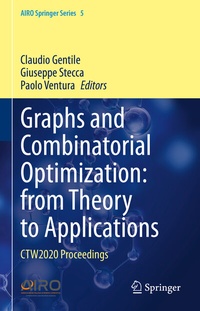
Graphs and Combinatorial Optimization: from Theory to Applications
Description

This book highlights new and original contributions on Graph Theory and Combinatorial Optimization both from the theoretical point of view and from applications in all fields. The book chapters describe models and methods based on graphs, structural properties, discrete optimization, network optimization, mixed-integer programming, heuristics, meta-heuristics, math-heuristics, and exact
methods as well as applications.
The book collects selected contributions from the CTW2020 international conference (18th Cologne-Twente Workshop on Graphs and Combinatorial Optimization), held online on September 14-16, 2020. The conference was organized by IASI-CNR with the contribution of University of Roma Tre, University Roma Tor Vergata, and CNRS-LIX and with the support of AIRO. It is addressed to researchers, PhD students, and practitioners in the fields of Graph Theory, Discrete Mathematics, Combinatorial Optimization, and Operations Research.
More details
Other editions
Additional editions
Persons
Claudio Gentile is a Research Director at the Institute of Systems Analysis and Computer Science "Antonio Ruberti" of the Italian National Research Council (CNR-IASI). From 2006 to 2015 he directed the CNRIASI research unit "Control and Optimization of Complex Systems" and since 2016 he directs the CNR-IASI research unit "OPTIMA: Optimization and Discrete Mathematics". His main researchinterests are in Combinatorial Optimization, Polyhedral Theory for Linear and Nonlinear Mixed-Integer Programming problems, Interior Point Methods with applications in Power Energy Production and Distribution, Logistics, Network Design, Sta? Management, and Ship Scheduling. He is author of many scienti?c publications among journal papers, book chapters, and articles in conference proceedings.
Giuseppe Stecca is a Research Scientist at the Institute of Systems Analysis and Computer Science "Antonio Ruberti" of the Italian National Research Council (CNR-IASI). He holds the Chair of Supply Chain Management at the University of Rome "Tor Vergata", where he also teaches Operations Research. He is a member of the board of the Italian Association for Operations Research (AIRO). His main research interests are related to the optimization of sustainable production and logistic systems. He works actively in research projects and also as an evaluator for the Italian Ministry of Economic Development in the area of logistics and industry 4.0.
Paolo Ventura is a Research Scientist at the Institute of Systems Analysis and Computer Science "Antonio Ruberti" of the Italian National Research Council (CNR-IASI). His main research interests are Integer Programming and Combinatorial Optimization with applications in logistics and transportation. He is author of many articles in the most relevant international journals of the area. Since 2004, he teaches Operations Research at the University of Rome "Tor Vergata". He is member of the organizing committee of the yearly "Cargese Workshop of Combinatorial Optimization" and, in the odd years, of the "Aussois Combinatorial Optimization Workshop".
