

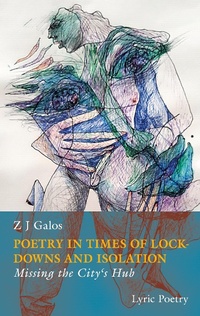
Poetry in Times of Lockdowns and Isolation
Book I Missing the City's Hub
1st Edition
Published on 27. February 2024
172 pages
978-3-7583-4731-3 (ISBN)
Description

Suddenly the COVID-19 Pandemic hit Europe and due to its rapid spread Lockdowns had been enforced by governments. Here in Austria, in the heart of Vienna, the poet would experience a completely changed city, reminding him of a ghost town.
During the First Lockdown, he traveled in empty trains and streets without people, for several weeks, musing and reflecting about this change of life in the city.
At times, he loses the face of a friend through abstinence, he used to meet at St Stephen's Square, though friends would be in contact through the mobile phone, yet personal meetings are still most important to the poet and he misses them.
Medical matters are questioned, as well as the products of inoculation, and besides information given seems controversial. In this situation, the poet remains at most times of the day at his writing desk and muses about his quality of life.
During the Second Lockdown, matters conducting a usual daily life became for most people very difficult, to say the least. However, it seemed to stir up the poet's memory banks.
During the time shopping for necessary food items, the poet observed extreme silence, except for the neighbor's knock on the door, checking on him, exchanging views on the government's offices of health, the wearing of masks, and the changing laws about inoculations.
The poet's mind wandered back to his experiences in life, friends, his occupation with art, and remembrances that suddenly appeared in clarity.
During the First Lockdown, he traveled in empty trains and streets without people, for several weeks, musing and reflecting about this change of life in the city.
At times, he loses the face of a friend through abstinence, he used to meet at St Stephen's Square, though friends would be in contact through the mobile phone, yet personal meetings are still most important to the poet and he misses them.
Medical matters are questioned, as well as the products of inoculation, and besides information given seems controversial. In this situation, the poet remains at most times of the day at his writing desk and muses about his quality of life.
During the Second Lockdown, matters conducting a usual daily life became for most people very difficult, to say the least. However, it seemed to stir up the poet's memory banks.
During the time shopping for necessary food items, the poet observed extreme silence, except for the neighbor's knock on the door, checking on him, exchanging views on the government's offices of health, the wearing of masks, and the changing laws about inoculations.
The poet's mind wandered back to his experiences in life, friends, his occupation with art, and remembrances that suddenly appeared in clarity.
More details
Other editions
Additional editions
Book
02/2024
1st Edition
BoD - Books on Demand
€12.99
Shipment within 15-20 days
Person
Born in Eastern Austria, close to the Hungarian border, he witnessed as a young man the horrors of a nation's suppression, erupting in the Hungarian Revolution of 1956. He finished his education in art and architecture in Vienna, married, and sailed for the Cape of Africa, an adventure that followed his childhood dreams. He had drawn African animals for his art classes, but the time had come to see them in their natural habitat.
Meeting a varied facet of people and cultures, working as a draughtsman in an engineering office, as an architect for a cultural centre, and as a coordinator for craftsmen and professionals, he made good use of his language skills travelling throughout Southern Africa.
During a trip to Lesotho, a native artist showed him rock paintings with their stark palimpsest outlines and with typified movements of animals and humans. It made a lasting impression on him and influenced his artistic work.
His vast collection of slides and drawings had been lost during a change of domiciles, but further studies of the art of the San people reawakened his dormant artistic longing for expression of his art, filling sketchbooks with drawings and notebooks with poetry and prose. While revisiting the capitals of Europe, he sensed that the bond of art being borderless and free, would reach out across continents into the world.
During a visit to Greece, he was accepted into a circle of artists and poets, who encouraged him to continue his art and a friend introduced him to the works of famous Greek poets.
In South Africa, he joined writing and poetry workshops of Writers Write. It was to open the floodgates of his creativity. He decided to travel through Greece and visit its sites of antiquity, read up on Classical mythology, and enjoy translations of Greek poetry and prose.
He settled in 2013/14 in Klosterneuburg-Weidling. Poet Nikolaus Lenau is buried here. Franz Kafka had visited here. Their writings will always be an inspiration.
Meeting a varied facet of people and cultures, working as a draughtsman in an engineering office, as an architect for a cultural centre, and as a coordinator for craftsmen and professionals, he made good use of his language skills travelling throughout Southern Africa.
During a trip to Lesotho, a native artist showed him rock paintings with their stark palimpsest outlines and with typified movements of animals and humans. It made a lasting impression on him and influenced his artistic work.
His vast collection of slides and drawings had been lost during a change of domiciles, but further studies of the art of the San people reawakened his dormant artistic longing for expression of his art, filling sketchbooks with drawings and notebooks with poetry and prose. While revisiting the capitals of Europe, he sensed that the bond of art being borderless and free, would reach out across continents into the world.
During a visit to Greece, he was accepted into a circle of artists and poets, who encouraged him to continue his art and a friend introduced him to the works of famous Greek poets.
In South Africa, he joined writing and poetry workshops of Writers Write. It was to open the floodgates of his creativity. He decided to travel through Greece and visit its sites of antiquity, read up on Classical mythology, and enjoy translations of Greek poetry and prose.
He settled in 2013/14 in Klosterneuburg-Weidling. Poet Nikolaus Lenau is buried here. Franz Kafka had visited here. Their writings will always be an inspiration.
