

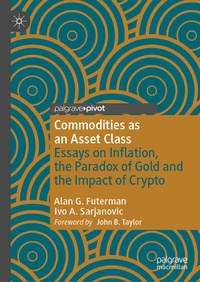
Commodities as an Asset Class
Description

This book challenges the notion that commodities are always good hedges against inflation, which is the conventional belief today in financial markets. Specifically, it focuses on gold as a traditional hedge and the ways in which crypto assets are argued to be positioned as an alternative hedge against inflationary risk.
The book engages with emerging debates around the performance of gold since the 2008 financial crisis, analyzing its characteristics, relationship with inflation, and the role of mining companies, and discusses ways that cryptocurrencies have replaced precious metals as an attractive asset class during an inflationary scenario. In considering the case of crypto as being or not a good inflation hedge, the book devotes particular attention to the theoretical financial and macroeconomic implications of a monetary system based on Bitcoin, dealing with the concept of money and the determination of Bitcoin's supply and purchasing power. Additionally, it outlines theconsequences that such a system would entail for the banking industry, and financial conditions involving interest rates, exchange rates, and the inflation-deflation dynamic. The book also analyses the relative impact of past and future events on the different commodity families.
This work will be of interest to students and researchers in financial economics, macroeconomics, and monetary economics, as well as analysts and traders in financial and commodity markets.Reviews / Votes
Using commodities as an inflation hedge has come back into vogue now that inflation has spiked in most advanced economies. But that is easier said than done, argue Ivo A. Sarjanovic and Alan G. Futerman in their important new book. The real (inflation-adjusted) return on commodities depends on hard-to-forecast fundamentals, not just on monetary factors, and only in two decades (1970s and the 2000s) were those real returns positive. Essential reading both for analysts trying to understand the commodity markets and for traders hoping not to get fleeced. I recommend it enthusiastically.(Andres Velasco - Dean of the School of Public Policy at the London School of Economics and Political Science)Futerman and Sarjanovic have written a valuable tonic to treat the raging disease that commodities are everywhere and always a good hedge against inflation. They dig carefully into the data and underlying theory to show that the right answer to thequestion of whether commodities are a good hedge against inflation is 'sometimes.' This analysis could not be better timed with inflation raging in many economies at the present time, the U.S., in particular. As useful as this part of the book is, the sections on cryptocurrency and gold investing are simply not to be missed. The authors carefully walk readers through classical ideas about what money is and how cryptocurrency does or does not meet the classic definitions. This is followed by a fascinating discussion of the relationship between gold and cryptocurrency investing and how crypto seems to have replaced gold as the preferred hedge against inflation in recent years. All in all, this book contains a very readable treatment of commodities, inflation, and cryptocurrencies. I highly recommend it to investors, market analysts, traders, or anyone interested in how or how not to protect themselves from inflation.
(Scott H. Irwin - Professor, Laurence J. Norton Chair of Agricultural Marketing, University of Illinois Urbana-Champaign)
More details
Other editions
Additional editions
Persons
Ivo Sarjanovic is Professor of Agricultural Commodites at the Di Tella University and Lecturer on "Soft Commodities" at the University of Geneva. He is currently independent director of several companies in the industry. He was Vice President of Cargill Switzerland and CEO of Alvean and he has more than 30 years of experience in commodity trading.
