

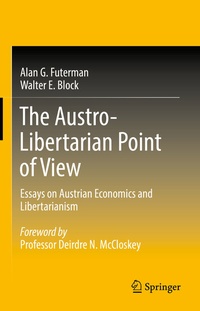
The Austro-Libertarian Point of View
Description

This book covers several areas of economic theory and political philosophy from the perspective of Austrian Economics and libertarianism. As such, it deals with Epistemology and Methodology, Microeconomics, Macroeconomics, Labor Economics, International Economics, Political Philosophy, Law and Public Policy, all from the Austro-libertarian perspective.
Hence, this book offers an integrated view of libertarianism and Austrian economics in the light of recent debates in the areas of economic science and political philosophy. Moreover, it builds from the foundations of the Austrian approach (epistemology and methodology), while the latter material deals with its application to the individual from the microeconomic perspective, which in turn allows an exploration of subjects in macroeconomics. Additionally, this work applies Austro-libertarianism to law, politics, and public policy. Thus, it offers a unified view of the entire approach, in a logical progression, allowing thereaders to judge this perspective in full.
Futerman and Block say that their book is not a manual, which I suppose it is not. But it is a collection of highly pertinent essays, from which you can understand what is mistaken in the orthodoxy of economics, law, and politics. The central term of art in Austrian economics is that phrase "human action." It is the exercise of human will, not the blind bumping of one molecule against another or one organism against another, as in the physical sciences.
Futerman and Block distinguish Austrian economics as a scientific enterprise based on liberty of the will from "libertarianism" as an advocacy based on policies implied by such liberty. "Although Austrian economics is positive and libertarianism is normative," they write, "this book shows how both are related; how each can support the other." Indeed they do.
Deirdre N. McCloskey, PhD
UIC Distinguished Professor of Economics and ofHistory Emerita,
Professor of English Emerita,
Professor of Communication Emerita,University of Illinois at Chicago
Reviews / Votes
"For those interested in Austrian economics and radical libertarianism, it is worth reading Futerman and Block's book to see the benefits and hazards of their attempted integration." (Jason Lee Byas, The Independent Review, Vol. 27 (3), 2022-2023)More details
Other editions
Additional editions
Persons
Alan G. Futerman is Adjunct Professor of Institutional Economics at the University of the Latin American Educational Center (Rosario - Argentina). He has done research on economic theory from the perspective of the Austrian School of Economics, dealing with macro and microeconomics, as well as epistemology and the methodology of economics. He has contributed essays to journals such as International Journal of Finance & Economics, Journal of Financial Economic Policy, The Review of Austrian Economics, and lectured on economic subjects in congresses and seminars.
