

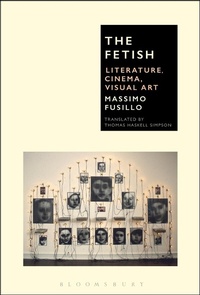
The Fetish
Literature, Cinema, Visual Art
1st Edition
Published on 21. September 2017
176 pages
978-1-5013-1238-0 (ISBN)
Description

Object fetishism is becoming a more and more pervasive phenomenon. Focusing on literature and the visual arts, including cinema, this book suggests a parallelism between fetishism and artistic creativity, based on a poetics of detail, which has been brilliantly exemplified by Flaubert's style. After exploring canonical accounts of fetishism (Marx, Freud, Benjamin), by combining a historicist approach with theoretical speculation, Massimo Fusillo identifies a few interpretive patterns of object fetishism, such as seduction (from Apollonius of Rhodes to Max Ophuels), memory activation (from Goethe to Louise Bourgeois and Pamuk), and the topos of the animation of the inanimate.
Whereas all these patterns are characterized by a projection of emotional values onto objects, modernism highlights a more latent component of object fetishism: the fascination with the alterity of matter, variously inflected by Proust, Woolf, Joyce, Barnes, and Mann. The last turning point in Fusillo's analysis is postmodernism and its obsession with mass media icons-from DeLillo's maximalist frescos and Zadie Smith's reflections on autographs to Palahniuk's porn objects; from pop art to commodity sculpture.
Whereas all these patterns are characterized by a projection of emotional values onto objects, modernism highlights a more latent component of object fetishism: the fascination with the alterity of matter, variously inflected by Proust, Woolf, Joyce, Barnes, and Mann. The last turning point in Fusillo's analysis is postmodernism and its obsession with mass media icons-from DeLillo's maximalist frescos and Zadie Smith's reflections on autographs to Palahniuk's porn objects; from pop art to commodity sculpture.
Reviews / Votes
Brilliantly debunking received understandings of fetishism as an individual perversion or as a consumerist obsession, and effectively severing it from its ideological and moralistic anchorings, Massimo Fusillo theorises the fetishist gaze as an inexhaustible site of creative production and compares it to the processes of literary composition and artistic creation. Richly interdisciplinary and convincingly argued, using philosophy, psychoanalysis, aesthetics, anthropology, and feminist, queer, and postcolonial theory as critical frameworks, Fusillo draws examples across a wide variety of genres-literature, film, the visual arts, photography, popular culture, and performance-to demonstrate the ways in which fetishism and artistic creativity project passions, impulses, and memories on to everyday objects and produce alternative worlds. Original and highly innovative in content and style, the book's relational approach to the fetish challenges allegiances to hierarchal knowledge and absolute identities, compelling a radical rethinking of our critical paradigms for the comparative study of literature and culture. * William J Spurlin, Professor of English, Brunel University London, UK * This is a remarkably well-integrated volume with a clear purpose: to redefine and interpret 'the fetish' in a broad range of works, from Marx and Freud to contemporary cinema. It offers brilliant exercises in close reading and unassailable overall arguments. It should establish itself as an important reference point in literary and cultural theory. * Jean Bessiere, Professor of Comparative Literature, Universite Sorbonne Nouvelle, France * Brimming with new ideas and examples, Massimo Fusillo's thought-provoking The Fetish leads us into a magic land where concrete objects radiate boundless energy. Seductive or violent, theatrical or incomprehensible, these objects inhabit the works of art and literature, be they realist, modernist, or post-modernist, and fill them with an irresistible power to attract. The most respectable traditional literature and the oddest contemporary art are thus shown to share crucial common interests. * Thomas Pavel, Gordon J. Laing Distinguished Service Professor in Romance Languages and Literature, University of Chicago, USA, and author of The Lives of the Novel *More details
Edition
1. Auflage
Language
English
Place of publication
New York
United States
Publishing group
Bloomsbury Publishing PLC (Digital)
Target group
Professional and scholarly
ISBN-13
978-1-5013-1238-0 (9781501312380)
Copyright in bibliographic data and cover images is held by Nielsen Book Services Limited or by the publishers or by their respective licensors: all rights reserved.
Schweitzer Classification
Other editions
Additional editions
Book
09/2017
Bloomsbury Academic USA
€163.42
Shipment within 15-20 days
Person
Massimo Fusillo is Professor of Literary Theory and Comparative Literature at the University of L'Aquila, Italy, where he is Director of the Ph.D. Program in Literary and Cultural Studies and Vice Chancellor for Cultural Affairs. He was Fulbright Visiting Professor at Northwestern University, USA, and Invited Professor at the PhD Program in Comparative Literature of Paris 3. He is a member of the Executive Council of the International Comparative Literature Association (ICLA/AICL).
Content
Preface: Creativity Is In the Details
Introduction: Object and Fetish: Theory, Intersection, Vision
1. The Object of Seduction
2. The Memorial Object: Between Wound and Catharsis
3. The Magic Object: Animating the Inanimate
4. Creating Worlds: The Mythopoetic Power of Objects
5. Theatricalizing the Fetish-Object
6. The Alterity of Matter
7. The Object-Icon
Bibliography
Index
Introduction: Object and Fetish: Theory, Intersection, Vision
1. The Object of Seduction
2. The Memorial Object: Between Wound and Catharsis
3. The Magic Object: Animating the Inanimate
4. Creating Worlds: The Mythopoetic Power of Objects
5. Theatricalizing the Fetish-Object
6. The Alterity of Matter
7. The Object-Icon
Bibliography
Index
