

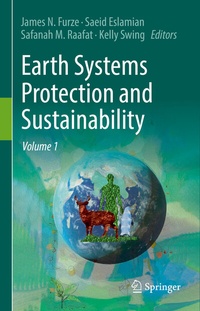
Earth Systems Protection and Sustainability
Description

Earth Systems Protection and Sustainability qualifies imperatives and discusses the use of mathematical approaches to assess and achieve sustainability in threatened and vulnerable Earth systems globally. Mathematical advances in this context include both operational and Boolean methods, as well as linguistic, logic-based Bayesian approaches and generative mathematics relevant to scenario formation. The mathematic methods are refined into functional areas and deeper learning, which enable the use of searching algorithms to achieve optimal solutions for the circular nature and application of sustainability. Pertinent sections and synergistic elements are covered in order to synthesize key informative nodes, advising of the very real dangers facing planet Earth and its biodiversity. Each volume stands in its own right. Analytical and scientific chapters are blended with social resilience and socio-economic development consideration, thus enabling the settings of sustainability within varying scenarios of climatic forces and species dynamics.
Volume 1 focuses on ground-breaking evolutionary expansion assisting with life's continuation on Earth, sustainable management of pathogens and halophyte uses in agroecology, bioremediation methods in drilling waste management, conservation and sustainability of diversity, climate change mitigation strategies, displacement management in a large scale ongoing crisis, risk reduction and management policy, sustainably intelligent-driven markets, sustainability consensus in an uncertain environment and path planning in static and dynamic environments. Pictorial contributions made from across the world refine particularly urgent problems for attention, and provide solutions and methods of environmental sustainability operated in communities, complementing the descriptive chapter sections. Both volumes are targeted for a global audience of academic, professional, classroom, governmental, unit and community members, and seek to include all sectors to ensure ongoing and comprehensive Earth Systems Protection.More details
Other editions
Additional editions
Persons
Dr. James Nicholas Furze is a member and Fellow of the Laboratory of Biotechnology and Valorization of Natural Resources, Ibn Zohr University, Morocco, also of the Control and Systems Engineering Department of the University of Technology, Baghdad, Iraq and an elected Fellow of the Royal Geographical Society (with the Institute of British Geographers), London, England.
Dr. Saeid Eslamian is a Professor of Hydrology and Water Resources Sustainability in the Department of Water Engineering at Isfahan University of Technology, Iran.
Dr. Safanah Mudheher Raafat is an Assistant Professor in the Control and Systems Engineering Department, University of Technology, Baghdad, Iraq.
Dr. Kelly Swing is a Professor of Environmental Science at the University of San Francisco de Quito and Director Emeritus of the Tiputini Biodiversity Station, Quito, Ecuador.
Content
Chapter1. Generators, Harmonics and Evolutionary Emergence.- Chapter2. Sustainable Management of Soil-borne Plant Pathogens.- Chapter3. Empirical Values of Halophytes in Agro-ecology and Sustainability.- Chapter4. Drilling Waste Management based on New Methods of Bioremediation and Solar Desalination.- Chapter5. Orchid Diversity, Conservation and Sustainability in North-Eastern India.- Chapter6. Effectiveness of the Role Technology Plays in Tackling Climate Change.- Chapter7. Social and Environmental Imperatives for Risk Management: Lessons from the Rohingya Refugee Crisis.- Chapter8. Risks for the Environment, Biodiversity, Humankind and the Planet.- Chapter9. Disaster Risk Reduction and Management Policy in Nepal: A Centralized - Decentralized Dichotomy.- Chapter10. Expanding Loops in Sustainable Intelligent Driven Markets in Zimbabwe.- Chapter11. Sustainable Consensus in an Uncertain Environment.- Chapter12. Robot Path Planning Research Applications in Static and Dynamic Environments.
