

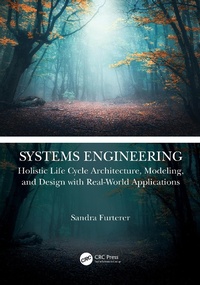
Systems Engineering
Holistic Life Cycle Architecture Modeling and Design with Real-World Applications
1st Edition
Published on 14. December 2021
400 pages
978-1-000-50959-5 (ISBN)
Description

This book provides a guide for systems engineering modeling and design. It focuses on the design life cycle with tools and application-based examples of how to design a system, focusing on incorporating systems principles and tools to ensure system integration. It provides product-based and service system examples to understand the models, tools, and activities to be applied to design and implement a system. The first section explains systems principles, models, and architecture for systems engineering, lifecycle models, and the systems architecture. Further sections explain systems design, development, and deployment life cycle with applications and tools and advanced systems engineering topics.
Features:
Focuses on model-based systems engineering and describes the architecture of the systems design models.
Uses real-world examples to corroborate different and disparate systems engineering activities.
Describes and applies the Vee systems engineering design methodology, with cohesive examples and applications of designing systems.
Discusses culture change and the skills people need to design and integrate systems.
Shows detailed and cohesive examples of the systems engineering tools throughout the systems engineering life cycle.
This book is aimed at graduate students and researchers in systems engineering, modeling and simulation, any major engineering discipline, industrial engineering, and technology.
Features:
Focuses on model-based systems engineering and describes the architecture of the systems design models.
Uses real-world examples to corroborate different and disparate systems engineering activities.
Describes and applies the Vee systems engineering design methodology, with cohesive examples and applications of designing systems.
Discusses culture change and the skills people need to design and integrate systems.
Shows detailed and cohesive examples of the systems engineering tools throughout the systems engineering life cycle.
This book is aimed at graduate students and researchers in systems engineering, modeling and simulation, any major engineering discipline, industrial engineering, and technology.
More details
Edition
1. Auflage
Language
English
Place of publication
London
United Kingdom
Publishing group
Taylor & Francis Ltd
Target group
College/higher education
Professional and scholarly
Illustrations
40 Tables, black and white; 329 Line drawings, black and white; 4 Halftones, black and white; 333 Illustrations, black and white
ISBN-13
978-1-000-50959-5 (9781000509595)
Copyright in bibliographic data and cover images is held by Nielsen Book Services Limited or by the publishers or by their respective licensors: all rights reserved.
Schweitzer Classification
Other editions
New editions
E-Book
03/2026
2nd Edition
CRC Press
€128.99
Available for download
Additional editions
Sandra Furterer
Systems Engineering
Holistic Life Cycle Architecture Modeling and Design with Real-World Applications
Book
10/2024
1st Edition
CRC Press
€70.50
Shipment within 15-20 days
Sandra Furterer
Systems Engineering
Holistic Life Cycle Architecture Modeling and Design with Real-World Applications
Book
12/2021
1st Edition
CRC Press
€184.90
Shipment within 15-20 days
Person
Dr. Sandy Furterer is an Associate Professor and Department Chair at the University of Dayton, in the Department of Engineering Management, Systems and Technology. She has applied Lean Six Sigma, Systems Engineering, and Engineering Management tools in higher education, healthcare, banking, retail, and other service industries. She had achieved the level of Vice President in several banking institutions. She previously managed the Enterprise Performance Excellence center in a healthcare system.
Dr. Furterer received her Ph.D. in Industrial Engineering with a specialization in Quality Engineering from the University of Central Florida in 2004. She received an MBA from Xavier University, and a Bachelor and Master of Science in Industrial and Systems Engineering from The Ohio State University.
Dr. Furterer is an author or co-author of several reference textbooks and handbooks on Lean Six Sigma, Design for Six Sigma, Lean Systems, Quality Management and Quality Improvement, as well as several journal articles, conference proceedings, and more than 90 conference presentations.
Dr. Furterer has extensive experience in business process and quality improvements. She is an ASQ Certified Six Sigma Black Belt, an ASQ Certified Manager of Quality/ Organizational Excellence, an ASQ Certified Quality Engineer, an ASQ fellow, and a certified Six Sigma Master Black Belt.
Dr. Furterer lives in Dayton with her husband Dan, rescue dogs Demi (Dr. Deming), Lily (Lilian Gilbreth), and cats Louis and Gypsy. Her 3 wonderful kids are also close by.
Dr. Furterer received her Ph.D. in Industrial Engineering with a specialization in Quality Engineering from the University of Central Florida in 2004. She received an MBA from Xavier University, and a Bachelor and Master of Science in Industrial and Systems Engineering from The Ohio State University.
Dr. Furterer is an author or co-author of several reference textbooks and handbooks on Lean Six Sigma, Design for Six Sigma, Lean Systems, Quality Management and Quality Improvement, as well as several journal articles, conference proceedings, and more than 90 conference presentations.
Dr. Furterer has extensive experience in business process and quality improvements. She is an ASQ Certified Six Sigma Black Belt, an ASQ Certified Manager of Quality/ Organizational Excellence, an ASQ Certified Quality Engineer, an ASQ fellow, and a certified Six Sigma Master Black Belt.
Dr. Furterer lives in Dayton with her husband Dan, rescue dogs Demi (Dr. Deming), Lily (Lilian Gilbreth), and cats Louis and Gypsy. Her 3 wonderful kids are also close by.
Content
Section 1 Systems Engineering Fundamentals
1. Systems Principles and Concepts
2. Life Cycle Models for Systems Engineering
3. Systems Architecture for Model-Based Systems Engineering
Section 2 Systems Design, Development, and Deployment Life Cycle - Service Applications and Tools
4. Concept of Operations Phase 1 - Define Strategic Mission Goals
5. Concept of Operations Phase 1 - Define Mission Analysis
6. Requirements and Architecture Phase 2 - Develop Logical Architecture
7. Requirements and Architecture Phase 2 - Elicit Requirements
8. Requirements and Architecture Phase 2 - Derive Requirements
9. Detailed Design Phase 3
10. Implementation, Integration, Test and Verification, System Verification, and Validation within Phases 4 and 5
11. Operation and Maintenance Phase 6
12. Systems Engineering Planning
13. Model-Based Systems Engineering (MBSE)
14. Lean, Iterative, and Agile Life Cycles that can be Used to Streamline System Design and Development Timelines
15. Holistic Culture and Change Management Concepts and Skills for Enhancing Systems
1. Systems Principles and Concepts
2. Life Cycle Models for Systems Engineering
3. Systems Architecture for Model-Based Systems Engineering
Section 2 Systems Design, Development, and Deployment Life Cycle - Service Applications and Tools
4. Concept of Operations Phase 1 - Define Strategic Mission Goals
5. Concept of Operations Phase 1 - Define Mission Analysis
6. Requirements and Architecture Phase 2 - Develop Logical Architecture
7. Requirements and Architecture Phase 2 - Elicit Requirements
8. Requirements and Architecture Phase 2 - Derive Requirements
9. Detailed Design Phase 3
10. Implementation, Integration, Test and Verification, System Verification, and Validation within Phases 4 and 5
11. Operation and Maintenance Phase 6
12. Systems Engineering Planning
13. Model-Based Systems Engineering (MBSE)
14. Lean, Iterative, and Agile Life Cycles that can be Used to Streamline System Design and Development Timelines
15. Holistic Culture and Change Management Concepts and Skills for Enhancing Systems
