

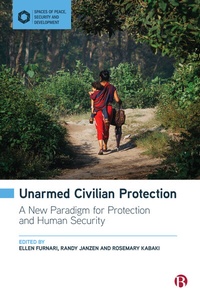
Unarmed Civilian Protection
A New Paradigm for Protection and Human Security
1st Edition
Published on 21. June 2023
220 pages
978-1-5292-2547-1 (ISBN)
Description

The frequent failure of military or armed interventions to protect civilians is well known. This edited collection provides a comprehensive account of a different, effective paradigm: unarmed civilian protection (UCP).
The principles and methods of UCP have been used for many decades to protect both specific, threatened individuals as well as whole communities. Featuring contributions from around the world, this book brings together a wide range of UCP practices in order to examine their underlying theory and interrelated strategies.
The book provides an important illustration of the contributions UCP can make, while also discussing its limitations and failures.
The principles and methods of UCP have been used for many decades to protect both specific, threatened individuals as well as whole communities. Featuring contributions from around the world, this book brings together a wide range of UCP practices in order to examine their underlying theory and interrelated strategies.
The book provides an important illustration of the contributions UCP can make, while also discussing its limitations and failures.
Reviews / Votes
"With a focus on survivors of wars, this book provides evidence that non-violent action is effective and powerful in protecting lives and human rights even in the most dangerous security situations." Mulanda Jimmy Juma, Scuola Superiore Sant'Anna "Interesting introduction to what feels like an important, under-discussed subject, including among left-wing and anti-war groups." Peace News "Weapons are not the only response to preventing violence in the middle of armed conflict. This book introduces UCP as an effective and viable approach to addressing human security and shows how this is already a real alternative to military responses." Diego Checa Hidalgo, Universidad de Granada "This is an excellent state-of-the-art collection of essays on a fast-growing field of practice and study. It is highly recommended for its comparative outlook and its blend of insights from practitioners and scholars." Roger Mac Ginty, Durham Global Security Institute "In the early days of decolonization in Africa, Zambian president-to-be Kenneth Kaunda asked a group of pacifists who had staunchly supported independence how the new country could protect its borders without an army or military presence. This vital new book finally fully answers that question-how security and protection without weapons is both possible and practical. At a time when violence and war seem intractable, the global examples expertly covered in this important collection show that positive peaceful transformation may only come about through creative examples like Unarmed Civilian Protection." Matt Meyer, Secretary-General, International Peace Research Association"This book analyzes and documents an effective, affordable and replicable approach to protecting civilians and preventing violence just when the world needs it most because of increasing violence, rising authoritarianism and climate disruption." Mel Duncan, Nonviolent Peaceforce
More details
Series
Edition
First Edition
Language
English
Place of publication
Bristol
United Kingdom
Target group
Professional and scholarly
Product notice
Reflowable
Illustrations
3 s/w Abbildungen, 1 s/w Tabelle
1 Tables, black and white; 3 Illustrations, black and white
File size
1,07 MB
ISBN-13
978-1-5292-2547-1 (9781529225471)
Copyright in bibliographic data and cover images is held by Nielsen Book Services Limited or by the publishers or by their respective licensors: all rights reserved.
Schweitzer Classification
Other editions
Additional editions
Ellen Furnari | Randy Janzen | Rosemary Kabaki
Unarmed Civilian Protection
A New Paradigm for Protection and Human Security
Book
12/2024
1st Edition
Bristol University Press
€35.00
Shipment within 3-4 weeks
Ellen Furnari | Randy Janzen | Rosemary Kabaki
Unarmed Civilian Protection
A New Paradigm for Protection and Human Security
Book
06/2023
1st Edition
Bristol University Press
€114.50
Shipment within 3-4 weeks
Persons
Ellen Furnari has been involved with accompaniment/unarmed civilian protection (A/UCP) primarily as a researcher and consultant since 2003, as well as teaching an online course.
Randy Janzen, Ph.D, has been involved with Unarmed Civilian Protection (UCP) as a practitioner (accompaniment work in Guatemala), as an educator (co-creating the first post-secondary program in UCP at Selkirk College, Canada) and a researcher. Randy is a recently retired professor of Peace and Justice Studies and currently involved in UCP work in Palestine and Burundi.
Rosemary Kabaki serves as the Head of Mission at Nonviolent Peaceforce in Myanmar.
Randy Janzen, Ph.D, has been involved with Unarmed Civilian Protection (UCP) as a practitioner (accompaniment work in Guatemala), as an educator (co-creating the first post-secondary program in UCP at Selkirk College, Canada) and a researcher. Randy is a recently retired professor of Peace and Justice Studies and currently involved in UCP work in Palestine and Burundi.
Rosemary Kabaki serves as the Head of Mission at Nonviolent Peaceforce in Myanmar.
Content
1. Introduction - Ellen Furnari
2. How Does UCP Protect Without Weapons? - M. S. Wallace
3. A Typology for the Various UCP Practices - Randy Janzen
4. UCP and Conflict Transformation - Christine Schweitzer
5. The Temporal and Embodied Construction of Space and UCP - Louise Ridden
6. Unarmed Civilian Protection: Security or Humanitarian Aid? - John Reuwer
7. Relational Strategies: Contested Approaches to Relationships in UCP - Felicity Gray
8. Unarmed Civilian Protection (UCP): Exploring the Challenge for Political Science - Cecile Dubernet
9. Gender and Care in Unarmed Civilian Protection - Derek Oakley
10. Unarmed Civilian Protection and Nonviolence With Attention to Sub-Saharan Africa - Moses Monday John
11. Transforming Armed Policing in the US: Contributions From Unarmed Civilian Protection Models - Eli McCarthy
12. Protecting Former Perpetrators? Expanding the Concept of UCP/A through an Exploration of Violence in the Reintegration of Ex-Combatants in Colombia - Beatriz Arias Lopez, Berit Bliesemann De Guevara and Laura Jimenez Ospina
13. Unarmed Civilian Protection: Impact on Strengthening Civilian Capacities in the Bangsamoro Autonomous Region in Muslim Mindanao - Jeyamurugan Vyappareddiyar
14. Conclusion - Ellen Furnari and Randy Janzen
2. How Does UCP Protect Without Weapons? - M. S. Wallace
3. A Typology for the Various UCP Practices - Randy Janzen
4. UCP and Conflict Transformation - Christine Schweitzer
5. The Temporal and Embodied Construction of Space and UCP - Louise Ridden
6. Unarmed Civilian Protection: Security or Humanitarian Aid? - John Reuwer
7. Relational Strategies: Contested Approaches to Relationships in UCP - Felicity Gray
8. Unarmed Civilian Protection (UCP): Exploring the Challenge for Political Science - Cecile Dubernet
9. Gender and Care in Unarmed Civilian Protection - Derek Oakley
10. Unarmed Civilian Protection and Nonviolence With Attention to Sub-Saharan Africa - Moses Monday John
11. Transforming Armed Policing in the US: Contributions From Unarmed Civilian Protection Models - Eli McCarthy
12. Protecting Former Perpetrators? Expanding the Concept of UCP/A through an Exploration of Violence in the Reintegration of Ex-Combatants in Colombia - Beatriz Arias Lopez, Berit Bliesemann De Guevara and Laura Jimenez Ospina
13. Unarmed Civilian Protection: Impact on Strengthening Civilian Capacities in the Bangsamoro Autonomous Region in Muslim Mindanao - Jeyamurugan Vyappareddiyar
14. Conclusion - Ellen Furnari and Randy Janzen
