

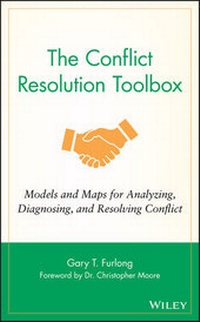
The Conflict Resolution Toolbox
Description

More details
Other editions
New editions
Additional editions
Person
Content
Foreword xii
Acknowledgements xv
Chapter One - Introduction 1
We All "Practice" Conflict Resolution Daily 3
Diagnosis: Finding the Root Causes of Conflict 4
Theories vs. Models in a Practice Profession 6
A Wide Range of Conflict Analysis Models 11
Becoming a Reflective Practitioner 13
Summary 15
How to Use this Book 17
Chapter Two - Overview of the Models 19
Why These Eight Models? 19
Model #1-The Circle of Conflict 21
Model #2-The Triangle of Satisfaction 21
Model #3-The Boundary Model 22
Model #4-The Interests/Rights/Power Model 22
Model #5-The Dynamics of Trust 23
Model #6-The Dimensions Model 23
Model #7-The Social Styles Model 24
Model #8-Moving Beyond Conflict 24
Chapter Three - The Conflict Story 25
Case Study 25
Chapter Four - Model #1: The Circle of Conflict 29
Background of the Circle of Conflict Model 29
Diagnosis with the Circle of Conflict 30
Case Study: Circle of Conflict Diagnosis 35
Strategic Direction from the Circle of Conflict 38
Case Study: Circle of Conflict Strategic Direction 40
Assessing and Applying the Circle of Conflict Model 44
Practitioner's Worksheet for the Circle of Conflict Model 46
Additional Case Study-Circle of Conflict 50
Circle of Conflict Worksheet: The Spanish Estate 54
Chapter Five - Model #2: The Triangle of Satisfaction 61
Background of the Triangle Model 61
Diagnosis with the Triangle of Satisfaction 61
Case Study: Triangle of Satisfaction Diagnosis 64
Strategic Direction from the Triangle of Satisfaction 68
Case Study: Triangle of Satisfaction Strategic Direction 72
Assessing and Applying the Triangle of Satisfaction Model 75
Practitioner's Worksheet for the Triangle of Satisfaction Model 77
Additional Case Study-Triangle of Satisfaction 79
Chapter Six - Model #3: The Boundary Model 89
Background of the Boundary Model 89
Diagnosis with the Boundary Model 89
Case Study: Boundary Model Diagnosis 94
Strategic Direction from the Boundary Model 96
Case Study: Boundary Model Strategic Direction 98
Assessing and Applying the Boundary Model 100
Practitioner's Worksheet for the Boundary Model 100
Additional Case Study-Boundary Model 103
Chapter Seven - Model #4: Interests, Rights, and Power 109
Background of the Interest/Rights/Power Model 109
Case Study: I/R/P Diagnosis 115
Strategic Direction from the I/R/P Model 116
Case Study: I/R/P Strategic Direction 118
Assessing and Applying the I/R/P Model 119
Practitioner's Worksheet for the I/R/P Model 120
Additional Case Study-I/R/P Model 122
Chapter Eight - Model #5: The Dynamics of Trust 127
Background of the Trust Model 127
Diagnosis with the Trust Model 132
Case Study-Trust Model Diagnosis 138
Strategic Direction from the Trust Model 142
Case Study: Trust Model Strategic Direction 150
Assessing and Applying the Trust Model 155
Practitioner's Worksheet for the Trust Model 156
Additional Case Study-Trust Model 158
Chapter Nine - Model #6: The Dimensions of Conflict 167
Background of the Dimensions Model 167
Diagnosis with the Dimensions Model 167
Case Study: Dimensions Model Diagnosis 172
Strategic Direction from the Dimensions Model 174
Case Study: Dimensions Model Strategic Direction 178
Assessing and Applying the Dimensions Model 182
Practitioner's Worksheet for the Dimensions Model 183
Additional Case Study-Dimensions Model 185
Chapter Ten - Model #7: The Social Style Model 191
Background of the Social Style Model 191
Diagnosis with the Social Style Model 193
Case Study: Social Style Diagnosis 198
Strategic Direction from the Social Style Model 200
Case Study: Social Style Strategic Direction 208
Assessing and Applying the Social Style Model 209
Practitioner's Worksheet for the Social Style Model 210
Additional Case Study: Social Style Model 213
Chapter Eleven - Model #8: Moving Beyond the Conflict 217
Background of the Moving Beyond Model 217
Diagnosis with the Moving Beyond Model 219
Stage One: Denial 220
Stage Two: Anger 221
Stage Three: Acceptance 222
Case Study: Moving Beyond Diagnosis 224
Strategic Direction from the Moving Beyond Model 229
Case Study: Strategic Direction with the Moving Beyond Model 235
Assessing and Applying the Moving Beyond Model 242
Practitioner's Worksheet for the Moving Beyond Model 243
Additional Case Study-Circle of Conflict 244
Moving Beyond Model Diagnosis and Worksheet: The Workplace Assault Case 245
Moving Beyond Model Strategic Direction: The Workplace Assault Case 247
Chapter Twelve - Conclusion 249
Index 253
