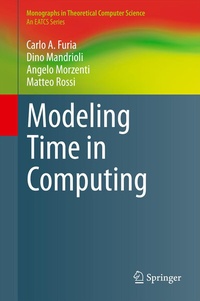
Modeling Time in Computing
Description

Reviews / Votes
From the reviews:
"All aspects of modeling time in computing are presented in this book, but that's not all it offers. Each of the chapters can be read as an independent text, allowing a very customized experience with the book. ... Part 1 is extremely useful for readers at an early level of computer science learning, as it presents aspects that can be easily understood by an undergraduate student. These chapters also offer the bonus of some exercises that help readers assess their ability to understand the concepts discussed. Part 2, I think, is harder to follow because it deals with a higher level of abstraction. However, these chapters are very well written and allow a complete understanding of the issues of simulating time. After the closing chapter, the authors provide an extensive set of references and a useful index. The authors have succeeded in writing a very complete text, which is fairly easy to read and to follow ... This book is now one of my favorite sources on this topic. " [Nuno M. Garcia, Computing Reviews, 2013]
"The book is well written, the details are given in a rigorous manner, the bibliography seems to be adequate and well explained. . I consider the book to be a nice presentation of a large range of results regarding time modeling in computer science, complemented by a considerable number of pointers towards further readings. In fewer words: a good starting point both for students and researchers interested in this topic." [Florin Manea, Zentralblatt MATH, Vol. 1260, 2013]
"... Next to its admirably comparative and conceptual approach, the highlight of this book are its numerous examples and its many excellent, albeit challenging, exercises ... its brilliantly written firstpart revisits the approaches adopted by physics and engineering for describing dynamic systems ... this is a successful monograph on the diverse and difficult topic of modeling time. I highly recommend it to engineers and practitioners who need to apply modern computer science techniques to developing and analyzing complex, software-intensive systems. " [G. Lüttgen, AMS Mathematical Reviews, MR3185244, 2015]
More details
Other editions
Additional editions