

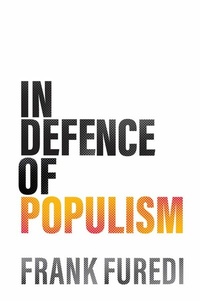
In Defence of Populism
Description

'Populist' is now most commonly used as a term of abuse. Populists, we are repeatedly told, are xenophobic ignoramuses offering irrational, emotive solutions to complex problems. But is this true?
Frank Furedi argues that this is a self-serving narrative that owes more to the desire of elites to protect their own power and interests than it does to the truth. The widespread disdain expressed towards populism in the media and by many academics is in fact poorly concealed contempt towards the idea of popular sovereignty and democratic decision-making. Populism is not equivalent to any specific ideology, as populist politicians vary greatly in their substantive views, but it is rather a broad disposition towards public life that stresses the value of giving the ordinary citizen a genuine voice in political decision-making. Attacks on 'populism' most commonly reveal the desire of those who run our institutions to keep real authority in the hands of unaccountable elites who veil their power under the guise of 'expertise'.
This bracing defence of basic democratic values by one of our most fearless polemicists should be read by anyone who mistakes the complacent assurances of our elite for the wisdom of our betters.
More details
Other editions
Additional editions
Person
Frank Furedi, author and social commentator, is Emeritus Professor of Sociology at the University of Kent. Author of more than 26 books, Furedi's studies have been devoted to an exploration of the cultural developments in Western societies. His most recent book, The War on the Past (Polity, 2024), was a lively attack on attempts by progressives to render our historical inheritance toxic.
His research has been oriented towards the way that risk and uncertainty are managed by contemporary culture. His two influential books, The Culture of Fear and Paranoid Parenting, investigated the interaction between risk consciousness and perceptions of fear, trust relations and social capital in contemporary society.
Content
Chapter 1: Introduction: A Spectre Haunting...
Chapter 2: A teleology of evil
Chapter 3: Populism vs Anti-populism
Chapter 4: The quest for home
Chapter 5: Populism's Defence of the Pre-political Sphere
Chapter 6: A Response to the Condition of Cultural Insecurity
Chapter 7: Championing cultural continuity
Chapter 8: Giving people a voice: giving meaning to democracy
Chapter 9: Conclusion: Taking Control
Preface
The idea for this book first began to take shape in February 2024. This was a moment when hundreds of thousands of European farmers launched a protest movement against the attack on their way of life by the technocrats running the European Union. As the Director of a Brussels-based think tank - MCC Brussels - I did what I could to support the movement that erupted in Belgium, France, the Netherlands and Germany.
As I watched their tractors roar into the centre of Brussels, I shared the sense of exhilaration of the protestors who felt that for once their voice was being heard. Tom, a Flemish farmer who drove his tractor to Brussels to protest against the harsh environmental laws that the European Union bureaucracy imposed on his community, told me that the media tried to scare off the public from supporting his cause by calling his movement far right and populist. He was livid. Having been told that he had to cut down the number of livestock he had on his land, he knew that it was only a matter of time before he would have to close down his farm.1
Our conversation ended when he smiled and said, 'They call me a populist, fine I'll take that!'.
As soon as Tom said 'I'll take that', I was struck by the defiant countercultural tone of his voice. These days the word populist carries so much negative baggage that you struggle to come across individuals who are prepared to publicly identify themselves as populist. And yet here was someone who enthusiastically embraced a designation that the media used as a term of condemnation.
Tom has never been interested in politics, but like hundreds of thousands of people living in rural Europe, he decided that he wanted his voice to be heard. He was not alone. During the months of 2024, populism demonstrated that it possessed a formidable staying power. Within the nation states of the European Union, the populist parties rattled the political establishment to the point that it is now on the defensive. In the United States, it was not old-fashioned party politics nor the old worn-out Republican establishment that bore responsibility for the victory of Donald Trump but the MAGA movement. Movements that are labelled as populist are visible throughout Europe and by all accounts they are growing from strength to strength. Yet, paradoxically, almost none of these parties or their political leaders refer to themselves as populist.
Populism is surrounded by ceaseless hostility and mystification. Just about everything you are likely to read about populism in the specialist academic literature is motivated by their authors' animosity and contempt. Their sentiments are reproduced in an intensely polemical form by the mainstream media that habitually dismisses populists as far right and even fascists. According to the dominant media narrative, populists are racist xenophobes, homophobes and a variety of other phobes. At times the media hysteria regarding the so-called populist threat echoes the Red Scare of the 1920s and 1950s in the United States.
After my conversation with Tom, I concluded that it was time that the moral panic against populism was demystified and challenged. I was already engaged in a study of the cultural drivers of twenty-first-century populism and had concluded that most publications dealing with this topic were simply not concerned to understand what made this movement tick. They appeared to be far more interested in pathologizing populism than in serious scholarly exploration. Though there is a veritable industry of so-called populism experts, their publications reflect a disposition - even an ideological commitment - towards demonizing this movement.
The term populist is applied to a bewildering variety of movements that have very little in common. Former Brazilian President Jair Bolsonaro was regularly characterized as a populist as is his bitter opponent, Lula (Luiz Inácio Lula da Silva), who replaced him as the leader of Brazil in the election of 2023. That the right-wing conservative Bolsonaro and the leftish socialist Lula can be ascribed the same political label speaks to a confusing use of the term populist. The Turkish President, Recep Tayyip Erdogan, the Prime Minister of India, Shri Narendra Modi and Viktor Orbán the Prime Minister of Hungary are all referred to as populists even though Erdogan presents himself as a Turkish Islamist, Modi speaks the language of Hindu nationalism and Orbán claims that his regime is committed to Christian democratic and bourgeois values.
At present, populism often works as an unhelpful umbrella term that is used to describe movements displaying an orientation towards activism and to parties that diverge from the centrist mainstream legacy political institutions. Even governmental policies that seek public popularity are described as populist. Some commentators attempt to get around the confused state of affairs by distinguishing between left-wing and right-wing or democratic and authoritarian populism.2
Some commentators have even invented the term technopopulism to characterize the use of populist rhetoric by politicians associated with the technocratic-managerial elites.3 The use of the term populist to characterize movements that have little in common, beyond that their policies and actions diverge from those of the legacy political establishment does little to illuminate what is specific and distinct about a phenomenon that represents an increasingly influential force in Western societies.
The focus of this text is national populism, arguably the most distinct and increasingly powerful movement in our times. National populism is often demonized as far-right and even as fascistic. However, as we explain in the chapters that follow, national populist movements such as those supporting Reform in the UK, or Fratelli in Italy, or Rassemblement Nationale in France, have no ideological affinities with the far-right politics of the 1930s far right. It is not ideology that draws sections of the electorate to support these parties but a demand for policies that secure and enhance people's way of life and provides them with a voice and a sense of solidarity.
In Defence of Populism sets out to put the record straight. It explains that the motives that inspire movements that are characterized as populist are positive expressions of the quest for solidarity. The story that unfolds in the following chapters highlights the democratic spirit that drives populism forward. It argues that in the current conjuncture, populism alone is serious about promoting the politics of hope. The impulse that drives populism forward is fuelled by a demand for voice and a determination to uphold the traditional values that are demonized by the political and cultural establishment of Western society.
Populism is not simply committed to the renewal of democracy but also to the advocacy of a system of cultural values that are antithetical to those of the technocratic-managerial classes that rule society. The polarization of values has acquired an intense logic which explains the degree of intolerance that society's elites direct towards populism. In Defence of Populism argues that what is important about populism is the spirit of freedom and community that it embodies. We hope that once the democratic spirit that animates populism is understood, readers' attitude towards this subject will become more sympathetic to people's quest for a voice.
During the course of working on this problem I had the good fortune to discuss the issues outlined in this book with representatives from a variety of parties labelled as populist. Members and supporters of the European Parliament political groups Patriots for Europe and ECR kindly shared their thoughts with me, as did some of the activists from Reform UK. My discussion with participants in the patriotic grassroots flaggers movement in August 2025 reinforced my conviction that the quest for a voice is one of the most animating forces in contemporary politics.4 Paradoxically none of my informants self-consciously identified themselves as populists, but their sympathies were clearly with people like Tom.
I am grateful to my colleagues at the think tank MCC Brussels, where I work alongside a great team of people. In particular, I have drawn on the insights of the formidable Jacob Reynolds, Tony Gilland, John O'Brien and Richard Schenk. Dr Jennie Bristow provided ruthless criticism of the text and saved me from not a few embarrassing faux pas. My editor at Polity Press, George Owers, offered some invaluable advice about how to improve the text. Needless to say, none of them are directly responsible for the views expressed in this text.
The book is dedicated to the memory of Hannah Arendt, whose wonderful reflections on judgement and common sense reinforced my conviction that populism represents democracy in action. If, as Simon and Garfunkel noted, 'silence like a cancer grows', then we urgently need a movement committed to helping people find their voice.
Frank Furedi
Brussels, September 2025
Notes
- 1. For an account of this protest, see https://www.politico.eu/article/belgium-farmer-protests-brussels-nitrogen-emissions/
- 2. https://www.populismstudies.org/the-nexus-between-activism-and-populism-amid-global-protests-and-digital-media/
- 3. See, for example, Bickerton, C.J. and Accetti, C.I. (2021) Technopopulism: The New Logic of Democratic Politics. Oxford: Oxford University Press.
- 4. On the flaggers movement, see...
