

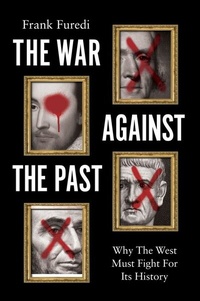
The War Against the Past
Description

In this book, Frank Furedi mounts a fierce defence of the past and calls for a fight back against the delegitimization of its ideals and accomplishments. Casting the past as a story of shame has become a taken-for granted outlook permeating the educational and cultural life of western society from the top down. Its advocates may see it as a cultural imperative, but a society that loses touch with its past will face a permanent crisis of identity. Squandering the wisdom provided by our historical inheritance means betraying humanity's positive achievements. Challenging this great betrayal, Furedi argues, is one of the most important battles of our time.
More details
Other editions
Additional editions


Person
Dr. Frank Furedi, author and social commentator is Emeritus Professor of Sociology at the University of Kent. Author of more than 26 books, Furedi's studies have been devoted to an exploration of the cultural developments in western societies. In recent years he has published several studies on the impact of the Culture Wars on family life, socialisation, education and public life. His most recent book, 100 Years of Identity Crisis, argues that it disrupts the socialisation of young people and encourages the estrangement of generations from one another.
His research has been oriented towards the way that risk and uncertainty is managed by contemporary culture. His two influential books, The Culture of Fear and Paranoid Parenting, investigated the interaction between risk consciousness and perceptions of fear, trust relations and social capital in contemporary society. His book How Fear Works: The Culture of Fear in the 21st Century (2018) explored the distinct features of contemporary fear culture.
Content
Acknowledgments
Preface
Introduction
Chapter 1 What Is the Past?
Chapter 2 The War's Long Gestation
Chapter 3 The Ideology of Year Zero
Chapter 4 The Present Eternalised
Chapter 5 Identity and the Past
Chapter 6 The Struggle to Control Language
Chapter 7 Disinheriting The Young from Their Past
Conclusion
Notes
Bibliography
Index
1
What Is the Past?
Before exploring how the past became a battleground, it is necessary to review the evolution of society's sense of the past. Our present attitude towards the past is paradoxical. Strident calls to break with history coexist with an obsessive desire to settle the score with it. As I shall argue in this and the following chapters, the outcome of this contradictory approach to the past is to erode the boundary that separates it from present times.
Consider how events that occurred centuries ago are often treated by sections of the media as current events. The Guardian, for instance, copying a previous endeavour by The New York Times, has commissioned academics to write a report about its founding in 1821 and the newspaper's owners' relation to the slave trade.1 Elsewhere, institutions such as the Church of England appear to feel more comfortable about accounting for their behaviour two centuries ago than with confronting the challenges of our time. In setting aside a fund to investigate the C of E's links with slavery, Archbishop Justin Welby claimed that he was motivated by 'the presence of the risen Christ alive in the church'.2
Since, as the American historian David Lowenthal reminds us, 'the past is everywhere', we tend to take its meaning for granted. 'Noticed or ignored, cherished or spurned, the past is omnipresent,' he wrote in his The Past Is a Foreign Country (1985) - its title a reference to the widely cited observation of L.P. Hartley in his novel The Go-Between (1953): 'The past is a foreign country . they do things differently there.'3 In its most literal sense, the past refers to what has preceded our moment. According to the common-sense definition offered by Wikipedia, the past refers to 'the set of all events that occurred before a given point in time' and 'the past denotes a period of time that has already happened, in contrast to the present and the future'.4 According to The Oxford English Dictionary, the past 'is the time that has gone by'; it 'existed or occurred prior to the current time'.5
In reality, the past does not simply refer to events that occurred before the current moment. It is also a distinct temporal realm that is perceived in the contemporary world as different from the present and the future. Nor does the past simply refer to the domain of temporality. Our consciousness of the past is principally a cultural accomplishment. It is strongly shaped by people's perception of their predicament in the present. Although societies possess a collective memory or sense of the past, different groups and individuals may experience them dissimilarly. The past can incite a wide range of emotions.
Watch, for example, any of those ancestry programmes in which experts 'dig up' documents and records of some celebrity's forebears. You may see some individuals react with pride and pleasure to the discovery that one of their ancestors was a notable historical character; for others the past brings tears to their eyes, when they realise that one of their relatives had a hard life and experienced the most trying of social conditions. The past, like the present, can elicit the full range of human emotions.6
Individuals may only sometimes be aware of their consciousness of the past but the relationship that they have to it is constitutive of who they are. Whether or not individuals are interested in studying their history and finding out about the life of their ancestors, they are inescapably the products of a community that preceded their existence. As the historian Eric Hobsbawm argued, 'For where we stand in regard to the past, what the relationships are between past, present and future are not only matters of vital interest to all: they are quite indispensable.' He added, 'We cannot help situating ourselves in the continuum of our own life, of the family and group to which we belong.'7
Society's perception of bygone days is best captured by the term the sense of the past. The literary critic Lionel Trilling has persuasively argued that possessing a sense of the past is an 'actual faculty of the mind, a "sixth sense"', through which we become conscious of history and our place in it.8 From this perspective, the working of this faculty is informed by how people position themselves in relation to the past. There are a range of possible reactions, from nostalgia towards the past to the impulse to leave it behind. However, in all modern societies, all human beings are conscious of history's existence. As Hobsbawm noted:
To be a member of any human community is to situate oneself with regard to one's (its) past, if only by rejecting it. The past is therefore a permanent dimension of the human consciousness, an inevitable component of the institutions, values and other patterns of human society. The problem for historians is to analyse the nature of this 'sense of the past' in society and to trace its changes and transformations.9
The 'sense of the past' constitutes a problem to be investigated because it is constantly subject to shifts in the cultural mood prevailing in society. Society's sensibility towards the past has a history, and how we view it very much depends on our circumstances in the present.
As I shall note later, the past and its meaning for society today is very different from how it was seen and experienced by previous generations. Even during my adult life, there has been a dramatic shift in attitudes towards the past. Back in 1992, when I published my study Mythical Past, Elusive Future: History and Society in an Anxious Age, I was struck by the all-pervasive sense of nostalgia that encouraged Western societies to reimagine their history. The focus of Mythical Past was on the loss of confidence and the anxiety about the future prevailing in Western societies, which 'stimulated a scramble to appropriate the past'.10 At the time, other historians and scholars also drew attention to what appeared to be a desperate attempt to sustain a sense of continuity with the past. Nostalgia towards bygone days led to the emergence of what came to be known as the Heritage Industry. The titles of Robert Hewison's The Heritage Industry: Britain in a Climate of Decline (1987) and Patrick Wright's On Living in an Old Country: The National Past in Contemporary Britain (1985) drew attention to a society that felt more comfortable living in the past than in the present. Wright associated what seemed as the compulsive celebration of heritage during the 1980s as an 'expression of loss of confidence in the future'.11 According to Nick Merriman, 'The rise of the pejoratively-termed "heritage industry" has been seen as a symptom of the failure of modern society to face the future after the decline of industry. Instead, society is looking back to a more glorious past, but this past, as portrayed in displays led by marketing policies, is a romanticised fiction.'12
The project of cultivating the sense of the past during the latter part of the 20th century was, to a considerable extent, a response to the fear of being too detached from it. Lowenthal's The Past Is a Foreign Country offered a compelling account of the steady erosion of the sense of continuity, which led to a breach with the past. This development was most astutely captured by the historian J.H. Plumb in his seminal study The Death of The Past (1969). Though Plumb was sympathetic to the loss of authority of the past, he was sensitive to the fact that something important was lost. He observed that 'whenever we look, in all areas of social and personal life, the hold of the past is weakening'.13
Plumb drew attention to the widespread derision towards what he posited as the 'hollow values' that emanated from the past. According to him, the consequence of this putative death of the past was that attitudes to it became primarily nostalgic: 'The new methods, new processes, new forms of living of scientific and industrial society have no sanction in the past, and no roots in it. The past becomes, therefore, a matter of curiosity, nostalgia, a sentimentality.'14 In a memorable and scathing remark, Plumb stated that 'the most remarkable aspect of Western ideology is its leech-like addiction to its past'.15
Far from serving as the principal cultural frame for perceiving the past, nostalgia and uncritical sentimentality towards it have given way to a mood of uncritical criticism. Today's society is conscious of its loss of historical continuity, but its principal impulse is to reject it. There is - as the title of our book indicates - a veritable War Against the Past, and nostalgia towards it has given way to rejection and detachment. For many, the past is not so much a foreign country as an enemy territory.
The popularity of period dramas such as Downton Abbey and The Crown can lead to the conclusion that sentimentality towards the past still retains a powerful influence over society. While its presence is manifestly evident, however, it has far from a dominant influence on the contemporary zeitgeist. The paradox of our times is that hostility towards the...
