

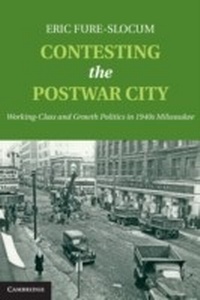
Contesting the Postwar City
Working-Class and Growth Politics in 1940s Milwaukee
1st Edition
Published on 1. June 2013
978-1-107-24067-4 (ISBN)
Description

Focusing on mid-century Milwaukee, Eric Fure-Slocum charts the remaking of political culture in the industrial city. Professor Fure-Slocum shows how two contending visions of the 1940s city - working-class politics and growth politics - fit together uneasily and were transformed amid a series of social and policy clashes. Contests that pitted the principles of democratic access and distribution against efficiency and productivity included the hard-fought politics of housing and redevelopment, controversies over petty gambling, questions about the role of organized labor in urban life, and battles over municipal fiscal policy and autonomy. These episodes occurred during a time of rapid change in the city's working class, as African-American workers arrived to seek jobs, women temporarily advanced in workplaces, and labor unions grew. At the same time, businesses and property owners sought to re-establish legitimacy in the changing landscape. This study examines these local conflicts, showing how they forged the postwar city and laid a foundation for the neoliberal city.
Reviews / Votes
'Eric Fure-Slocum takes an in-depth look at the politics and public life of 1940s Milwaukee. He resurrects the history of long-forgotten struggles over public entertainment, housing shortages, and downtown modernization, and uses them to illustrate two very different visions of postwar urban development: what he calls 'working-class' versus 'growth' politics. Related analyses should be written for many US cities, but Milwaukee is a particularly good site for such study. The city had a powerful and vibrant socialist governing tradition dating from 1910, as well as an emerging energetic business coalition committed to reshaping what it saw as an outmoded, inefficient city. Fure-Slocum has us rethink the periodization of twentieth-century urban history as he seamlessly takes us from the depression era to wartime to reconversion, showing how Milwaukeeans reshaped their city and their lives.' Margo Anderson, University of Wisconsin, Milwaukee "In this gracefully written, deeply researched, and cleverly illustrated book, Eric Fure-Slocum breaks the traditional division between 'wartime' and 'postwar', and challenges the easy assumption that 'growth politics' and urban renewal were necessarily benign and inevitable. What counted as modern and outmoded were code words for other interests often dimly understood. Underneath the daily political headlines of bond issues and elections, Americans were defining who belonged and who didn't deserve respect. Fure-Slocum challenges the habits of mind that treat African Americans and women of all ethnic groups as marginal. In his vision of the city, race and gender politics are present from the outset, linked sharply with the politics of class, and enacted by individuals whose histories he studies and whose alliances he analyzes.' Linda K. Kerber, University of Iowa, and author of No Constitutional Right to Be Ladies: Women and the Obligations of Citizenship 'Fure-Slocum offers a detailed case study of the post-World War II resurgence of conservativism in the US. This solidly researched study focuses on the effective rejection of liberal New Deal policies regarding race, organized labour, and working-class politics ... especially useful for readers interested in local, political, or urban history.' Choice 'Fure-Slocum has provided an extremely fine-grained account of postwar Milwaukee politics.' Bruce Fetter, Journal of Interdisciplinary History 'This is an insightful, carefully crafted, and deeply researched study.' Roger D. Simon, The Journal of American History 'Fure-Slocum's fine book is part of a growing literature on mid-century urbanism and the origins of the Rust Belt ... The book's greatest strength lies in its perspective: it does not look to explain the urban crises of the 1960s or the political and environmental costs of suburbanization, yet it encourages us to rethink how the policies and practices of public housing, racial segregation, industrial mobility, and urban sprawl emerged not from an inevitable and shared sense of urban decline.' Paul O'Hara, The American Historical Review 'In this detailed case study of a lone city during a single decade, the author manages to tackle a number of important issues to students of US urban life in the late twentieth and early twenty-first centuries. His analysis of how Milwaukee's political culture changed significantly considers the important roles played by African Americans, women, trade unions, and other groups striving for economic security in a hazardous time of deindustrialization.' Robert A. Beauregard, The Michigan Historical Review 'Fure-Slocum does a wonderful job of portraying the resistance mounted by organized labor and working-class communities and the persistence of liberal reformers who viewed the city's prosperity as hinging on the growth of the downtown.' Joe William Trotter, Jr, Social History 'In this detailed case study of a lone city during a single decade, the author manages to tackle a number of important issues to students of US urban life in the late twentieth and early twenty-first centuries. His analysis of how Milwaukee's political culture changed significantly considers the important roles played by African Americans, women, trade unions, and other groups striving for economic security in a hazardous time of deindustrialization.' Roger Biles, The Michigan Historical ReviewMore details
Language
English
Place of publication
Cambridge
United Kingdom
Target group
Professional and scholarly
Illustrations
17 Tables, unspecified; 2 Maps; 23 Halftones, unspecified
File size
8,81 MB
ISBN-13
978-1-107-24067-4 (9781107240674)
Copyright in bibliographic data and cover images is held by Nielsen Book Services Limited or by the publishers or by their respective licensors: all rights reserved.
Schweitzer Classification
Other editions
Additional editions
Book
06/2013
Cambridge University Press
€149.20
Shipment within 15-20 days
Person
Eric Fure-Slocum teaches History and American Studies at St Olaf College. His research and writing focuses on twentieth-century US urban and working-class history, with an interest in the shaping of American political culture and the political economy.
Content
Introduction: contesting democracy: working-class and growth politics in the city; 1. Milwaukee: a mid-twentieth-century working-class city; 2. New Deal legacies and wartime urgencies: housing politics, private enterprise, and public authority; 3. Wartime gambling, working-class leisure, and urban reform: 'why do our boys have to fight if we can't play bingo?'; 4. A militant CIO vision for city democracy: power, security, and egalitarianism; 5. Debt, growth, and democracy in the early postwar city; 6. Housing the postwar city: crowding, race, and policy; 7. Public housing, redevelopment, and urban citizenship: the 1951 referendum fight; Epilogue: revising postwar democracy: a city with class.
