

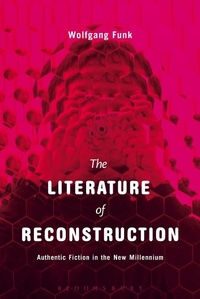
The Literature of Reconstruction
Authentic Fiction in the New Millennium
1st Edition
Published on 24. September 2015
224 pages
978-1-5013-0618-1 (ISBN)
Description

Winner of the 2016 ESSE Junior Scholar Book Award in Literatures in the English Language
The Literature of Reconstruction argues for the term and concept of 'postmillennial reconstruction' to fill the gap left by the decline of postmodernism and deconstruction as useful cultural and literary categories. Wolfgang Funk shows how this notion emerges from the theoretical and philosophical development that led to the demise of postmodernism by relating it to the idea of 'authenticity': immediate experience that eludes direct representation. In addition, he provides a clear formal framework with which to identify and classify the features of 'reconstructive literature' by updating the narratological category of 'metafiction', originally established in the 1980s. Based on Werner Wolf's observation of a 'metareferential turn' in contemporary arts and media, he illustrates how the specific use of metareference results in a renegotiation of the specific patterns of literary communication and claims that this renegotiation can be profitably described with the concept of 'reconstruction'.
To substantiate this claim, in the second half of the book Funk discusses narrative texts that illustrate this transition from postmodern deconstruction to postmillennial reconstruction. The analyses take in distinguished and prize-winning writers such as Dave Eggers, Julian Barnes, Jennifer Egan and Jasper Fforde. The broad scope of authors, featuring writers from the US as well as the UK, underlines the fact that the reconstructive tendencies and strategies Funk diagnoses are of universal significance for the intellectual and cultural self-image of the global North.
The Literature of Reconstruction argues for the term and concept of 'postmillennial reconstruction' to fill the gap left by the decline of postmodernism and deconstruction as useful cultural and literary categories. Wolfgang Funk shows how this notion emerges from the theoretical and philosophical development that led to the demise of postmodernism by relating it to the idea of 'authenticity': immediate experience that eludes direct representation. In addition, he provides a clear formal framework with which to identify and classify the features of 'reconstructive literature' by updating the narratological category of 'metafiction', originally established in the 1980s. Based on Werner Wolf's observation of a 'metareferential turn' in contemporary arts and media, he illustrates how the specific use of metareference results in a renegotiation of the specific patterns of literary communication and claims that this renegotiation can be profitably described with the concept of 'reconstruction'.
To substantiate this claim, in the second half of the book Funk discusses narrative texts that illustrate this transition from postmodern deconstruction to postmillennial reconstruction. The analyses take in distinguished and prize-winning writers such as Dave Eggers, Julian Barnes, Jennifer Egan and Jasper Fforde. The broad scope of authors, featuring writers from the US as well as the UK, underlines the fact that the reconstructive tendencies and strategies Funk diagnoses are of universal significance for the intellectual and cultural self-image of the global North.
Reviews / Votes
The demise of postmodernism might be said to be a long time coming, as scholars in the last few years have begun to characterise a transformation in literary and cultural production since the early 1990s. ... Within this new wave of literary criticism that reflects on a new body of writing, Wolfgang Funk's The Literature of Reconstruction persuasively argues that recent literary fiction has moved away from the postmodern project through formal innovation. * Textual Practice * Funk (Gutenberg-Universitaet, Mainz, Germany) offers an academic treatise on authenticity in the wake of postmodernism. He focuses on David Eggers's Heartbreaking Work of Staggering Genius, seven novels by Jasper Fforde, Julian Barnes's The Sense of an Ending and England, England, and Jennifer Egan's A Visit from the Goon Squad, in each examining the scholarly value in the voice. Eggers entangles his narrator with the voice of the writer, thus creating a self-conscious narrator. Fforde uses paradox to disrupt time. Funk's view of modern literature relies on technique rather than plot. The book covers the discourse in a range of postmodern novels, works that focus not on plot or character development but rather on meta reference to create a narrative assemblage for the reader. Summing Up: Recommended. Graduate students, researchers, faculty. * CHOICE * The number of critical studies telling us how to think about the fiction of the early twenty-first-century is growing by the day. Amid this abundance, Wolfgang Funk's The Literature of Reconstruction stands out for its critical breadth and sophistication, its nuanced and original readings, and its fresh and accessible style. It is a must for scholars of contemporary literature, but not only for them: the book should also be read by anyone interested in the idea of authenticity, as Funk's anatomy of this concept is nothing short of a revelation. * Adam Kelly, Lecturer in American Literature, University of York, UK, and author of American Fiction in Transition *More details
Edition
1. Auflage
Language
English
Place of publication
New York
United States
Publishing group
Bloomsbury Publishing PLC (Digital)
Target group
Professional and scholarly
ISBN-13
978-1-5013-0618-1 (9781501306181)
Copyright in bibliographic data and cover images is held by Nielsen Book Services Limited or by the publishers or by their respective licensors: all rights reserved.
Schweitzer Classification
Other editions
Additional editions
Book
03/2017
Bloomsbury Academic USA
€55.70
Shipment within 15-20 days
Book
09/2015
Bloomsbury Academic USA
€176.30
Shipment within 15-20 days
Person
Wolfgang Funk is Lecturer in English Literature at Johannes Gutenberg-Universitaet Mainz, Germany.
Content
Acknowledgements
List of Abbreviations
1) Postmodernism's Wake: From Deconstruction to Reconstruction
2) "To thine own self be true": Eight Theses on Authenticity
Thesis One: It is impossible to clearly define authenticity
Thesis Two: The History of Authenticity is a History of Loss
Thesis Three: Authenticity both presupposes and generates a notion of self
Thesis Four: Authenticity is both the antithesis to postmodern simulation and the ultimate simulacrum itself
Thesis Five: Recent media transformations necessitate a rethinking of authenticity
Thesis Six: Authenticity is an emergent phenomenon
Thesis Seven: Authenticity functions as a black box which sublates discursivedichotomies
Thesis Eight: Metareference constitutes an appropriate formal approach to authenticity
3) Holding the Mirror up to Fiction: Metareference in Art
The Truth and Nothing But: Does Realism Still Matter?
A Framework for Reconstruction: The Metareferential Turn
Essentially Strange Loops: Metareference as Tangled Hierarchy
4) From Innocence to Ignorance: Julian Barnes's England, England
5) Reconstructing the Author: Dave Eggers's A Heartbreaking Work of Staggering Genius
6) Reconstructing Literary Influence: Jasper Fforde's Thursday-Next Series
Revisitations and Revisions: The Eyre Affair
Inside Literature: Reconstructing Thursday Next
7) Reconstructing Narration: Jennifer Egan's A Visit from the Goon Squad and Julian Barnes'sThe Sense of an Ending
Narrative Assemblage: Jennifer Egan's A Visit from the Goon Squad
Implicit Narrative: Julian Barnes's The Sense of an Ending
8) Remainder
References
Index
List of Abbreviations
1) Postmodernism's Wake: From Deconstruction to Reconstruction
2) "To thine own self be true": Eight Theses on Authenticity
Thesis One: It is impossible to clearly define authenticity
Thesis Two: The History of Authenticity is a History of Loss
Thesis Three: Authenticity both presupposes and generates a notion of self
Thesis Four: Authenticity is both the antithesis to postmodern simulation and the ultimate simulacrum itself
Thesis Five: Recent media transformations necessitate a rethinking of authenticity
Thesis Six: Authenticity is an emergent phenomenon
Thesis Seven: Authenticity functions as a black box which sublates discursivedichotomies
Thesis Eight: Metareference constitutes an appropriate formal approach to authenticity
3) Holding the Mirror up to Fiction: Metareference in Art
The Truth and Nothing But: Does Realism Still Matter?
A Framework for Reconstruction: The Metareferential Turn
Essentially Strange Loops: Metareference as Tangled Hierarchy
4) From Innocence to Ignorance: Julian Barnes's England, England
5) Reconstructing the Author: Dave Eggers's A Heartbreaking Work of Staggering Genius
6) Reconstructing Literary Influence: Jasper Fforde's Thursday-Next Series
Revisitations and Revisions: The Eyre Affair
Inside Literature: Reconstructing Thursday Next
7) Reconstructing Narration: Jennifer Egan's A Visit from the Goon Squad and Julian Barnes'sThe Sense of an Ending
Narrative Assemblage: Jennifer Egan's A Visit from the Goon Squad
Implicit Narrative: Julian Barnes's The Sense of an Ending
8) Remainder
References
Index
