

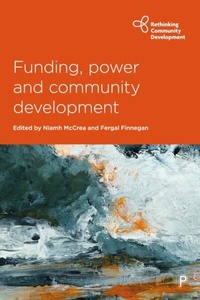
Funding, Power and Community Development
Policy Press
1st Edition
Published on 23. January 2019
208 pages
978-1-4473-3618-1 (ISBN)
Description

This edited collection critically explores the funding arrangements governing contemporary community development and how they shape its theory and practice.
International contributions from activists, practitioners and academics consider the evolution of funding in community development and how changes in policy and practice can be understood in relation to the politics of neoliberalism and contemporary efforts to build global democracy from the 'bottom up'.
Thematically, the collection explores matters such as popular democracy, the shifting contours of the state-market relationship, prospects for democratising the state, the feasibility of community autonomy, the effects of managerialism and hybrid modes of funding such as social finance.
The collection is thus uniquely positioned to stimulate critical debate on both policy and practice within the broad field of community development.
International contributions from activists, practitioners and academics consider the evolution of funding in community development and how changes in policy and practice can be understood in relation to the politics of neoliberalism and contemporary efforts to build global democracy from the 'bottom up'.
Thematically, the collection explores matters such as popular democracy, the shifting contours of the state-market relationship, prospects for democratising the state, the feasibility of community autonomy, the effects of managerialism and hybrid modes of funding such as social finance.
The collection is thus uniquely positioned to stimulate critical debate on both policy and practice within the broad field of community development.
Reviews / Votes
"...an important contribution to the study of community development and ought to be required reading for anyone interested in the subject." Studies in the Education of Adults "Funding, in austere times, is critical in community development. This book, however, makes an important contribution to our understanding of the costs, as well as benefits, of different funding models and their impact on community development principles and practice." Angus McCabe, University of BirminghamMore details
Series
Edition
First Edition
Language
English
Place of publication
Bristol
United Kingdom
Publishing group
Bristol University Press
Target group
Professional and scholarly
Product notice
Reflowable
Illustrations
Not illustrated
File size
1,20 MB
ISBN-13
978-1-4473-3618-1 (9781447336181)
Copyright in bibliographic data and cover images is held by Nielsen Book Services Limited or by the publishers or by their respective licensors: all rights reserved.
Schweitzer Classification
Other editions
Additional editions
Book
01/2019
1st Edition
Policy Press
€48.20
Shipment within 15-20 days
Book
01/2019
1st Edition
Policy Press
€105.60
Shipment within 15-20 days
E-Book
01/2019
1st Edition
Policy Press
€231.99
Available for download
Persons
Niamh McCrea is a lecturer at the Department of Humanities, Institute of Technology Carlow, Ireland where she teaches community development, youth work and adult education, with a particular focus on equality studies.
Fergal Finnegan is now a lecturer at the Department of Adult and Community Education, Maynooth University. His research interests include social movements, popular education, biographical research, social class and equality and higher education.
Fergal Finnegan is now a lecturer at the Department of Adult and Community Education, Maynooth University. His research interests include social movements, popular education, biographical research, social class and equality and higher education.
Contributions
Zentrum fuer Arbeit und Politik der Universitaet Bremen
Institut fuer Ethnologie und Kulturwissenschaft, Universitaet Bremen
Ubunifu Associates Ltd
Helen Macpherson Smith Trust
QUT Business School, Queensland University of Technology
Consultant, Small Change
School of Environmental Planning, Queen's University Belfast
Content
Chapter 1: Funding, power and community development: an introduction, Fergal Finnegan and Niamh McCrea
PART 1: New configurations of power and governance
Chapter 2: Critical issues in philanthropy: power, paradox, possibility and the private foundation, Erica Kohl-Arenas
Chapter 3: 'Walking the tightrope': the funding of South African NGOs and the governance of community development, Natascha Mueller-Hirth
Chapter 4: The reinvention of 'civil society': transnational conceptions of development in East-Central Europe, Agnes Gagyi and Mariya Ivancheva
Chapter 5: Social finance and community development: exploring egalitarian possibilities, Brendan Murtagh and Niamh Goggin
Chapter 6: Corporate funding and local community development: a case from the mining industry in Australia, Robyn Mayes
PART 2: Questions of state and grassroots democracy
Chapter 7: Funding community organising: diversifying sources, democratising civil society, Robert Fisher and Helene Balazard
Chapter 8: 'It is time to re-territorialise utopian thinking': community, the commons and the funding of autonomous movements in Latin America - An interview with Marcelo Lopes de Souza
PART 3: Modes of agency and horizons of possibility
Chapter 9: Keeping the show on the road: a reflective dialogue between a community worker and a funder, Lin Bender and Japhet Makongo
Chapter 10: Local philanthropy and women's empowerment: the case of Tewa, the Nepal Women's Fund, Rita Thapa
Chapter 11: Communities of hope? Gendered re-signification of microcredit in rural India, Debarati Sen and Sarasij Majumder
Chapter 12: Building alternative communities within the state: the Kurdish movement, local municipalities and democratic autonomy, Ulrike Flader and Cetin Guerer
PART 1: New configurations of power and governance
Chapter 2: Critical issues in philanthropy: power, paradox, possibility and the private foundation, Erica Kohl-Arenas
Chapter 3: 'Walking the tightrope': the funding of South African NGOs and the governance of community development, Natascha Mueller-Hirth
Chapter 4: The reinvention of 'civil society': transnational conceptions of development in East-Central Europe, Agnes Gagyi and Mariya Ivancheva
Chapter 5: Social finance and community development: exploring egalitarian possibilities, Brendan Murtagh and Niamh Goggin
Chapter 6: Corporate funding and local community development: a case from the mining industry in Australia, Robyn Mayes
PART 2: Questions of state and grassroots democracy
Chapter 7: Funding community organising: diversifying sources, democratising civil society, Robert Fisher and Helene Balazard
Chapter 8: 'It is time to re-territorialise utopian thinking': community, the commons and the funding of autonomous movements in Latin America - An interview with Marcelo Lopes de Souza
PART 3: Modes of agency and horizons of possibility
Chapter 9: Keeping the show on the road: a reflective dialogue between a community worker and a funder, Lin Bender and Japhet Makongo
Chapter 10: Local philanthropy and women's empowerment: the case of Tewa, the Nepal Women's Fund, Rita Thapa
Chapter 11: Communities of hope? Gendered re-signification of microcredit in rural India, Debarati Sen and Sarasij Majumder
Chapter 12: Building alternative communities within the state: the Kurdish movement, local municipalities and democratic autonomy, Ulrike Flader and Cetin Guerer
