

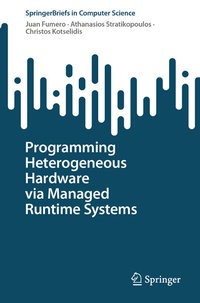
Programming Heterogeneous Hardware via Managed Runtime Systems
Description

This book provides an introduction to both heterogeneous execution and managed runtime environments (MREs) by discussing the current trends in computing and the evolution of both hardware and software. To this end, it first details how heterogeneous hardware differs from traditional CPUs, what their key components are and what challenges they pose to heterogenous execution. The most ubiquitous ones are General Purpose Graphics Processing Units (GPGPUs) which are pervasive across a plethora of application domains ranging from graphics processing to training of AI and Machine Learning models. Subsequently, current solutions on programming heterogeneous MREs are described, highlighting for each current existing solution the associated advantages and disadvantages.
This book is written for scientists and advanced developers who want to understand how choices at the programming API level can affect performance and/or programmability of heterogeneous hardware accelerators, how toimprove the underlying runtime systems in order to seamlessly integrate diverse hardware resources, or how to exploit acceleration techniques from their preferred programming languages.
More details
Other editions
Additional editions
Persons
Athanasios Stratikopoulos is a Research Fellow at the University of Manchester with specialization on heterogeneous architectures and reconfigurable accelerators. He has authored more than 15 research articles in the field of hardware acceleration, system software and programming languages. Currently his work involves heterogeneous architectures ranging from low-power devices to high-end cloud deployments. His interests include computer architecture, high-performance computing, virtualization, and hardware acceleration.
Christos Kotselidis is an Associate Professor (Reader) at The University of Manchester and a Chief Engineer at Pierer Innovation. His research interests lie in the areas of managed runtime systems, CPU microarchitecture, compilers, memory management, and heterogeneous hardware acceleration. He is currently leading the TornadoVM project which enables hardware acceleration of Java applications along with several EU projects in the areas of green computing, cybersecurity, and edge-to-cloud system architectures.
