

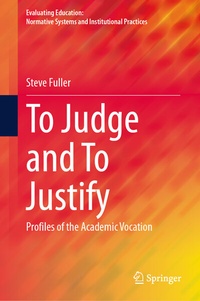
To Judge and To Justify
Description

This book argues that judging and justifying are the two skills that specifically require academic training. In the current times, where the value of a university degree is increasingly questioned, it's important to emphasize the significance of these skills. This volume addresses that universities are not necessarily stressing these skills, preferring instead to focus on the delivery of 'content' and the provision of 'credentials'. Its main focus is on articulating the positive case for the university's focus on judging and explaining as its core 'transferable skills.' It involves examining the historical and philosophical case for this claim, canvassing arguments made - and the example set -- by Plato, Francis Bacon, Immanuel Kant, William Whewell, Ludwig Wittgenstein, Paul Feyerabend, Richard Rorty, John Rawls and Robert Nozick - as well as considering how they might be realized in today's world.
This book extends the arguments in Fuller's recent book, Back to the University's Future: The Second Coming of Humboldt (Springer, 2023).
More details
Other editions
Additional editions
Person
Steve Fuller is Auguste Comte Professor of Social Epistemology at the University of Warwick, UK. Originally trained in history, philosophy and sociology of science, Fuller is best known for his foundational work in the field of 'social epistemology', which is the name of a quarterly journal he founded in 1987 as well as the first of his twenty-six books. His most recent research has focused on the future sustainability of 'humanity' as a concept in light of post/trans-human challenges, as well as the future of the university as a mainstay of society's intellectual life. His most recent books are Back to the University's Future: The Second Coming of Humboldt (Springer 2023) and Media and the Power of Knowledge (Bloomsbury 2025).
Content
Chapter 1. Introduction: Judgement and Explanation as Uniquely Transferable Academic Skills.- Chapter 2. Plato's Legacy.- Chapter 3. Bacon's Legacy.- Chapter 4. Kant's Legacy.- Chapter 5. Whewell's Legacy.- Chapter 6. Wittgenstein's Legacy.- Chapter 7. Feyerabend's Legacy.- Chapter 8. Rawls' and Nozick's Legacy.- Chapter 9. Rorty's Legacy.- Chapter 10. Conclusion: Knowledge as a Global Public Good as the Goal of Judgement and Explanation.
