

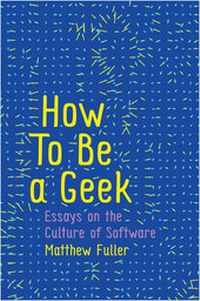
How To Be a Geek
Description

Computer software and its structures, devices and processes are woven into our everyday life. Their significance is not just technical: the algorithms, programming languages, abstractions and metadata that millions of people rely on every day have far-reaching implications for the way we understand the underlying dynamics of contemporary societies.
In this innovative new book, software studies theorist Matthew Fuller examines how the introduction and expansion of computational systems into areas ranging from urban planning and state surveillance to games and voting systems are transforming our understanding of politics, culture and aesthetics in the twenty-first century. Combining historical insight and a deep understanding of the technology powering modern software systems with a powerful critical perspective, this book opens up new ways of understanding the fundamental infrastructures of contemporary life, economies, entertainment and warfare.
In so doing Fuller shows that everyone must learn 'how to be a geek', as the seemingly opaque processes and structures of modern computer and software technology have a significance that no-one can afford to ignore. This powerful and engaging book will be of interest to everyone interested in a critical understanding of the political and cultural ramifications of digital media and computing in the modern world.
More details
Other editions
Additional editions
Person
Content
Acknowledgements
Biographies of Co-Authors
Introduction
Histories
1. The Obscure Objects of Object Orientation (with Andrew Goffey)
2. Abstract Urbanism (with Graham Harwood)
Entities
3. Software Studies Methods
4. Big Diff, granularity, incoherence and production in the Github software repository, (with Andrew Goffey, Adrian Mackenzie, Richard Mills and Stuart Sharples)
5. The Author Name (with Nikita Mazurov and Dan McQuillan)
Aesthetics
6. Always One Bit More, computing and the experience of ambiguity
7. Computational Aesthetics (with M. Beatrice Fazi)
8. Phrase (with Olga Goriunova)
9. Feral Computing: from ubiquitous computing to wild interactions (with Sonia Matos)
10. Just fun enough to go completely mad about: on games, procedures and amusement
Powers
11. Black Sites and Transparency Layers
12. Algorithmic Tumult and the Brilliance of Chelsea Manning
Index
