

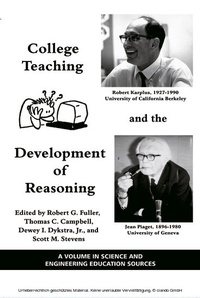
College Teaching and the Development of Reasoning
1st Edition
Published on 10. January 2009
345 pages
978-1-61735-246-1 (ISBN)
Description

This book is intended to offer college faculty members the insights of the development of reasoning movement that enlighten physics educators in the late 1970s and led to a variety of college programs directed at improving the reasoning patterns used by college students. While the original materials were directed at physics concepts, they quickly expanded to include other sciences and the humanities and social sciences. On-going developments in the field will be included.The editors have introduced new topics, including discussions of Vygotsky's ideas in relation to those of Piaget, of science education research progress since 1978, of constructivist learning theory applied to educational computer games and of applications from anthropology to zoology. These materials are especially relevant for consideration by current university faculty in all subjects.
All prices
More details
Other editions
Additional editions
Robert G. Fuller | Thomas C. Campbell | Dewey I. Dykstra
College Teaching and the Development of Reasoning
Book
09/2009
Information Age Publishing
€71.00
Article not available at the moment
Content
- Intro
- College Teaching and the Development of Reasoning
- A volume in Science and Engineering Education Sources
- Series Editor: Calvin Kalman, Concordia University, Montreal
- CONTENTS
- 1. How Students Reason 1
- 2. Concrete and Formal Operational Reasoning 19
- 3. Formal Reasoning Patterns 35
- 4. Interviews of College Students 51
- 5. College Student Research Findings 63
- 6. Analysis of Test Questions 69
- 7. Analysis of Textbooks 75
- 8. Self-Regulation 107
- 9. The Learning Cycle 115
- 10. Teaching Goals and Strategies 135
- 11. Implementation and Suggested Readings 147
- 12. Progress Since 1978 153
- 13. Theoretical Foundations for College Learning- Piaget & Vygotsky: Sorting Fact From Fiction 183
- 14. College Programs 203
- APPENDIX A
- APPENDIX b
- APPENDIX c
- APPENDIX d
- Appendix E
- Appendix F
- Information Age Publishing, Inc.
- Charlotte, North Carolina www.infoagepub.com
- Science and Engineering Education Sources
- Dedicated to
- Jean Piaget,
- Robert Karplus,
- and
- Arnold B. Arons
- Their pioneering efforts on behalf of students
- transformed our careers
- and
- provide guidance for the transformation of college teaching
- Calvin S. Kalman, Concordia University, Montreal, QC
- Dewey Dykstra , Professor of Physics at Boise State University
- Igal Galili, Head of The Science Teaching Department Hebrew University
- Charles Henderson, Chair Committee on Research in Physics Education, American Association of Physics Teachers
- Teresa Larkin, Chair Physics Department American University
- Michael Matthews, Editor Science & Education, President International History and Philosophy of Science Teaching Group
- Craig Nelson, First President, International Society for the Scholarship of Teaching and Learning, Professor of Biology, Indiana University
- Edward Redish, Professor of Physics University of Maryland founder and Coprincipal investigator of the Maryland University Project in Physics Education and Technology (M.U.P.P.E.T.) and Comprehensive Unified Physics
- Learning Environment (CUPLE)
- David W. Rudge, Associate Professor, Biological Sciences & The Mallinson Institute for Science Education Western Michigan University
- Eric Scerri, Editor, Foundations of Chemistry
- College Teaching and the Development of Reasoning
- edited by
- Robert G. Fuller
- University of Nebraska Lincoln
- Thomas C. Campbell
- Illinois Central College
- Dewey I. Dykstra, Jr.
- Boise State University
- and
- Scott M. Stevens
- Carnegie Mellon University
- Contents ix
- Acknowledgments
- introduction and Rationale
- note
- References
- Additional readings
- Figure 1. 1. The Islands Puzzle. © 1975 American Association of Physics Teachers, edited by ADAPT circa 1980.
- Figure 1. 5. The Dig.
- Figure 1. 3. Mr. Short. © 1975 American Association of Physics Teachers, edited by ADAPT circa 1980.
- Figure 1. 4. Chain of paperclips.
- How Students Reason
- Introduction
- Objective of This Chapter
- Procedure
- The Islands Puzzle
- Island Puzzle-Students' Responses
- Students' Responses
- The Mealworm Puzzle
- Figure 1. 2. Boxes of mealworms. ©1975 The Regents of the University of California, Lawrence Hall of Science.
- (a) light but not moisture
- (b) moisture but not light
- (c) both light and moisture
- (d) neither light nor moisture
- The Mealworm Puzzle-Students' Responses
- Mealworm Puzzle Questions
- 1. What similarities did you find among the type A responses? Please record your analyses here.
- 2. What similarities did you find among the type B responses? Please record your analyses here.
- 3. What features do you find that distinguish type A from type B responses?
- 4. Looking back, did your own solution resemble any of the above? If so, how?
- The Mr. Short / Mr. Tall Puzzle
- Mr. Short/Mr. Tall-Students' Responses
- Mr. Short/Mr. Tall-Questions:
- 1. What comparisons can you make between your response and those of the students? Record those comparisons here.
- 2. Center your attention on several of those responses which were different from yours. What common elements you can detect among those responses that disagree with yours. Record those common elements here.
- 3. Center your attention on those responses which agree with yours. What common elements you can detect among those student responses that agree with yours. List those common elements here.
- 4. Compare Type A responses to Type B responses.
- The Treasure Hunt Puzzle
- Figure 1. 7. The Hunt. © 1980 ADAPT
- The Treasure Hunt-Students' Responses
- 1. What similarities did you find among the responses of students A? Please record your analyses here.
- 2. What similarities did you find among the responses of students B? Please record your analyses here.
- 3. What difference did you find between A and B responses?
- 4. Looking back, did your own solution, perhaps in its initial stages, resemble any of the above? If so, how?
- Concluding Remarks
- CHAPTER 1
- Figure 1. 6. The Hut.
- Figure 2. 1. Dr. Piaget, 1975, Philadelphia, PA.
- Table 2.2. Logical Knowledge Stages of Cognitive Development (Jean Piaget)
- Concrete and Formal Operational Reasoning
- Introduction
- Objective of This Chapter
- Procedure
- Essay Piaget's Theory in a Nutshell
- Table 2.1
- Schemes That Constitute Important Aspects of Concrete Operational Reasoning:
- (a) use concepts and simple hypotheses that make a direct reference to familiar actions and objects, and can be explained in terms of simple association (e.g., the plants in this container are taller because they get more fertilizer)
- (b) follow step-by-step instructions as in a recipe, provided each step is completely specified (e.g., can identify organisms with the use of a taxonomic key, or find an element in a chemical solution using a standard procedure)
- (c) relate one's own viewpoint to that of another in a simple situation (e.g., a girl is aware that she is her sister's sister).
- (d) searches for and identifies some variables influencing a phenomenon, but does so unsystematically (e.g., investigates the effects of one variable but does not necessarily hold the others constant)
- (e) makes observations and draws inferences from them, but does not consider all possibilities
- (f) responds to difficult problems by applying a related but not necessarily correct algorithm
- (g) processes information but is not spontaneously aware of one's own reasoning (e.g. does not check one's own conclusions against the given data or other experience).
- Schemes That Constitute Important Aspects of Formal Operational Reasoning:
- The Theory's Main Implications for College Teaching Are:
- 1. Reasoning is an active, constructing process that must engage your students in developing more adequate schemes.
- 2. Be aware that some of your students may sometimes use predominantly concrete schemes.
- 3. Be aware that many of the topics and concepts you teach require formal operational reasoning. You should figure out which topics these are.
- 4. Try to arrange your subject matter so it follows the developmental progression of familiar, directly observable to less familiar, less observable, and more theoretical.
- 5. Demonstrate to your students a questioning, dynamic, and active attitude towards the course you teach. Generate hypotheses, discuss alternative explanations and encourage your students to do the same. Turn your classroom into a laboratory where re...
- Analysis of Student Responses in Chapter 1
- Puzzle Analysis Addendum
- Islands Puzzle
- Mealworm Puzzle
- Mr. Short/Mr. Tall Puzzle
- Treasure Hunt Puzzle
- Summary
- The Frog and the Student Population Puzzles
- The Student Population Puzzle
- From Her Data:
- Frog Puzzle:
- Student Population Puzzle:
- Concluding Remarks
- CHAPTER 2
- Table 2.3. Characteristics of Concrete and Formal Operational Reasoning
- Table 2.4. Your Classification of Student Responses
- Table 2.5. College Students' Responses
- Figure 2. 2. The Frog Puzzle. ©1975 The Regents of the University of California, Lawrence Hall of Science.
- Figure 2. 3. The Population Puzzle. ©1980. ADAPT, University of Nebraska Lincoln.
- Figure 3. 1. Flexibility of rods apparatus.
- Formal Operational Reasoning Patterns
- Introduction
- Objective of this Chapter
- Procedure
- Notes on the Film, Formal Reasoning Patterns, by Robert Karplus and Rita Peterson (1976)
- Transcriptions of Parts of the Formal Reasoning Patterns Film
- Proportional Reasoning (Mr. Short/Mr. Tall Puzzle-Karplus, Karplus, & Wollman, 1974)
- Separation and Control of Variables (Flexible Rods- Inhelder & Piaget, 1958)
- Combinatorial Reasoning (Chemical Mixtures-Inhelder & Piaget, 1958)
- Application of Proportional Reasoning and Separation of Variables (Equal Arm Balance-Inhelder & Piaget, 1958)
- 1. Use a 7-weight and a 3-weight to balance a 10-weight placed 10 units from the fulcrum.
- 2. Use a 5-weight to balance a 10-weight placed at 10 units from the fulcrum.
- 3. Use a 7-weight to balance a 10-weight placed 14 units from the fulcrum.
- 4. Use a 7-weight to balance a 5-weight placed 7 units from the fulcrum.
- Concluding Remarks
- References
- Viewers of the film find Karplus and myself taking turns interacting one-to- one with each student. The film reveals Bob's very compelling enthusiasm for solving problems and watching students discover new relationships. Playfully Bob challenges Vl...
- Everyone who has watched to film has some of favorite bits. One viewer's favorite is Bob's questioning of the girl who starts to explain how to control variables on the rods task, and Bob says "Can you show me?" The girl says something like, ...
- -Rita Peterson (2002)
- CHAPTER 3
- Figure 4. 1. The Algae Puzzle as shown to the student. © 1975 The Regents of the University of California, Lawrence Hall of Science.
- Figure 4. 2. The Frog Puzzle as shown to the student. © 1975 The Regents of the University of California, Lawrence Hall of Science.
- Figure 4. 3. The Mealworm Puzzle. © 1975 The Regents of the University of California, Lawrence Hall of Science.
- Interviews of College Students
- Introduction
- Objective of This Chapter
- Procedure
- Illinois Central College Students Doing Algae, Frog and Mealworm Puzzles
- Interview Setting
- The Algae Puzzle
- The Frog Puzzle
- The Mealworm Puzzle
- Concluding Remarks
- Reference
- CHAPTER 4
- Table 5.2. Classification of College Students' Responses to Piagetian Type Tasks (Continued From Table 5.1)
- Table 5.2. Continued
- Table 5.1. Classification of College Students' Responses to Piagetian Type Tasks
- College Student Research Findings
- Introduction
- Objective of This Chapter
- Results
- Procedure
- Concluding remarks
- Questions for You to Consider:
- 1. What do you think are the implications of these studies for your work as a teacher of college students?
- 2. In what ways do these results relate to your observations of students' performances in your introductory classes?
- Neither of us had ever seen or heard students actually respond to the problems described by Piaget, even though we were familiar with Piaget's description of Swiss students' responses to the problems. As far as we knew, we were the first research...
- Early the next morning Bob and I set up two card-tables in the foyer of the Lawrence Hall of Science where we attempted to entice students as they emerged from school busses, expecting to spend the day at the many exhibits at LHS. Our plan was to inv...
- -Rita Peterson (2002)
- CHAPTER 5
- Analysis of Test Questions
- Introduction
- Objectives of This Chapter
- Procedure
- 1. Select several exams or quizzes you have recently given to students enrolled in introductory college class where most students are freshman. Select several items from each of the tests which you feel a student thinking concrete operationally could...
- 2. Consider the limitations of a student attempting each selected test item. Make notes on the parts of the question that would present no problems for a student using concrete operational reasoning patterns.
- 3. For the same test questions, consider how a student using formal operational reasoning patterns would approach the question or problem. What advantages are afforded a student using formal operational reasoning patterns over a student using concret...
- 4. After reviewing several test questions using this procedure, select an item which definitely requires formal operational reasoning. Consider how you might rewrite the question to require only concrete operational thought.
- 5. Select a question which requires only concrete operational reasoning. Consider how it might be rewritten to require formal operational reasoning.
- Chapter 6-Essay-"CONCRETE" AND "FORMAL" TEST ITEMS
- 1. recall or recognize information and statements (but not determine the criteria for their relevance)
- 2. establish one-to-one correspondence between two sets of data, serial order a set of observations, or classify observations into groups
- 3. apply a memorized algorithm or formulas (but not judge its suitability)
- 4. use concepts defined only in terms of familiar objects, events, and situations
- 5. process information and identify variables (but not systematically or completely).
- 1. reason hypothetically, that is, with the form, if . then . therefore
- 2. apply theories or idealized models to interpret data
- 3. evaluate results of experiments and recognize ambiguous and unambiguous conditions, that is, to understand a general necessity for the control of variables and recognize hidden assumptions
- 4. use combinatorial, proportional, or probabilistic reasoning
- 5. understand and apply concepts that derive meaning through inferences from experience rather than through direct experience.
- Clues for Recognizing "Concrete" Questions:
- Clues for Recognizing "Formal" Questions:
- Concluding Remarks
- Reference
- CHAPTER 6
- Figure 7. 1. First Biology Textbook Analysis. © 1977, Regents of the University of California
- Figure 7. 2. First Biology Textbook Analysis, continued. © 1977, Regents of the University of California.
- Figure 7. 3. Second Biology Textbook Analysis, continued. © 1977, Regents of the University of California.
- Figure 7. 3. Second Biology Textbook Analysis. © 1977, Regents of the University of California. (Figure continues on next page)*98
- Analysis of Textbooks
- Introduction
- Objective of This Chapter
- Procedure
- Textbook Analysis Activities
- (a) How does the passage introduce its content? How does it progress from the concrete operational, real to the formal operational, theoretical?
- (b) How is the rationale for the sequence of ideas in the passage developed? In what ways does the rationale grow out of familiar experiences? Out of a hypothetical framework?
- (c) What kinds of idealizations are made in the passage? What details are likely to confuse a neophyte?
- (d) How much of the passage is based upon the manipulation of concepts, rules, or formulae? Upon the use of definitions, operations, or experiences?
- (e) What models, or mental constructs, are essential for the understanding of this passage? What evidence do you have that your students have already constructed, or are now ready to construct, these models?
- Concluding Remarks
- Just as William Perry said about teaching, "Every student in my class has a different teacher," we say about a required textbook for a course that every student in the course is reading a different textbook.
- -Fuller and Dykstra (2009)
- CHAPTER 7
- Figure 7. 4. Second Biology Textbook Analysis, continued. © 1977, Regents of the University of California
- Figure 7. 5. First Chemistry Textbook Analysis.
- Figure 7. 6. Second Chemistry Textbook Analysis.
- Figure 7. 8. First Economics Textbook Analysis, continued. © 1977, ADAPT, UNL.
- Figure 7. 7. First Economics Textbook Analysis. © 1977, ADAPT, UNL.
- Figure 7. 10. Second Economics Textbook Analysis, continued.
- Figure 7. 9. Second Economics Textbook Analysis. © 1977, ADAPT, UNL.
- Figure 7. 11. First English Textbook Analysis. ©1977, ADAPT, UNL.
- Figure 7. 13. Second English Textbook Analysis. ©1977, ADAPT, UNL.
- Figure 7. 12. First English Textbook Analysis, continued. ©1977, ADAPT, UNL.
- Figure 7. 14. Summary of First and Second English Textbook Analyses. ©1977, ADAPT, UNL.
- Figure 7. 15. Third and Fourth English Textbook Analyses. ©1977, ADAPT, UNL.
- Figure 7. 16. Third English Textbook Analysis. ©1977, ADAPT, UNL.
- Figure 7. 21. Second Mathematics Textbook Analysis. © 1977, ADAPT, UNL.
- Figure 7. 17. Fourth English Textbook Analysis. ©1977, ADAPT, UNL.
- Figure 7. 18. Fourth English Textbook Analysis, continued. ©1977, ADAPT, UNL.
- Figure 7. 19. First Mathematics Textbook Analysis. © 1977, ADAPT, UNL.
- Figure 7. 20. First Mathematics Textbook Analysis, continued. © 1977, ADAPT, UNL.
- Figure 7. 22. Second Mathematics Textbook Analysis, continued. © 1977, ADAPT, UNL.
- Figure 7. 24. Third Mathematics Textbook Analysis, continued. © 1977, ADAPT, UNL.
- Figure 7. 23. Third Mathematics Textbook Analysis.
- Figure 7. 25. First Physics Textbook Analysis. ©1975, AAPT.
- Figure 7. 26. Second Physics Textbook Analysis. ©1975, AAPT.
- Figure 7. 27. Third Physics Textbook Analysis.
- Figure 7. 28. First Psychology Textbook Analysis. © 1977, ADAPT, UNL.
- Figure 7. 29. Second Psychology Textbook Analysis. © 1977, ADAPT, UNL.
- Figure 8. 1. Petals Around A Rose-Six Dice.
- Self-Regulation
- Introduction
- Objective of this Chapter
- Procedure
- 1. This chapter begins with an activity, Petals Around A Rose
- 2. After completion of this activity, please read the essay on self- regulation.
- Petals Around A Rose
- 1. the name of the game tells you what the rule is.
- 2. No one is EVER TOLD what the rule is. Everyone must discover the rule for one's self.
- Thinking About Your Thinking
- Essay on Self-Regulation
- Concluding Remarks
- Reference
- The wonderful ideas that I refer to need not necessarily look wonderful to the outside world. I see no difference in kind between wonderful ideas that many other people have already had, and wonderful ideas that nobody has yet happened upon. That is,...
- -Eleanor Duckworth (1996)
- CHAPTER 8
- The Learning Cycle
- Introduction
- Objectives of This Chapter
- Procedure
- Concluding Remarks
- 1. Consider how you could introduce your students to a concept using the Learning Cycle. Now practice creating a Learning Cycle. Select a concept from a class you teach on a regular basis. How could you structure teaching this concept using the Learn...
- It is most important that Piaget's ideas can and should be used actively for instructional improvement and should not be interpreted as implying that education must wait until development has occurred spontaneously. Piaget (1973) has described the ...
- -Robert Karplus (1977)
- CHAPTER 9
- Table 10.1. Characteristics of Concrete and Formal Operational Reasoning
- Teaching Goals and Strategies
- Introduction
- Objectives of This Chapter
- Procedure
- DESIGNING ACTIVE LEARNING: BASED UPON THE WORK OF PIAGET AND KARPLUS
- 1. Since much of our class work is focused on specific aspects of our discipline, we usually design our Learning Cycles by starting with INVENTION and/or APPLICATION activities. Frequently we have a task we want our students to be able to do, for exa...
- 2. We find it very helpful to try out our Learning Cycles on other faculty members (not in our discipline) before using them with students.
- 1. This phase of the Learning Cycle provides students with reinforcement of previous "hands-on," "eyes-on" experiences and/or introduces them to new "hands-on," "eyes-on" experiences to be related to the later INVENTION phase.
- 2. EXPLORATION allows for open-ended considerations, encouraging students to use concrete experiences to consider new ideas.
- 3. During EXPLORATION the instructor supplies encouragement, provides challenges, asks questions, and suggests alternatives. The instructor should encourage students to try a variety of experiments.
- 4. Student behavior during EXPLORATION provides information for the teacher about the student's ability to deal with the concepts and/or skills being introduced. The students will reveal the reasoning skills which they evoke in search for the solut...
- 1. To begin the APPLICATION, the students and the instructor may interact in planning an activity for applying the invented concept and/or skill. The activity should provide a new or unique concrete situation.
- 2. Students are asked to complete the designed activity to the satisfaction of the instructor. The activities should provide further experience which will act as broadening and stabilizing experiences related to the new skills or concepts.
- Essay: Teaching Strategies for Self-Regulation
- Introducing a New Topic
- 1. Arrange your teaching sequence so you can begin with concepts defined operationally through demonstrations, examples and actions. Present more formal definitions of these concrete concepts and any other concepts only at a later time.
- 2. Use EXPLORATION activities at the beginning of a new topic or before introducing a new concept. At this time and on other occasions, give your students opportunities to work with objects and make observations in an environment that allows them to ...
- 3. Begin class discussions with simple demonstrations and challenge your students to raise questions or predict the outcome of experiments. Then use the actual results for initiating an examination of unexpressed assumptions or expectations.
- Following Through
- 4. Encourage students to interact with one another during discussions, laboratories and problem-solving sessions. By learning about the view points of others, they will become more aware of their reasoning. Students using formal operational reasoning...
- 5. Allow students time and opportunities for abundant and repeated experiences. Material covered in your course may have to decrease. The resulting deeper understanding constructed by the students as a result yields far more capable students-less m...
- 6. Though you may feel strange at first, allow your students more control of their behavior so they may become aware and critical of their own reasoning. Recognize that many of them are accustomed to teaching that delivers information without challen...
- 7. Reason out loud in your discussions with students. Reveal how you consider alternative possibilities and may at times be unsure how to proceed. Propose hypotheses, make inferences, compare them with other data, and examine evidence. Invite the cla...
- 8. Try to be as receptive as possible to apparently off-the-track ideas or hypotheses. Don't squelch a timid first attempt, but encourage it to draw attention to its good points and possibly unusual point of view. Suggest a laboratory activity, fur...
- Using the Laboratory
- 9. Use the Learning Cycle to organize laboratory activities. Always begin with 20 to 30 minutes (or more) of EXPLORATION during which the students use the equipment with only a very general goal statement. Encourage students to make discoveries, even...
- 10. As an introduction to a laboratory activity, invite your students to identify the variables that might affect the phenomenon being studied. Then give them a written list of their ideas and encourage them to design experiments for testing their id...
- 11. Before making an assignment from your text, read the selection carefully as we have suggested in chapter 7. Identify the demands for formal reasoning it presents and possibly supplement it with short explanations that will help students using con...
- 12. Assign specially constructed problems that encourage students to evaluate their own reasoning allowing several answers, each justifiable on a different basis. An example might be this:
- Managing Small Groups
- 13. An important characteristic of the Learning Cycle as implemented in the ADAPT program is the use of small groups of students working together on the tasks set for them. Ample evidence exists on the value of using small groups of students for coop...
- Testing
- 14. When you select items for a test, keep in mind that it makes demands on subject knowledge and on reasoning. Avoid problems in which ingenious reasoning overshadows the subject - use these only in supplementary materials for gifted students. Also ...
- 15. Include test items on which you ask students to justify their answers so you can assess their reasoning patterns as well as their knowledge. Chapter 6 has more detailed suggestions on this topic.
- Course Goals, Content or Reasoning?
- 16. The teacher who intends to explore new material must expect to allow for self-regulation if he wishes the students to construct a good working understanding of new ideas. How much time will be needed depends on the level of the course and prepara...
- Summary of Major Ideas
- 1. Piaget's theory describes two major stages of logical, operational reasoning in human intellectual development, the stage of concrete operational reasoning and the stage of formal operational reasoning. Earlier stages identifiable in the behavio...
- 2. Each of these two major stages is characterized by certain reasoning patterns, used by individuals to classify observations, interpret data, draw conclusions, and make predictions (see Table 10.1).
- 3. The formal operational stage is an idealization in that most persons after age 12 use formal operational reasoning patterns under some conditions and concrete operational reasoning patterns under others. The latter is likely to occur whenever the ...
- 4. The process of self-regulation plays a vital role when an individual advances from the use of concrete operational reasoning patterns to the use of formal operational reasoning patterns. Self-regulation begins with one's awareness that the concr...
- 5. A person who uses only concrete operational reasoning patterns is likely to proceed through self-regulation in a new subject much more slowly than a person who reasons formal operationally in connection with other subjects. The latter individual b...
- 6. Some students who are required to learn formal operational-level material in a subject in which they so far have only used concrete operational reasoning may go through self-regulation spontaneously. Other students, with less experience or self-aw...
- 7. Tests should be designed to evaluate the students' reasoning and also help them engage in self-regulation.
- 8. The Learning Cycle can be an effective strategy in classes where some students display concrete operational reasoning patterns and some formal operational reasoning patterns.
- Concluding Remarks
- Reference
- Our school system, as much under left-wing as under right-wing regimes, has been constructed by conservatives (from the pedagogic point of view) who were thinking much more in terms of fitting our rising generation into the molds of traditional learn...
- From every point of view then, the problem of teacher training constitutes the key problem upon whose solution those of all the other questions examined until now depend.
- -Jean Piaget (1965)
- CHAPTER 10
- Implementation and Suggested Readings
- -Jean Piaget (1964)
- Introduction
- Objective of This Chapter
- Procedure
- 1. You are encouraged to evaluate the reasoning patterns used by your students. Do the concrete/formal operational ideas seem useful in explaining student performance?
- 2. In what ways do the Piagetian notions enable you to anticipate student reasoning difficulties?
- 3. Review the teaching strategies for self-regulation suggested in chapter 10. Try to apply them in your teaching. Do they help improve student reasoning?
- 4. Design a Learning Cycle for use in one of your classes. Expect it not to go well. Students tend to resist exploration activities when they are used to teacher-directed work.
- 5. Try to organize a discussion group with like-minded teachers. It is difficult to stand against a world of rote-learning, algorithmic thinking students by yourself. You will need a supportive community if you seriously try to change the way you und...
- 6. Continue to read articles on the development of reasoning to provide for your own intellectual growth with these ideas. To assist you with this we have provided a set of readings and an annotated bibliography.
- Additional Readings-Appendix A
- 1. Science Teaching and the Development of Reasoning, Lawrence Hall of Science, University of California, Berkeley, CA 94720. © 1975. Various parts of these materials are included in this book and are referenced by the © Board of Regents note at th...
- 2. Workshop on Physics Teaching and the Development of Reasoning. American Association of Physics Teachers, One Physics Ellipse, College Park, MD 20740. © 1975. Some of these materials are included in Appendix B in their original form.
- Epilogue
- Straight Scoop on Piagetian Books by Robert G. Fuller
- I. David Elkind
- 1. David Elkind (1974). Childen and adolescence
- Interpretive essays on Jean Piaget (2nd ed.). New York: Oxford University Press.
- 2. David Elkind (1976). Child development and education, A Piagetian perspective. New York: Oxford University Press. A more advanced book with a good discussion of Piaget's ideas and their educational implications. Mostly in an elementary school se...
- II. Eleanor Duckworth
- 3. Eleanor Duckworth (1996). The having of wonderful ideas & Other essays on teaching and learning (2nd ed.) New York: Teachers College Press.
- III. Jean Himself
- 4. Jean Piaget (1976). To understand is to invent: The future of education. New York: Penguin Books. A general interest book prepared for common folk. Several excellent quotable sections, for example, pp. 19-20, pp. 105-106.
- 5. Barbel Inhelder & Jean Piaget (1958). The growth of logical thinking from childhood to adolescence. New York: Basic Books. This is it! Very interesting first half of each chapter. Perhaps skip the last half of each chapter to avoid disequilibratio...
- IV. Others
- 6. H. G. Furth and M. Wachs (1974). THINKING Goes to School. New York: Oxford University Press. The sections, pp. 12-30 and 40-47, provide good practical insights into the applications of Piaget's concepts to teaching. Again the setting is elementa...
- 7. P. G. Richmond (1971). An introduction to Piaget. New York: Basic Books. Near the end of this book there is a discussion of applications to education. I thought pp. 106-109 contained ideas for college teaching.
- 8. Howard E. and J. Jacques Voneche (1976). The essential Piaget: An interpretive reference and guide. New York: Basic Books. The heavy weight of Piaget's books. A super compilation of all kinds of Piaget's articles and books. Reading this lifts ...
- 9. Brian Rotman (1977). Jean Piaget: Psychologist of the real. Ithaca, NY: Cornell University Press. This book allows a gradually transition from neophyte to Piagetian amateur. Sets the work of Piaget in the broad perspective of Western culture. Afte...
- Addenda by Melvin C. Thornton
- 1. Journal of Research in Science Teaching, 2(3), 1964. The entire issue is titled " 'Piaget Rediscovered': Selected papers from a report of the Conference on Cognitive Studies and Curriculum Development, March 1964." Piaget's important "...
- 2. Herbert Ginsburg and Sylvia Opper (1969). Piaget's theory of intellectual development, an introduction. Prentice Hall, paperback. This is a very basic introduction for teachers. The first chapter gives a biography of Piaget and a good summary of...
- In ordinary daily work, our understanding of how students see, whether we agree or not, legitimizes their being as makers of sense. If they make overly simple sense, we must ask them to look further. But by acknowledging that making sense as they use...
- -William G. Perry, Jr. (1985)
- CHAPTER 11
- Figure 12. 2. Example of space fantasy to motivate physics problem solving.
- Figure 12. 6. The study of energy transformations with (a) traditional lab apparatus
- (b) 2D simulation
- and (c) a hypothetical roller coaster interactive simulation with routing and other factors under user control.
- Figure 12. 1. The Investigative Science Learning Environment (ISLE) Cycle.
- Progress since 1978
- Introduction
- Conceptual Learning
- A Test of Scientific Reasoning
- The Force and Motion Conceptual Evaluation, Tools for Scientific Thinking4 and Real-Time Physics5
- Interactive Lecture Demonstrations
- 1. Instructor describes the demonstration and does it for the class without MBL measurements.
- 2. Students record their names and individual predictions on a Prediction Sheet, which will be collected. (Students are assured that these predictions will not be graded, although some course credit is usually awarded for attendance at these ILD sess...
- 3. Students engage in small-group discussions with their one or two nearest neighbors.
- 4. Students record their final predictions on the Prediction Sheet.
- 5. Instructor elicits common student predictions from the whole class.
- 6. nstructor, sometimes with students, carries out demonstration with MBL measurements suitably displayed (using multiple monitors, LCD, panel or computer projector).
- 7. A few students describe the results and discuss them in the context of the demonstration. Option: Students fill out Results Sheet, identical to Prediction Sheet, to take with them.
- 8. Instructor discusses analogous physical situation(s) with different "surface" features-that is, different physical situation(s) based on the same concept(s).
- Powerful Ideas in Physical Science8
- Cognitive Acceleration
- Physics Education Group: University of Washington
- Investigative Science Learning Environment
- (a) observing phenomena and looking for patterns,
- (b) developing explanations for these patterns,
- (c) using these explanations to make predictions about the outcomes of testing experiments,
- (d) deciding if the outcomes of the testing experiments are consistent with the predictions, and
- (e) revising the explanations if necessary.
- Force Concept Inventory and Modeling Instruction
- Cognitive Studies' Impact on Physics Teaching
- 1. The Construction Principle
- 2. The Assimilation Principle
- 3. The Accommodation Principle
- 4. The Individuality Principle (Redish, 1994)
- Interactive Learning
- I believe that the motion picture is destined to revolutionize our educational system and that in a few years it will supplant largely, if not entirely, the use of textbooks.
- -Thomas Edison (1922)
- At the time of its creation more than 50 years ago, instructional television (ITV) was regarded as a means of increasing the quality of teaching by replacing the traditional classroom teacher.
- -Hendry (2001)
- Games as Entertainment
- Educational Games
- Games With a Purpose
- A Theory of Educational Games
- Challenge
- Curiosity
- Fantasy
- When Harder is Better
- Game Design
- 1. Games are entered willfully.
- 2. Games have goals.
- 3. Games have conflict.
- 4. Games have rules.
- 5. Games can be won and lost.
- 6. Games are interactive.
- 7. Games have challenge.
- 8. Games can create their own internal value.
- 9. Games engage players.
- 10. Games are closed formal systems.
- Concluding Remarks
- Notes
- References
- CHAPTER 12
- Figure 12. 3. Laboratory setup for standing wave experiment.
- Figure 12. 4. TNB video laboratory.
- Figure 12. 5. Variable Selection Matrix.
- Theoretical Foundations for College Learning-
- Piaget and Vygotsky: Sorting Fact From Fiction
- Piaget's Theory of Cognitive Equilibration
- Piaget's Theory and Implications for Teaching
- Delving Deeper Into Piaget's Theory
- Claims
- Piaget6 and Vygotsky7
- Vygotsky in Brief
- Piaget in Contrast: A View From a Teaching Perspective
- Fact From Fiction
- Concluding Remarks
- Notes
- References
- CHAPTER 13
- Table 14.1.
- Table 14.2. DOORS Cognitive Skills Time Table
- College Programs
- Introduction
- Researching Programs
- The ADAPT Program
- THE DOORS Program
- Project COMPAS
- Faculty Use of the Learning Cycle
- COMPAS Program Evaluation
- Qualitative Data Results
- Quantitative Data Results
- Survival of Piagetian-Based Programs
- Institutional Support
- Assessment and Evaluations
- Individual Commitment
- Reference
- ... what I am talking about is something that we have left out of our talk of promoting development: What do we do about the house we leave when we go to a new place? When we leave the way we saw the world, in which everything was just so and just as...
- Does the teacher have a responsibility here, not other to promote growth and development, but to help people to do something with the losses?
- -Perry (1978)
- CHAPTER 14
- Appendix a
- Bibliography1
- Note
- Problems of Equilibration1
- By Jean Piaget
- Note
- Acknowledgment
- We have stressed this example of mathematics somewhat since there is no field where the "full development of the human personality" and the mastery of the tool of logic and reason which insure full intellectual independence are more capable of re...
- -Jean Piaget (1973)
- Appendix b
- Physics Teaching and Development of Reasoning Materials © 1975 American Association of Physics Teachers (AAPT)
- Appendix B continuted-Readings from the Physics Teaching and Development of Reasoning publication
- Appendix B continued
- Appendix B continued
- Figure C.1. Petals Around a Rose-Five Dice Configurations.
- Appendix c
- Petals Around A Rose
- 1. The name of the game tells you what the rule is.
- 2. No one is EVER TOLD what the rule is. Everyone must discover the rule for one's self.
- The pedagogical point to be stressed in conclusion is that this type of discovery teaching appears to be strongly motivating and rewarding. Yet, the teaching seems also to be reasonably efficient even when compared with a more verbal expository appro...
- -Robert Karplus (1962)
- Figure C.2. Petals Around a Rose-Four Dice Configurations.
- Figure C.3. Petals Around a Rose-Three Dice Configurations.
- Figure C.4. Petals Around a Rose-Two Dice Configurations.
- Figure C.5. Petals Around a Rose-One Die Configuration.
- Quotation Sources and Locations
- APPENDIX d
- College Cognitive Development Programs and Their Acronyms
- Table continued
- APPENDIX e
- ADAPT Anthropology
- by Dr. Martin Q. Peterson
- On the whole, whether it is a question of education of the mind and of intellectual functions, or of education of the ethical conscience, if the "right to education" implies that it envisions "full development of the human personality and . t...
- -Jean Piaget (1973)
- APPENDIX F: Learning by Design
- Constructing Experiential Learning Programs
- Daniela Weinberg and Gerald M. Weinberg
- A Typical Learning Experience
- Piaget's Model of the Learning Process
- The Learning Cycle
- The Exploration Phase
- Invention
- Application
- Experience With the Learning Cycle
- Learning Versus Teaching
- Index

