

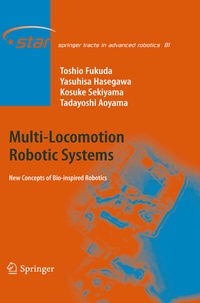
Multi-Locomotion Robotic Systems
New Concepts of Bio-inspired Robotics
Published on 15. June 2012
XIV, 314 pages
978-3-642-30135-3 (ISBN)
Description

Nowadays, multiple attention have been paid on a robot working in the human living environment, such as in the field of medical, welfare, entertainment and so on. Various types of researches are being conducted actively in a variety of fields such as artificial intelligence, cognitive engineering, sensor- technology, interfaces and motion control. In the future, it is expected to realize super high functional human-like robot by integrating technologies in various fields
including these types of researches.
The book represents new developments and advances in the field of bio-inspired robotics research introducing the state of the art, the idea of multi-locomotion robotic system to implement the diversity of animal motion. It covers theoretical and computational aspects of Passive Dynamic Autonomous Control (PDAC), robot motion control, multi legged walking and climbing as well as brachiation focusing concrete robot systems, components and applications. In addition, gorilla type robot systems are described as hardware of Multi-Locomotion Robotic system. It is useful for students and researchers in the field of robotics in general, bio-inspired robots, multi-modal locomotion, legged walking, motion control, and humanoid robots. Furthermore, it is also of interest for lecturers and engineers in practice building systems cooperating with humans.
including these types of researches.
The book represents new developments and advances in the field of bio-inspired robotics research introducing the state of the art, the idea of multi-locomotion robotic system to implement the diversity of animal motion. It covers theoretical and computational aspects of Passive Dynamic Autonomous Control (PDAC), robot motion control, multi legged walking and climbing as well as brachiation focusing concrete robot systems, components and applications. In addition, gorilla type robot systems are described as hardware of Multi-Locomotion Robotic system. It is useful for students and researchers in the field of robotics in general, bio-inspired robots, multi-modal locomotion, legged walking, motion control, and humanoid robots. Furthermore, it is also of interest for lecturers and engineers in practice building systems cooperating with humans.
Reviews / Votes
From the reviews:
"The present book describes robotic locomotion systems, such as multi-legged locomotion, brachiation, hopping, and snake locomotion. . The intended audience for this book consists of control scientists and control engineers as well as graduate and PhD students in the area of robotics and mechatronics." (Clementina Mladenova, Zentralblatt MATH, Vol. 1260, 2013)More details
Other editions
Additional editions
Toshio Fukuda | Yasuhisa Hasegawa | Kosuke Sekiyama
Multi-Locomotion Robotic Systems
New Concepts of Bio-inspired Robotics
Book
06/2012
Springer
€106.99
Shipment within 7-9 days
Content
- Title
- Foreword
- Preface
- Contents
- Introduction
- Robot Locomotion
- Related Works of Robot Locomotion
- Quadruped Locomotion
- Hexapod Locomotion
- Hopping
- Brachiation
- Snake Locomotion
- Biped Locomotion
- Bio-inspired System
- Foundation of Neural Network
- Recurrent Neural Network
- Feed-forward Neural Network
- Cerebellar Model Arithmetic Computer (CMAC)
- Fuzzy Neural Network
- Genetic Algorithms
- Central Pattern Generator
- Multi-Locomotion Robot
- Bio-inspired Robot
- Diversity of Locomotion in Animals
- Multi-Locomotion Robot
- Organization of This Book
- Basics
- Trajectory Generation Method of Robots
- Generation of a Desired Trajectory
- Basic Orbital Function
- Design of Basic Orbital Function Using n-Dimensional Polynomial
- Limit Cycle
- Passive Dynamic Autonomous Control (PDAC)
- Dynamics of PDAC
- Control System
- Advantage of PDAC
- Hardware of Multi-Locomotion Robot
- Brachiation Robot (Conventional Bio-inspired Robot)
- Gorilla Robot (Multi-Locomotion Robot)
- Gorilla Robot I
- Gorilla Robot II
- Gorilla Robot III
- Summary
- Brachiation
- What Is Brachiation?
- Learning Algorithm for a Gorilla Robot Brachiation
- Motion Learning
- Experiment
- Summary of This Section
- Continuous Brachiation Using the Gorilla Robot
- Smooth, Continuous Brachiation
- Controller Design
- Experiment
- Summary of This Section
- Continuous Brachiation on the Irregular Ladder
- Motion Design of the Brachiation
- Locomotion Action
- Swing Action
- Experiment
- Summary of This Section
- Summary
- Quadruped Walking
- Realization of a Crawl Gait
- Motion Design of a Crawl Gait
- Joint Trajectory of the Leg
- Estimation of Walking Energy
- Experiment
- Joint Torque Evaluation of the Gorilla Robot on Slopes as Quadruped Hardware
- Structure of Gorilla Robot III
- Basic Gait Pattern
- Evaluation of Joint Torque in Quadruped Walk on a Slope
- Simulation Analysis
- Experiment
- Summary
- Ladder Climbing Motion
- Model of Ladder Climbing
- Basic Motion Model
- Ladder Climbing Gait
- Body Yawing Momentum
- Error Recognition and Escape Motion
- Experiment
- Transverse Gait
- Pace Gait with Constant Velocity
- Trot Gait with Acceleration
- Summary
- Transition Motion from Ladder Climbing to Brachiation
- Motion Design
- Environment Statement
- Motion Planning
- Transition Motion
- Contact Forces Formulation
- Assumptions and Equilibrium Equations
- Supporting Forces Decomposition
- Brief Summary and Problem Statement
- Load-Allocation Control
- Concept of Load-Allocation Control
- Objective Function and Constraints
- Generation of Optimized Supporting Forces
- Load-Allocation Algorithm
- Eexperiment Results and Discussion
- Validating the Assumptions and Load-Allocation Ability
- Discussion of Failures with Position Control
- Experiment Results with Load-Allocation Control
- Summary
- Locomotion Transition Based on Walking Stabilization Norm Using Bayesian Network
- Introduction
- Sensor System and Locomotion Mode
- Locomotion Stabilization
- Stabilization Based on External Information
- Recognition of Ground
- Stabilization Based on Internal Conditions
- Estimation of Probability
- Consideration of Stability Margin
- Shift of Locomotion Mode
- Experiments
- Experimental Conditions
- Experimental Result
- Summary
- Application of the Passive Dynamic Autonomous Control (PDAC)
- Lateral Motion Control with PDAC
- Lateral Motion and Dynamics
- Control of Lateral Period
- Stabilization
- Experimental Results
- Summary of This Section
- Sagittal Motion Control with PDAC
- Sagittal Motion and Dynamics
- Stabilization
- Sagittal Motion Period
- Quick Convergency Method
- Simulation
- Experiment
- Upper Layer Controller
- Summary of This Section
- Heel-off Walking Control with PDAC
- Sagittal Motion Design
- Converged Dynamics
- Stabilization
- Foot-Contact
- Simulation
- Summary of This Section
- 3-D Biped Walking Based on 3-D Dynamics with PDAC
- Walking Model
- Foot-Contact Model
- Stabilization
- Experiment
- Simulation
- Summary of This Section
- 3-D Biped Walking Adapted to Rough Terrain Environment
- Foot-Contact Model
- Stability Analysis
- Experiment
- Summary of This Section
- Quadruped Walking with PDAC
- Lateral Motion Control
- Design of Pendulum Length
- Sagittal Motion Control
- Estimation of Walking Energy
- Experiment
- Summary of Quadruped Walking Control
- Brachiation with PDAC
- Brachiation Controller with PDAC
- Analysis of the Robot Dynamics
- Experiment
- Summary of Brachiation Control
- Summary
- Conclusion
- Summary
- Future Perspective
- References
