

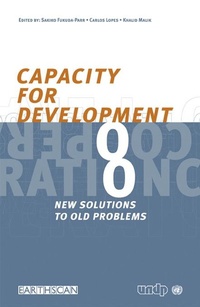
Capacity for Development
New Solutions to Old Problems
1st Edition
Published on 17. June 2013
284 pages
978-1-136-57050-6 (ISBN)
Description

'The United Nations system was a pioneer in the field of technical cooperation, and capacity development is its central mandate. UNDP has long played an important leadership role in both, as a source of technical cooperation funds and advisory services and as the home of innovative intellectual research and analysis on how to make them more efficient and effective. This book [presents] a vision that builds on new possibilities for knowledge-sharing, for which the revolution in information and communications technologies offers ample opportunities... a vision that is firmly founded on genuine ownership by the ultimate beneficiaries of development efforts: the government and citizens of developing countries'
From the Foreword by MARK MALLOCH BROWN, Administrator, UNDP
Capacity for Development brings together innovative and well-supported studies of technical cooperation along with its potential to build sustainable capacities in developing countries, by enhancing the knowledge, skills and productive aptitudes of their populations.
A team of eminent development professionals and economists examine the achievements of technical cooperation and offer recommendations for reform in the context of globalization, democratisation, the information revolution and the growth of capacities in the South. They analyse the issues from three perspectives: ownership, capacity enablers and knowledge. The team show how the complex processes involved can be restructured to produce local involvement and empowerment, set out a normative framework for the input from society, and describe a new paradigm of knowledge for capacity building in the network age.
This book will be essential reading for all development professionals and policy-makers, as well as providing an invaluable research and teaching resource.
From the Foreword by MARK MALLOCH BROWN, Administrator, UNDP
Capacity for Development brings together innovative and well-supported studies of technical cooperation along with its potential to build sustainable capacities in developing countries, by enhancing the knowledge, skills and productive aptitudes of their populations.
A team of eminent development professionals and economists examine the achievements of technical cooperation and offer recommendations for reform in the context of globalization, democratisation, the information revolution and the growth of capacities in the South. They analyse the issues from three perspectives: ownership, capacity enablers and knowledge. The team show how the complex processes involved can be restructured to produce local involvement and empowerment, set out a normative framework for the input from society, and describe a new paradigm of knowledge for capacity building in the network age.
This book will be essential reading for all development professionals and policy-makers, as well as providing an invaluable research and teaching resource.
More details
Language
English
Place of publication
London
United Kingdom
Publishing group
Taylor & Francis Ltd
Target group
College/higher education
Product notice
Reflowable
File size
3,55 MB
ISBN-13
978-1-136-57050-6 (9781136570506)
Copyright in bibliographic data and cover images is held by Nielsen Book Services Limited or by the publishers or by their respective licensors: all rights reserved.
Schweitzer Classification
Other editions
Additional editions
Book
06/2002
1st Edition
Earthscan Ltd
€35.20
Shipment within 3-4 weeks

Carlos Lopes | Khalid Malik | Sakiko Fukuda-Parr
Capacity for Development
New Solutions to Old Problems
Book
03/2002
Earthscan Ltd
€126.28
Article exhausted; check different version
Persons
Sunil Chacko is Executive Director of the Science and Conscience Foundation in Geneva. He conducts science, technology, finance and equity analysis on the medical digitalgenomics, pharmaceutical and biotechnology sectors. He has received a M. D. from Kerala University in India, a masters in public health from Harvard University and an M. B. A. from Columbia University, along with training in information technology and database/software programming.
Stephen Denning was the Program Director, Knowledge management at the World Bank from 1996 to 2000. He now consults with organizations in the United States, Europe and Australia on knowledge management and organizational storytelling.
David Ellerman is an adviser and speechwriter to the Chief Economist of the World Bank, previously Joseph Stiglitz and currently Nicholas Stern. His undergraduate education was in humanities at M.I.T.; he also has two masters degrees in philosophy and economics, and a Ph. D. in mathematics from Boston University.
Sakiko Fukudo-Parr is currently the Director of the Human Development Report Office at the United Nations Development Programme. She is a graduate of Cambridge University, the Fletcher School of Law and Diplomacy, and the University of Sussex.
Ruth Hill is a research student at the Centre for the Study of African Economies, Department of Economics, Oxford University.
Juana Kuramoto is an economist and Associate Researcher at the Group of Analysis for Development (GRADE). She is a Ph. D. candidate in technology and innovation policy at the University of Maastricht, and holds a masters of science in public policy from Carnegie Mellon University.
Sanjaya Lall is Professor of Development Economics at the International Development Centre and a Fellow of Green College at Oxford University. He was educated at Oxford and has been a staff member of the World Bank.
Carlos Lopes has a masters in development economics from the University of Geneva and a Ph. D. in history from the University of Paris1-Pantheon-Sorbonne. He is currently the Acting Director of UNDP's Bureau for Development Policy.
Khalid Malik is Director of the Evaluation Office at the United Nations Development Programme, following his assignment as UN Representative in Uzbekistan. Educated as an economist at the universities of Oxford, Cambridge, Essex and Punjab, he is presently Chair of the UN Interagency Group on Evaluation.
Thandika Mkandawire is the Director of the United Nations Research Institute for Social Development (UNRISD) in Geneva. He studied economics at Ohio State University and the University of Stockholm.
Gustavo Lins Ribeiro is a Professor in the Department of Anthropology at the University of Brasilia. He holds a Ph. D. in anthropology from the City University of New York.
Francisco Sagasti is Director of the AGENDA: Peru programme of activities at FORO Nacional/Internacional. He holds a Ph. D. from the University of Pennsylvania and engineering degrees from the National Engineering University I Lima.
Joseph E. Stiglitz holds joint professorships at Columbia University's Economics Department, School of International and Public Affairs, and Business School. Dr. Stiglitz was awarded the Nobel Prize in Economics in 2001.
Swarnim Wagle is a consultant at the World Bank. Trained as an economist at the L.S.E and Harvard University, his academic interests span issues of growth, international trade, poverty and social relations.
Stephen Denning was the Program Director, Knowledge management at the World Bank from 1996 to 2000. He now consults with organizations in the United States, Europe and Australia on knowledge management and organizational storytelling.
David Ellerman is an adviser and speechwriter to the Chief Economist of the World Bank, previously Joseph Stiglitz and currently Nicholas Stern. His undergraduate education was in humanities at M.I.T.; he also has two masters degrees in philosophy and economics, and a Ph. D. in mathematics from Boston University.
Sakiko Fukudo-Parr is currently the Director of the Human Development Report Office at the United Nations Development Programme. She is a graduate of Cambridge University, the Fletcher School of Law and Diplomacy, and the University of Sussex.
Ruth Hill is a research student at the Centre for the Study of African Economies, Department of Economics, Oxford University.
Juana Kuramoto is an economist and Associate Researcher at the Group of Analysis for Development (GRADE). She is a Ph. D. candidate in technology and innovation policy at the University of Maastricht, and holds a masters of science in public policy from Carnegie Mellon University.
Sanjaya Lall is Professor of Development Economics at the International Development Centre and a Fellow of Green College at Oxford University. He was educated at Oxford and has been a staff member of the World Bank.
Carlos Lopes has a masters in development economics from the University of Geneva and a Ph. D. in history from the University of Paris1-Pantheon-Sorbonne. He is currently the Acting Director of UNDP's Bureau for Development Policy.
Khalid Malik is Director of the Evaluation Office at the United Nations Development Programme, following his assignment as UN Representative in Uzbekistan. Educated as an economist at the universities of Oxford, Cambridge, Essex and Punjab, he is presently Chair of the UN Interagency Group on Evaluation.
Thandika Mkandawire is the Director of the United Nations Research Institute for Social Development (UNRISD) in Geneva. He studied economics at Ohio State University and the University of Stockholm.
Gustavo Lins Ribeiro is a Professor in the Department of Anthropology at the University of Brasilia. He holds a Ph. D. in anthropology from the City University of New York.
Francisco Sagasti is Director of the AGENDA: Peru programme of activities at FORO Nacional/Internacional. He holds a Ph. D. from the University of Pennsylvania and engineering degrees from the National Engineering University I Lima.
Joseph E. Stiglitz holds joint professorships at Columbia University's Economics Department, School of International and Public Affairs, and Business School. Dr. Stiglitz was awarded the Nobel Prize in Economics in 2001.
Swarnim Wagle is a consultant at the World Bank. Trained as an economist at the L.S.E and Harvard University, his academic interests span issues of growth, international trade, poverty and social relations.
Content
Foreword * Editor's Acknowledgements * Overview * Part 1: Capacity and Development - Towards a Normative Framework: Technical Cooperation, Capacities and Development * Autonomy-Respecting Assistance: Towards New Strategies for Capacity-Building and Development Assistance * Technical Cooperation and Institutional Capacity-Building and Development Assistance * Technical Cooperation and Institutional Capacity-Building for Development: Back to the Basics * Civic Engagement and Development: Introducing the Issues * Social Capital and Industrial Transformation * Part 2: Ownership - Should We Mind the Gap? * Incentives, Governance and Capacity Development in Africa * Power, Networks and Ideology in the Field of Development * Part 3: Knowledge - The Network Age: Creating New Models of Technical Cooperation * Integrating Local and Global Knowledge, Technology and Production Systems: Challenges for Technical Cooperation * Technical Cooperation and Knowledge Networks * Developments in Private Sector knowledge-Based Entrepreneurship in the South * Knowledge of Technology and the Technology of Knowledge: New Strategies for Development * About the Authors
