

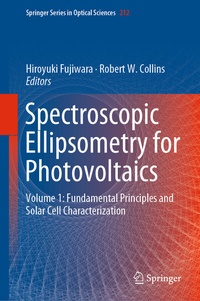
Spectroscopic Ellipsometry for Photovoltaics
Description

This book provides a basic understanding of spectroscopic ellipsometry, with a focus on characterization methods of a broad range of solar cell materials/devices, from traditional solar cell materials (Si, CuInGaSe2, and CdTe) to more advanced emerging materials (Cu2ZnSnSe4, organics, and hybrid perovskites), fulfilling a critical need in the photovoltaic community.
The book describes optical constants of a variety of semiconductor light absorbers, transparent conductive oxides and metals that are vital for the interpretation of solar cell characteristics and device simulations. It is divided into four parts: fundamental principles of ellipsometry; characterization of solar cell materials/structures; ellipsometry applications including optical simulations of solar cell devices and online monitoring of film processing; and the optical constants of solar cell component layers.
More details
Other editions
Additional editions
Persons
Hiroyuki Fujiwara received the Ph.D. degree from Tokyo Institute of Technology. He was a research associate at The Pennsylvania State University. In 1998, he joined Electrotechnical laboratory, Ministry of International Trade and Industry, Japan. Later in 2007, he became a team leader of Research Center for Photovoltaics, National Institute of Advanced Industrial Science and Technology (AIST) in Japan. He is currently a professor in the Department of Electrical, Electronic and Computer Engineering, Gifu University.
Robert W. Collins received the Ph.D. degree from Harvard University. He worked at BP America/Standard Oil Co. In 1992, he became a professor of Physics and Materials Research at The Pennsylvania State University. He is currently a Distinguished University Professor and NEG Endowed Chair of Silicate and Materials Science with the Department of Physics and Astronomy, University of Toledo. He co-directs the Center for Photovoltaics Innovation and Commercialization.
Content
Introduction.- Part I: Fundamental Principles of Ellipsometry.- Measurement Technique of Ellipsometry.- Data Analysis.- Optical Properties of Semiconductors.- Dielectric Function Modeling.- Effect of Roughness on Ellipsometry Analysis.- Part II: Characterization of Materials and Structures.- Ex-situ Analysis of Multijunction Solar Cells Based on Hydrogenated Amorphous Silicon.- Crystalline Silicon Solar Cells.- Amorphous/Crystalline Si Heterojunction Solar Cells.- Optical Properties of Cu(In,Ga)Se 2 .- Real Time and In-Situ Spectroscopic Ellipsometry of Cu y In 1-x Ga x Se 2 for Complex Dielectric Function Determination and Parameterization.- Cu 2 ZnSn(S,Se) 4 and Related Materials.- Real Time and Mapping Spectroscopic Ellipsometry for CdTe Photovoltaics.- High Efficiency III-V Solar Cells.- Organic Solar Cells.- Organic-Inorganic Hybrid Perovskite Solar Cells.- Solar Cells with Photonic and Plasmonic Structures.- Transparent Conductive Oxide Materials.- High-Mobility Transparent Conductive Oxide Layers.
