

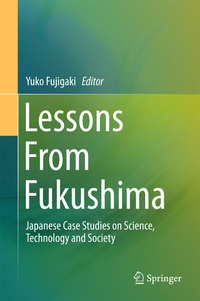
Lessons From Fukushima
Description

This book is about the consequences of the Fukushima disaster in light of their technological, societal, political, cultural and environmental origins. The magnitude of the nuclear accident is investigated in this book in the contexts of politics, economy, and society. The authors scrutinize the relationships between science, technology and society leading to this accident. Further, the authors reveal how these relationships were constructed historically.
This book provides a case analysis on the Fukushima disaster in political, societal, economic and cultural dimensions. In addition, analyses for historically grown relationships between different societal spheres mouthing into disasters are presented using examples of the Minamata disease (Mercury pollution), Itai-Itai Disease (Cadmium pollution), BSE, and GMOs.
With this book, Yuko Fujigaki achieves to connect local and cultural peculiarities with generalized scientific information and practices in a coherent, logical fashion to a comprehensive volume on a very actual topic of global significance. In light of a globally increasing energy gap, this book has a distinct global relevance, providing an honest account on different triggers mouthing into the nuclear disaster. This book not only gives a scientific account. It also can also contribute to prevent future disasters starting from similar vectors.
More details
Other editions
Additional editions
Content
1 Introduction.- Part I: Lessons from Fukushima.- 2 The Processes Through Which Nuclear Power Plants Are Embedded in Political, Economic, and Social Contexts in Japan.- 3 Agenda Building Intervention of Socio-Scientific Issues: A Science Media Centre of Japan Perspective.- 4 Rhetorical Marginalization of Science and Democracy: Politics in Risk Discourse on Radioactive Risks in Japan.- 5 Public Participation in Decision-making on Energy Policy: The Case of the "National Discussion" after the Fukushima Accident.- Part II: Historical Construction of Science, Technology and Society Relationship.- 6 Minamata Disease: Interaction between Government, Scientists, and Media.- 7 Itai-itai Disease: Lessons for the Way to Environmental Regeneration.- 8 The Monju Trial: Nuclear Controversy in Japan.- 9 AIDS Patients due to Transfusion of HIV Infected, Non-heat-treated Blood Products.- 10 Winny Criminal Case: How Have Controversial Science, Technology, and Society Problems Been Solved While Avoiding Conflicts?.
