

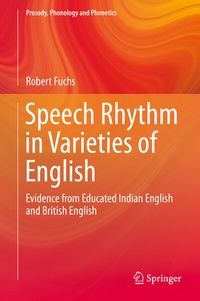
Speech Rhythm in Varieties of English
Evidence from Educated Indian English and British English
Published on 25. September 2015
XVII, 226 pages
978-3-662-47818-9 (ISBN)
Description

This book addresses the question whether Educated Indian English is more syllable-timed than British English from two standpoints: production and perception. Many post-colonial varieties of English, which are mostly spoken as a second language in countries such as India, Nigeria and the Philippines, are thought to have a syllable-timed rhythm, whereas first language varieties such as British English are characterized as being stress-timed. While previous studies mostly relied on a single acoustic correlate of speech rhythm, usually duration, the author proposes a multidimensional approach to the production of speech rhythm that takes into account various acoustic correlates. The results reveal that the two varieties differ with regard to a number of dimensions, such as duration, sonority, intensity, loudness, pitch and glottal stop insertion. The second part of the study addresses the question whether the difference in speech rhythm between Indian and British English is perceptually relevant, based on intelligibility and dialect discrimination experiments. The results reveal that speakers generally find the rhythm of their own variety more intelligible and that listeners can identify which variety a speaker is using on the basis of differences in speech rhythm.
More details
Series
Edition
1st ed. 2016
Language
English
Place of publication
Berlin
Germany
Publishing group
Springer Berlin
Target group
Professional and scholarly
Product notice
Reflowable
Illustrations
XVII, 226 p. 37 illus., 24 illus. in color.
File size
3,90 MB
ISBN-13
978-3-662-47818-9 (9783662478189)
DOI
10.1007/978-3-662-47818-9
Schweitzer Classification
Other editions
Additional editions
Robert Fuchs
Speech Rhythm in Varieties of English
Evidence from Educated Indian English and British English
Book
10/2015
Springer
€53.49
Shipment within 7-9 days
Content
- Intro
- Preface
- References
- Contents
- Abbreviations
- Abbreviations of Rhythm Metrics (Details on pp. 39-41 and 78-79)
- 1 Introduction: Why a Study on the Speech Rhythm of Indian English and British English Is Necessary
- References
- 2 The Historical and Social Context of Indian English
- 2.1 Use of English in India
- 2.1.1 Development and Classification of Indian English
- 2.1.2 The Linguistic Landscape of India
- 2.1.3 Number of Speakers and Sociolinguistic Varieties of Indian English
- 2.2 The Phonetics and Phonology of Indian English
- 2.2.1 Segmental Characteristics
- 2.2.1.1 Vowels
- 2.2.1.2 Consonants
- 2.2.2 Suprasegmental Characteristics
- 2.2.2.1 Intonation
- 2.2.2.2 Speech Rhythm
- References
- 3 The Concept and Measurement of Speech Rhythm
- 3.1 Approaches to Speech Rhythm
- 3.2 Speech Rhythm Metrics Based on Duration
- 3.3 Robustness and Normalisation: Which Metric Is More Reliable?
- 3.4 Remaining Theoretical and Empirical Problems
- 3.4.1 An Empirical Problem
- 3.4.2 Lack of Theoretical Grounding and Testing of Hypotheses
- 3.4.3 Perceptual Grounding
- 3.4.4 Other Criticisms
- 3.5 Rhythm Metrics Based on Acoustic Correlates Other than Duration
- 3.5.1 Intensity
- 3.5.2 Loudness
- 3.5.3 Fundamental Frequency (f0)
- 3.5.4 Sonority
- 3.5.5 Summary
- 3.6 Conclusions
- References
- 4 Speech Rhythm in Varieties of English
- 4.1 Degrees of Syllable and Stress Timing in Varieties of English
- 4.2 Hypotheses for the Study of Indian English Speech Rhythm
- References
- 5 Data and Methods
- 5.1 Description of the Material and Tasks
- 5.2 Recording Procedure
- 5.3 Sociological Profile of the Speakers
- 5.4 Annotation of the Data
- 5.5 Calculation of the Rhythm Metrics
- 5.6 Statistical Analysis
- References
- 6 Speech Rhythm in Indian English and British English
- 6.1 Vocalic and Consonantal Durations
- 6.1.1 Results
- 6.1.2 Discussion
- 6.2 Syllable Durations
- 6.2.1 Results
- 6.2.1.1 Syllabification Across Word Boundaries
- 6.2.1.2 Syllabification Within Word Boundaries
- 6.2.1.3 Automatic Syllabification
- 6.2.2 Discussion
- 6.3 Sonority
- 6.3.1 Automatic
- 6.3.2 Duration Based
- 6.3.3 Discussion
- 6.4 Voicing
- 6.4.1 Results
- 6.4.2 Discussion
- 6.5 Fundamental Frequency
- 6.5.1 Results
- 6.5.2 Discussion
- 6.6 Intensity
- 6.6.1 Results
- 6.6.2 Discussion
- 6.7 Loudness
- 6.7.1 Results
- 6.7.2 Discussion
- 6.8 Speech Rate
- 6.8.1 Results
- 6.8.2 Discussion
- 6.9 Word-Initial Glottal Stop Insertion Before Vowels
- 6.9.1 Results
- 6.9.2 Discussion
- 6.10 Discussion
- References
- 7 The Perception of Speech Rhythm in Indian English and British English
- 7.1 Mixing and Suppressing Acoustic Cues with Resynthesis
- 7.2 Accent Discrimination
- 7.2.1 Previous Research
- 7.2.2 Pilot Study
- 7.2.2.1 Hypotheses
- 7.2.2.2 Stimuli and Methods
- 7.2.2.3 Results
- 7.2.2.4 Discussion
- 7.2.3 Main Study
- 7.2.3.1 Hypotheses
- 7.2.3.2 Results
- 7.2.3.3 Discussion
- 7.3 Attending to One of Two Simultaneous Talkers (`Cocktail Party Effect')
- 7.3.1 Previous Research
- 7.3.2 Pilot Study
- 7.3.2.1 Hypotheses
- 7.3.2.2 Methods
- 7.3.2.3 Results
- 7.3.2.4 Discussion
- 7.3.3 Main Study
- 7.3.3.1 Hypotheses
- 7.3.3.2 Methods
- 7.3.3.3 Results
- 7.3.3.4 Discussion
- References
- 8 Conclusion and Outlook
- 8.1 Summary of Results
- 8.2 The Phonology of Indian English
- 8.3 The Future Development of Indian English
- 8.4 Significance for Research on the Phonology of Varieties of English
- 8.5 Implications for Future Research on Indian English Phonology
- 8.6 Implications for Research on the Phonology of Varieties of English
- References
- Appendix
- Index
