

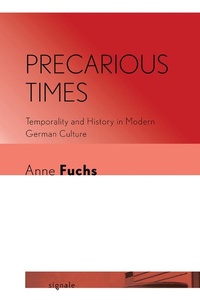
Precarious Times
Temporality and History in Modern German Culture
Published on 1. October 2019
342 pages
978-1-5017-3482-3 (ISBN)
Description

In Precarious Times, Anne Fuchs explores how works of German literature, film, and photography reflect on the profound temporal anxieties precipitated by contemporary experiences of atomization, displacement, and fragmentation that bring about a loss of history and of time itself and that is peculiar to our current moment.
The digital age places premiums on just-in-time deliveries, continual innovation, instantaneous connectivity, and around-the-clock availability. While some celebrate this 24/7 culture, others see it as profoundly destructive to the natural rhythm of day and night-and to human happiness. Have we entered an era of a perpetual present that depletes the future and erodes our grasp of the past?
Beginning its examination around 1900, when rapid modernization was accompanied by comparably intense reflection on changing temporal experience, Precarious Times provides historical depth and perspective to current debates on the "digital now." Expanding the modern discourse on time and speed, Fuchs deploys such concepts as attention, slowness and lateness to emphasize the uneven quality of time around the world.
The digital age places premiums on just-in-time deliveries, continual innovation, instantaneous connectivity, and around-the-clock availability. While some celebrate this 24/7 culture, others see it as profoundly destructive to the natural rhythm of day and night-and to human happiness. Have we entered an era of a perpetual present that depletes the future and erodes our grasp of the past?
Beginning its examination around 1900, when rapid modernization was accompanied by comparably intense reflection on changing temporal experience, Precarious Times provides historical depth and perspective to current debates on the "digital now." Expanding the modern discourse on time and speed, Fuchs deploys such concepts as attention, slowness and lateness to emphasize the uneven quality of time around the world.
Reviews / Votes
Fuchs first documents the effect of speed on society and looks at how the rapid pace of change suppresses the past and clouds the future...In the final chapters, she rightly recognizes that in the last 30 years the most profound effect on German culture was the "overnight" fall of the Berlin Wall. Fuchs's treatment of German unification is the book's most important contribution. -- R.C. Conard, University of Dayton * Choice * Masterfully achieved, this work instills in the reader the contingent precarity of existing in the present. Reading it, one is transported to a time before the global pandemic when the issue emanated more of a theoretical than literal nature. Located on the other side of the tipping point, scholars from cultural, media, and literary studies, along with their general reader counterparts, encounter the uncanniness and become flaneurs of the past. * Studies in Twentieth- and Twenty-First Century Literature * Fuchs's study engages with a magnificent range of theoretical and cultural engagements with time to explore fundamental questions raised by the temporal shifts of the twenty-first century. The book stands out for its far-reaching and careful exploration of a diverse range of theory and art[.] * Modern Language Review * In this extraordinary and timely book, Anne Fuchs examines the contingent precarity of living in the present, offering a clear and comprehensive analysis that interrupts prevalent deterministic interpretations of modern temporality. Fuchs delivers a rigorous, extensive, and elaborate re-examination of the modern discourse on time that includes works of literature, film, and photograpy. * Monatshefte * Anne Fuchs brilliant analysis shifts between careful close readings of texts and images and insightful linkages to key thinkers. The result is a highly readable and fiercely intelligent book. * Seminar: A Journal of Germanic Studies * Anne Fuchs provides a meticulous account of existential temporality in her study of post-modern pictorial and text artists, utilising sensitive readings of a wide range of literary works, films and photography reflecting on the profound cultural anxieties precipitated by experiences of atomisation, displacement and fragmentation which, she argues, 'brings about a loss of history and of time itself. * Journal of Contemporary European Studies * Stuck in an expanding present, we paradoxically seem never to manage to fit everything in. While this might feel particular to our current moment, there is a longer history of precarious times, which Anne Fuchs revealingly traces in a German cultural context. Her book offers a broad perspective on current debates in our digitalised present with added historical depth. Analysing works of fiction, photography and film from the modernist period to now, Fuchs shows how their subjective experiences of time overturn the imperative to be always connected. * Journal of Contemporary European Studies *More details
Series
Language
English
Place of publication
Ithaca
United States
Publishing group
Cornell University Press
Illustrations
1 Halftones, color; 9 Halftones, black and white
ISBN-13
978-1-5017-3482-3 (9781501734823)
Copyright in bibliographic data and cover images is held by Nielsen Book Services Limited or by the publishers or by their respective licensors: all rights reserved.
Schweitzer Classification
Other editions
Additional editions
Book
10/2019
Cornell University Press and Cornell University Library
€53.41
Shipment within 15-20 days
Person
Anne Fuchs is Professor and Director of the University College Dublin Humanities Institute. She is author of After the Dresden Bombing, Phantoms of War in Contemporary German Literature, Films and Discourse, and Die Schmerzensspuren der Geschichte. Follow her on X, @AnneFuchsUCD.
Content
List of Illustrations
Acknowledgments
List of Abbreviations
Introduction
1. Theoretical Perspectives: Temporal Anxieties in the Digital Age
Timeless Time
Acceleration
Resonance
Atomization
Immediacy
The Extended Present
Time-Space Compression
Network Time
Precarious Times
2. Historical Perspectives: Modernism and Speed Politics
Temporality and the Modern Imagination
Two Visions of Late Culture: Friedrich Nietzsche and Thomas Mann
Attention, Distraction, and the Modern Conditions of Perception: Georg Simmel and Franz Kafka
Modern Man and the Trouble with Time: Franz Kafka's Der Process
Speed Politics in Robert Walser's Short Prose
From Lateness to Latency: Sigmund Freud
Conclusion
3. Contemporary Perspectives: Precarious Time(s) in Photography and Film
Slow Art
The Disruption of Linear Time: Michael Wesely's Time Photography
The Disruption of Historical Time: Ulrich Wuest's Photobook Spaeter Sommer/Letzter Herbst
In the Acoustic Space of the GDR: Christian Petzold's Barbara
The Longing for Transcendence: Ulrich Seidl's Paradies: Glaube
Disruptive Performances: Maren Ade's Toni Erdmann
Conclusion
4. Narrating Precariousness
Dis/connectedness in Contemporary German Literature
Acceleration and Point Time: Clemens Meyer's Als wir traeumten
Empty Time and the Extended Present: Julia Schoch's Mit der Geschwindigkeit des Sommers and Karen Duve's Taxi
The Cult of Immediacy and the Search for Resonance: Wilhelm Genazino's Das Glueck in gluecksfernen Zeiten
The Search for Transcendence: Arnold Stadler's Sehnsucht: Versuch ueber das erste Mal and Salvatore
Precarious Times, Precarious Lives: Jenny Erpenbeck's Gehen, ging, gegangen
Conclusion
Epilogue: Presentist Dystopias or the Case for Environmental Humanities
Bibliography
Index
Acknowledgments
List of Abbreviations
Introduction
1. Theoretical Perspectives: Temporal Anxieties in the Digital Age
Timeless Time
Acceleration
Resonance
Atomization
Immediacy
The Extended Present
Time-Space Compression
Network Time
Precarious Times
2. Historical Perspectives: Modernism and Speed Politics
Temporality and the Modern Imagination
Two Visions of Late Culture: Friedrich Nietzsche and Thomas Mann
Attention, Distraction, and the Modern Conditions of Perception: Georg Simmel and Franz Kafka
Modern Man and the Trouble with Time: Franz Kafka's Der Process
Speed Politics in Robert Walser's Short Prose
From Lateness to Latency: Sigmund Freud
Conclusion
3. Contemporary Perspectives: Precarious Time(s) in Photography and Film
Slow Art
The Disruption of Linear Time: Michael Wesely's Time Photography
The Disruption of Historical Time: Ulrich Wuest's Photobook Spaeter Sommer/Letzter Herbst
In the Acoustic Space of the GDR: Christian Petzold's Barbara
The Longing for Transcendence: Ulrich Seidl's Paradies: Glaube
Disruptive Performances: Maren Ade's Toni Erdmann
Conclusion
4. Narrating Precariousness
Dis/connectedness in Contemporary German Literature
Acceleration and Point Time: Clemens Meyer's Als wir traeumten
Empty Time and the Extended Present: Julia Schoch's Mit der Geschwindigkeit des Sommers and Karen Duve's Taxi
The Cult of Immediacy and the Search for Resonance: Wilhelm Genazino's Das Glueck in gluecksfernen Zeiten
The Search for Transcendence: Arnold Stadler's Sehnsucht: Versuch ueber das erste Mal and Salvatore
Precarious Times, Precarious Lives: Jenny Erpenbeck's Gehen, ging, gegangen
Conclusion
Epilogue: Presentist Dystopias or the Case for Environmental Humanities
Bibliography
Index
