

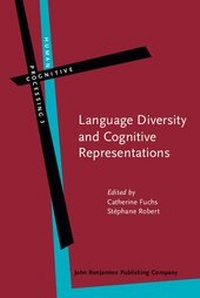
Language Diversity and Cognitive Representations
1st Edition
Published on 15. November 1999
X, 229 pages
978-90-272-8450-1 (ISBN)
Description

Significant new developments in brain activity research have revived the debate on the universality of language and its neural basis. Within this debate, the question of language diversity and its implications for cognition remains central and controversial. It is here investigated in an original multimodal approach, covering various aspects of cross-linguistic variation, differences between spoken, signed and drum languages, between normal speech and pathological speech, and also between language and music, as revealed in electric brain activity associated with language processing. The various contributions (linguistic, anthropological, psychological and neurophysical) on the nature and status of variation and invariants in language provides evidence for complex interactions between language-specific processes and general cognitive faculties. This overview of some recent trends in cognitive linguistics opens up a promising new research area in the humanities as well as in the cognitive sciences.
More details
Other editions
Additional editions
Catherine Fuchs | Stephane Robert
Language Diversity and Cognitive Representations
Book
11/1999
John Benjamins Publishing Co
€111.30
Shipment within 10-15 days
Persons
Content
- Language Diversity and Cognitive Representations
- Editorial page
- Title page
- Copyright page
- Table of contents
- Introduction
- Part I. Semantic variationsand invariance: Cognitive issues
- Diversity in Linguistic Representations A Challenge for Cognition
- 1. Language and languages: Unity and diversity
- 2. Variation and invariance
- Conclusion
- Notes
- References
- Cognitive Invariants and Linguistic Variability From Units to Utterance
- Introduction
- 1. Variability of representations at the level of the meaningful units
- 2. From units to utterance: The dynamics of meaning
- 3. The utterance: Formal sequencing and non-linear semantic effects
- Conclusion
- References
- Subjectivity, Invariance, and the Development of Forms in the Construction of Linguistic Representations
- Introduction
- 1. Markers, invariant elements, and representations: The example of Vietnamese phài
- 2. Differentiation of meaning, or chance and necessity in the construction of representations: The example of (ga-)motan
- 3. Aspects of the notion of 'representational construct': The example of French tôt
- 4. Representations as complex constructs: On German vielleicht and diverse equivalents
- Conclusion
- Notes
- References
- Language Evolution and Semantic Representations A Case Study of the Evolutionfrom "Subjectivity" to "Objectivity"in French
- 1. Historical linguistics: Questions about linguistic change
- 2. A case of morphological reorganization: The evolution of demonstratives in French
- 3. The extension to two other cases, and conclusion
- Notes
- References
- Part II. Conceptualization andrepresentations of spaceacross languages
- Spatial Orientationin some Austronesian Languages
- Introduction
- 1. Absolute and relative spatial orientation
- 2. Directional systems in Western Austronesian
- 3. Directional systems in the Oceanic Area
- Conclusion
- Notes
- References
- Language Space and Sociolect Cognitive Correlates of Gendered Speech in Mopan Maya
- Introduction
- 1. Cross-linguistic variation in the encoding of spatial information
- 2. Universal strategies: Figure and Ground only
- 3. Mopan speakers and the picture description task
- 4. The Mirror Image task
- 5. Discussion of gender
- 6. Gender and spatial language in Mopan
- 7. Discussion and conclusion
- Appendix
- Notes
- References
- Localization and Predication Ancient Greek and various other Languages
- Introduction
- 1. The continuum of preposition-adverbs in Ancient Greek
- 2. The continuum of the development of local expressions
- 3. Continua of local relations across languages
- 4. Localization and predication - centralized and decentralized
- Conclusion
- Epilog
- Appendix
- Notes
- References
- The Expression of Spatial Relations and the Spatialization of Semantic Relations in French Sign Language
- Introduction
- 1. The process of ¡conization for deaf individuals
- 2. Iconic intent and great iconicity
- 3. The construction of reference exclusive of iconic intent
- 4. Iconicity and language as systems of differentiation
- 5. Sign languages as cognitive languages
- Acknowledgment
- References
- Part III. Language activity: From linguisticto cognitive processes
- From Natural Language to Drum Language An Economical Encoding Procedure in Banda-Linda (Central African Republic)
- Introduction
- 1. The principles of encoding
- 2. How decoding takes place
- 3. Recovery of the message as a cognitive process
- Conclusion
- Notes
- References
- Electrical Signs of Language in the Brain
- Introduction
- 1. The brain's electrical activity
- 2. What can we learn from ERPs?
- Conclusion
- Acknowledgments
- References
- Linguistic Variations and Cognitive Constraints in the Processing and the Acquisition of Language
- Introduction
- 1. Off-line principles of sentence processing
- 2. On-line principles of sentence processing
- 3. Final remarks
- References
- Universal vs Language-Specific Constraints in Agrammatic Aphasia Is comparatism back?
- Introduction
- 1. Agrammatism: From the description of symptoms to their interpretation
- 2. The case for a cross-linguistic description and interpretation of agrammatic symptoms
- 3. What kind of deficit?
- 4. By way of a conclusion...
- Notes
- References
- Schizophasia and Cognitive Dysfunction
- Introduction
- 1. Indeterminacy of meaning in schizophrenic speech
- 2. Examples of schizophrenic discourse breaks
- 3. A cognitive hypothesis for a motor control disorder in schizophrenia
- Conclusion
- References
- Index
- Subject index
- Author index
- Language index
