

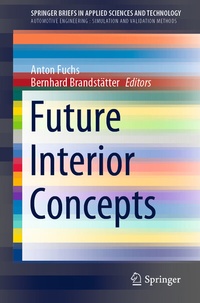
Future Interior Concepts
Description

In this book, the authors highlight multiple aspects of and views on comprehensive automotive interior comfort for future mobility. In this context, passenger comfort comprises thermal, acoustic, seat perception, as well as human-machine interaction in the passenger cabin.
In five chapters, the contributing authors, hailing from universities, research centers and industry, share their expertise and insights. They take a closer look at future interior concepts from the standpoints of fundamental and applied research, as well as practical aspects.
More details
Other editions
Additional editions
Persons
Anton Fuchs studied Telematics in Graz, Austria. He received his doctoral degree in Electrical Engineering and his venia docendi from Graz University of Technology in 2006 and 2009, respectively. In 2008, he joined VIRTUAL VEHICLE Research Center, where he heads the "NVH and Information Systems" department and coordinates the center's "Strategic Area - Disruptive Digitalization". His current research focus is on sensors for transportation applications. He is author or co-author of more than 100 scientific papers and 12 granted patents in the field of electrical measurement science.
Bernhard Brandstätter studied Electrical Engineering in Graz, Austria, and Genoa, Italy. He received his Ph.D. in Electrical Engineering and his venia docendi from Graz University of Technology in 1999 and 2003, respectively. From 2002 to 2005, he was engaged in a major Austrian research project on automotive measurement. From 2005 to 2014, he served as Research Coordinator andCTO of ELIN Motoren GmbH. In 2014, he joined VIRTUAL VEHICLE Research Center, heading the "Energy Management and Human Centric Systems" department as well as the business unit "Efficiency and Comfort" and acquiring and coordinating several European projects. He is the author or co-author of more than 100 scientific papers in the fields of optimization, field numerics, electrical machines and inverse problems.
Content
Chapter 1 - Seat-Human Interaction and Perception: a Multi-Factorial-Problem (Maximilian Wegner, Christian Reuter, Florian Fitzen, Shabila Anjani and Peter Vink).- Chapter 2 - Vibro-Acoustic Metamaterials for Improved Interior NVH Performance in Vehicles (Lucas Van Belle, Luca Sangiuliano, Noé Geraldo Rocha de Melo Filho, Matias Clasing Villanueva, Régis Boukadia, Sepide Ahsani, Felipe Alves Pires, Ze Zhang, Claus Claeys, Elke Deckers, Bert Pluymers and Wim Desmet).- Chapter 3 - Active Sound Control in the Automotive Interior (Jordan Cheer).- Chapter 4 - Motivating Drivers to Drive Energy Efficient (Sandra Trösterer, Peter Mörtl).- Chapter 5 - Energy Efficient & Comfortable Cabin Heating (Alois Steiner, Alexander Rauch, Jon Larrañaga, Mikel Izquierdo, Walter Ferraris, Andrea Alessandro Piovano, Tibor Gyoeroeg, Werner Hünemörder, Damian Backes, Marten Trenktrog).
