

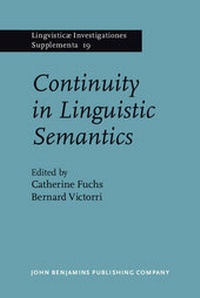
Continuity in Linguistic Semantics
1st Edition
Published on 17. November 1994
IV, 255 pages
978-90-272-7666-7 (ISBN)
Description

Until recently, most linguistic theories as well as theories of cognition have avoided use of the notion of continuity. At the moment, however, several linguistic trends, sharing a preoccupation with semantico-cognitive problems (e.g. cognitive grammars, 'psychomechanics', 'enunciative theories'), are trying to go beyond the constraints imposed by discrete approaches. At the same time, mathematical (e.g. differential geometry and dynamical systems) and computer science tools (e.g. connectionism) have been proposed that can be used for modelling of continuous linguistic phenomena.
In this volume, linguists, philosophers, mathematicians and computer scientists discuss which semantic phenomena (linked to the lexicon, to grammatical theories or to syntactic structures) call for continuous models and which formalisation tools can contribute to the development of such models. The first part of the book is devoted to linguistic issues, the second part deals with modelling issues.
Many important questions are raised in the discussion, for instance: Is continuity just a convenient representation of gradual yet discrete facts, or is it an intrinsic characteristic of semantic phenomena? How can the introduction of continuity be reconciled with a methodology based on the falsifiability of theories? What is the link between continuity and Gestalt theory? Can linguistic continuity be accounted for by mathematical models? What about statistical models? How can continuity be implemented on a digital and therefore discrete machine?
In this volume, linguists, philosophers, mathematicians and computer scientists discuss which semantic phenomena (linked to the lexicon, to grammatical theories or to syntactic structures) call for continuous models and which formalisation tools can contribute to the development of such models. The first part of the book is devoted to linguistic issues, the second part deals with modelling issues.
Many important questions are raised in the discussion, for instance: Is continuity just a convenient representation of gradual yet discrete facts, or is it an intrinsic characteristic of semantic phenomena? How can the introduction of continuity be reconciled with a methodology based on the falsifiability of theories? What is the link between continuity and Gestalt theory? Can linguistic continuity be accounted for by mathematical models? What about statistical models? How can continuity be implemented on a digital and therefore discrete machine?
More details
Other editions
Additional editions
Catherine Fuchs | Bernard Victorri
Continuity in Linguistic Semantics
Book
11/1994
John Benjamins Publishing Co
€116.60
Shipment within 10-15 days
Content
- CONTINUITY IN LINGUISTIC SEMANTICS
- Editorial page
- Title page
- Copyright page
- Table of contents
- PREFACE
- PART I. LINGUISTIC ISSUES
- THE LIMITS OF CONTINUITY : DISCRETENESS IN COGNITIVE SEMANTICS
- REFERENCES
- CONTINUITY AND MODALITY
- Introduction
- 1. The choice of a theoretical framework and an attempt at a definition of continuity
- 2. The example of pouvoir
- 3. Manifestations of continuity in other types of examples
- REFERENCES
- CONTINUUM IN COGNITION AND CONTINUUM IN LANGUAGE
- 1. Introduction
- 2. Theses about the continuum
- 3. The cognitive-conceptual dimension of Participation
- 4. Linguistic coding and typology
- 5. Concluding remarks
- REFERENCES
- IS THERE CONTINUITY IN SYNTAX ?
- 0. Introduction
- 1. Discreteness : a point of transition between two continuities
- 2. The degree of discreteness in linguistic coding
- 3. Are units totally discrete ?
- 4. Problems of grammatical categorization
- 5. The example of Fr. que
- REFERENCES
- THE USE OF COMPUTER CORPORAIN THE TEXTUAL DEMONSTRABILITY OF GRADIENCE IN LINGUISTIC CATEGORIES
- 1. Introduction
- 2. An Example of Gradience : the English Genitive and of-Constructions
- 3. Technique of Analysis
- 4. Step-by-step Methodology
- 5. Statistical Modelling
- 6. Conclusions Drawn from the Analysis
- 7. General Conclusion
- REFERENCES
- A "CONTINUOUS DEFINITION" OF POLYSEMOUS ITEMS : ITS BASIS, RESOURCES AND LIMITS
- 1. How to build a "continuous
- definition
- 2. Basis, resources and limits of a "continuous definition
- 2.1. Basis
- 2.2. Resources
- 2.3. Limits
- 2.4. Specificity
- REFERENCES
- THE CHALLENGES OF CONTINUITY FOR A LINGUISTIC APPROACH TO SEMANTICS
- 0. Introduction
- 1. The linguistic phenomena
- 2. Underlying problematics
- 3. Arguments : the example of polysemy
- REFERENCES
- PART II. MODELLING ISSUES
- WHAT KIND OF MODELS DO WE NEED FOR THE SIMULATION OF UNDERSTANDING ?
- 1. The Framework
- 2. Against Arguments of Necessity
- 3 . Continuity versus Multiplicity
- 4. About criteria
- 5. Advantages of (a multiplicity of) Discrete Models over Continuous Models
- a) Labelling facts and Meta-Reasoning
- b) Qualitative Physics
- c) Vagueness
- d) Thresholds and Trade-offs
- e) Consistency
- 6. Conclusion
- REFERENCES
- CONTINUUM, COGNITION AND LINGUISTICS
- 1. Various legitimacies of continuum related to linguistics
- 1.1. The perception input
- 1.2. Cognitive dynamism
- 1.3. A continuum of meaning ?
- 2. Cognitive space and transcendental space
- 2.1. The position of the problem
- 2.2. The cognitive point of view : Talmy and Poincaré
- 2.3. Confrontation between cognitive-linguistic space and transcen-dental/geometrical space
- 3. Conclusion : the dispute of continuum
- REFERENCES
- REFLECTIONS ON HANSJAKOB SEILER'S CONTINUUM
- 1. The opposition Continuous-Discrete : Generalities
- 2. The Discrete in the continuous
- 3. The notion of genus and the couple Genus-Species
- 4. Archeology of Seiler's continuum
- 5. Seiler's continuum and the theory of C.S. Peirce
- REFERENCES
- ATTRACTOR SYNTAX : MORPHODYNAMICS AND COGNITIVE GRAMMAR
- Introduction
- 1. The problem of syntactic constituency as a challenge for con-nectionist modeling
- 1.1. The main arguments of Fodor and Pylyshyn
- 1.2. Smolensky's tensorial product
- 1.3. The core of the debate : the need of a configurational definition of the roles
- 2. From syntactic constituency to cognitive archetypes
- 3. From cognitive image-schemas to perceptive constituency
- 4. Contour propagation and the cut locus theory
- REFERENCES
- A DISCRETE APPROACH BASED ON LOGIC SIMULATING CONTINUITY IN LEXICAL SEMANTICS
- 1. Polysemous lexical elements : words that tamper with the stability of concepts
- 1.1. An undecidability in the type of relationship between concepts and polysemous words
- 1.2. Are polysemous words modifiers of the essence of concepts ?
- 2. How a discrete approach could still manage to give the impression of continuity
- 2.1. Continuity as a decomposition into fine-grained particles
- 2.1.1. Example of a componential representation of continuity
- 2.1.2. Continuity in the depth of interpretation
- 2.2. The requirements for a discrete computational approach to polysemy
- 2.3. The EDGAR1 model : a possible solution considering constraints and goals
- 2.3.1. Formalization of the lexical model
- 2.3.2. Formalization of the interpretation function
- 2.4. Possibilities and Limits of the EDGAR model
- REFERENCES
- COARSE CODING AND THE LEXICON
- Coarse Coding
- Coarse Coding and Locating Visual Features
- Coarse Coding and the Lexicon
- Limits to Linguistic Compositionality
- Is the word the building block ?
- Words' contextual stickiness
- Why don't words with many meanings, or one abstract meaning, pose a comprehension burden ?
- Computational realization
- An Illustrative Model
- Construction of corpus and training
- Network behavior
- Assessment of the implementation of prepositional polysemy
- Processing Factors
- Closing Remarks, Related Approaches
- REFERENCES
- CONTINUITY, POLYSEMY, AND REPRESENTATION : UNDERSTANDING THE VERB CUT
- Introduction
- 1. The Verb cut
- 2. Inference in Localist Networks
- 3. Continuity and Distributed Networks
- 4 . The Holy Grail
- REFERENCES
- THE USE OF CONTINUITY IN MODELLING SEMANTIC PHENOMENA
- Introduction
- 1. Linguistic issues
- 1.1. Categorisation
- 1.2. Compositionality
- 1.3. Representation of meaning
- 2. Mathematical definitions
- 2.1. Continuity versus discontinuity
- 2.2. Discreteness
- 2.3. Continuum
- 3. Modelling considerations
- 3.1 Qualitative modelling
- 3.2 Dynamical systems
- 3.3 General framework
- 4. Computer tools
- 4.1. Continuity on a digital computer
- 4.2. Connectionism
- 4.3. Current limits of connectionism
- REFERENCES
- INDEX
