

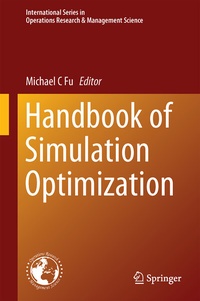
Handbook of Simulation Optimization
Description

The Handbook of Simulation Optimization presents an overview of the state of the art of simulation optimization, providing a survey of the most well-established approaches for optimizing stochastic simulation models and a sampling of recent research advances in theory and methodology. Leading contributors cover such topics as discrete optimization via simulation, ranking and selection, efficient simulation budget allocation, random search methods, response surface methodology, stochastic gradient estimation, stochastic approximation, sample average approximation, stochastic constraints, variance reduction techniques, model-based stochastic search methods and Markov decision processes.
This single volume should serve as a reference for those already in the field and as a means for those new to the field for understanding and applying the main approaches. The intended audience includes researchers, practitioners and graduate students in the business/engineering fields of operations research, management science, operations management and stochastic control, as well as in economics/finance and computer science.
More details
Other editions
Additional editions
Person
Dr. Michael C. Fu received his Ph.D. in applied mathematics from Harvard University and master's and bachelor's degrees in EECS and mathematics from MIT. Since 1989, he has been at the University of Maryland in the Robert H. Smith School of Business, where he is currently Ralph J. Tyser Professor of Management Science, with a joint appointment in the Institute for Systems Research (ISR) and an affiliate appointment in the Electrical and Computer Engineering Department, A. James Clark School of Engineering. At the University of Maryland, he was named a Distinguished Scholar-Teacher and received the ISR's Outstanding Systems Engineering Faculty Award and the Business School's Allen J. Krowe Award for Teaching Excellence. He served as the Stochastic Models and Simulation Department Editor of Management Science from 2006-2008, as Simulation Area Editor of Operations Research from 2000-2005 and on the Editorial Boards of the INFORMS Journal on Computing , Mathematics of Operations Research , Production and Operations Management and IIE Transactions . He served as Program Chair of the 2011 Winter Simulation Conference and as Operations Research Program Director at the National Science Foundation from 2010-2012. His co-authored book, Conditional Monte Carlo: Gradient Estimation and Optimization Applications received the INFORMS College on Simulation Outstanding Publication Award. He also co-authored the research monograph Simulation-based Algorithms for Markov Decision Processes and co-edited the books Perspectives in Operations Research , Advances in Mathematical Finance and the 3rd edition of the Encyclopedia of Operations Research and Management Science . He is a Fellow of IEEE and the Institute of Operations Research and the Management Sciences (INFORMS).
