

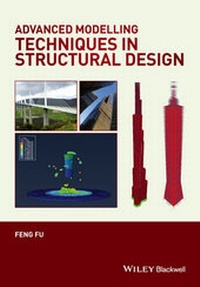
Advanced Modelling Techniques in Structural Design
Description

Reviews / Votes
"The book will be of interest to specialised structural analysis practitioners who would like to broaden their practical knowledge of the scope of other providers of currently available acceptable analysis software for more specialised structural analyses and scenarios." (The Structural Engineer, March 2016)More details
Other editions
Additional editions
Person
Content
About the Author xi
Preface xiii
Acknowledgements xv
1 Introduction 1
1.1 Aims and scope 1
1.2 Main structural design problems 2
1.3 Introduction of finite element method 3
1.3.1 Finite element methods 3
1.3.2 Finite element types 4
1.4 Conclusion 8
References 8
2 Major modelling programs and building information modelling (BIM) 9
2.1 Fundamentals of analysis programs 9
2.1.1 Selection of correct analysis packages 9
2.1.2 Basic analysis procedures 10
2.2 Building information modelling (BIM) 10
2.3 Main analysis programs in current design practice 11
2.3.1 Abaqus® 11
2.3.2 ANSYS 12
2.3.3 SAP2000 12
2.3.4 ETABS 12
2.3.5 Autodesk robot structural analysis professional 13
2.3.6 STAAD.Pro 13
2.4 Major draughting program 13
2.4.1 AutoCAD 14
2.4.2 Autodesk Revit 14
2.4.3 Rhino3D 14
2.4.4 Bentley MicroStation 15
2.5 Method to model complex geometry 15
2.5.1 Import geometry into SAP 2000 16
2.5.2 Import geometry into ETABS 19
2.5.3 Import geometry into Abaqus® 21
2.5.4 Set up model with Revit 25
References 25
Software and manuals 25
3 Tall buildings 26
3.1 Introduction 26
3.2 Structural systems of tall buildings 26
3.2.1 Gravity load resisting systems 26
3.2.2 Lateral load resisting systems 27
3.3 Lateral resisting systems and modelling examples 27
3.3.1 Moment resisting frames (MRF) 27
3.3.2 Shear walls 28
3.3.3 Bracing systems 28
3.3.4 Outrigger structures 29
3.3.5 Tube structures and modelling example of the Willis Towers 30
3.3.6 Diagrid structures and modelling example of the Gherkin 34
3.3.7 Super frame (mega frame) structures and modelling example 45
3.4 Modelling example of the Burj Khalifa 45
3.4.1 Model set up 49
3.4.2 Analysis and result 54
3.5 Modelling example of Taipei 101 with tuned mass damper (TMD) 55
3.5.1 TMD modelling 55
3.5.2 TMD modelling result 60
3.6 Conclusion 60
References 60
4 Earthquake analysis of buildings 61
4.1 Introduction 61
4.2 Basic earthquake knowledge 61
4.2.1 Categories of earthquake waves 61
4.2.2 Measurement of earthquake 62
4.3 Basic dynamic knowledge 62
4.3.1 SDOF 62
4.3.2 SDOF under earthquake 63
4.3.3 MDOF under earthquake 66
4.3.4 Response spectrum 67
4.3.5 Modal analysis 68
4.3.6 Response spectrum from Eurocode 8 68
4.3.7 Ductility and modified response spectrum 69
4.4 Modelling example of the response spectrum analysis using SAP20001 70
4.5 Time history analysis and modelling example using SAP2000 81
4.5.1 Fundamentals of time history analysis 81
4.5.2 Modelling example of time history analysis using SAP2000 81
4.6 Push-over analysis and modelling example using SAP2000 87
4.6.1 Introduction 87
4.6.2 Modelling example of push-over analysis using SAP2000 88
References 97
Codes and building regulations 97
Software and manuals 97
5 Progressive collapse analysis 98
5.1 Introduction 98
5.2 Design guidance for progressive collapse analysis 98
5.3 Risk assessment 99
5.4 Design and analysis method 99
5.4.1 Indirect design method 99
5.4.2 Direct design method 100
5.4.3 Selection of design method 101
5.4.4 Structural analysis procedures and acceptance criteria 101
5.5 Modelling example of progressive collapse analysis using SAP2000 - nonlinear dynamic procedure 104
References 112
Codes and building regulations 112
6 Blast and impact loading 113
6.1 Introduction 113
6.2 Fundamentals of blast loading 113
6.2.1 Basic design principles 113
6.2.2 Major blast attack regimes 114
6.2.3 Blast load characteristics 114
6.2.4 Principle of the scaling law 114
6.2.5 Simplification of the blast load profile 115
6.2.6 Material behaviours at high strain-rate 116
6.2.7 Dynamic response and pressure impulse diagrams 116
6.3 Introduction of SPH theory 117
6.4 Modelling examples of impact loading analysis using the coupled SPH and FEA method in Abaqus® 119
6.4.1 Modelling technique 119
6.4.2 Modelling example 120
References 139
Codes and building regulations 139
Software and manuals 139
7 Structural fire analysis 140
7.1 Introduction 140
7.2 Basic knowledge of heat transfer 140
7.3 Fire development process 141
7.4 Fire protection method 142
7.4.1 Active system control 142
7.4.2 Passive system control 143
7.5 Fire temperature curve 143
7.6 Determination of the thermal response of structural members 145
7.7 Structural fire design 145
7.7.1 Fire safety design objectives 145
7.7.2 Fire safety design framework 146
7.8 Major modelling techniques for structural fire analysis 146
7.8.1 Zone model 146
7.8.2 CFD model 146
7.8.3 Finite element method using the fire temperature curve 147
7.9 Modelling example of heat transfer analysis using Abaqus® 147
7.9.1 Model set up 147
7.9.2 Define the heat transferring parameters 152
7.9.3 Analysis 164
7.9.4 Model results 164
7.9.5 Other type of slabs 164
References 166
Building codes and regulations 166
8 Space structures 167
8.1 Introduction 167
8.2 Type of space structures 167
8.2.1 Double layer grids 167
8.2.2 Latticed shell structures 168
8.2.3 Tensegrity domes 170
8.3 Design load 172
8.3.1 Dead load 172
8.3.2 Live load 173
8.3.3 Temperature effect 173
8.4 Stability analysis of space structures 173
8.4.1 Member buckling analysis 173
8.4.2 Local buckling analysis 174
8.4.3 Global buckling analysis 175
8.5 Modelling example of a single layer dome using SAP 2000 (including global buckling analysis) 176
8.5.1 Set up a 3D model in AutoCAD 177
8.5.2 Import the 3D model into SAP 2000 177
8.5.3 Define load pattern 177
8.5.4 Define load cases (including global buckling analysis) 177
8.5.5 Run global buckling analysis 180
8.5.6 Define load combination 183
8.5.7 Analysis and result 183
8.5.8 Auto-design module 185
8.6 Nonlinear geometric analysis of Tensegrity structures 185
8.6.1 The initial geometrical equilibrium (form finding) 185
8.6.2 Static analysis 186
8.7 Modelling example of Tensigrity dome using SAP 2000 (nonlinear geometrical analysis) 187
8.7.1 Set up a 3D model in Rhino 187
8.7.2 Import 3D model into SAP 2000 187
8.7.3 Nonlinear geometric analysis of Tensegrity using SAP 2000 188
8.7.4 Define the prestressed force 190
8.7.5 Form finding (determination of initial geometrical equilibrium 191
8.7.6 Static analysis 195
References 195
Building codes and regulations 196
Software and manuals 196
9 Bridge structures 197
9.1 Introduction 197
9.2 Structural types of bridges 197
9.2.1 Beam bridges and truss bridges 197
9.2.2 Arch bridges 198
9.2.3 Cantilever bridges 198
9.2.4 Suspension bridges 198
9.2.5 Cable-stayed bridges 200
9.3 Structural design of bridge structure 201
9.4 Design loading 201
9.4.1 Dead loads 202
9.4.2 Live loads 202
9.4.3 Seismic effects on bridges 202
9.4.4 Wind effects on bridges 203
9.4.5 Accidental actions (impact loads) 203
9.5 Modelling example of Milau Viaduct using CSI Bridge 203
9.5.1 Model set up 203
9.6 Defining abutments 208
9.6.1 Define the vehicle loading 209
9.6.2 Analysis and result 211
9.7 Modelling example of Forth Bridge using SAP 2000 213
References 221
Codes and regulations 221
10 Foot-induced vibration 222
10.1 Introduction to vibration problems in structural design 222
10.2 Characteristics of foot-induced dynamic loads 222
10.2.1 Pace frequency 222
10.2.2 Vertical loading 223
10.2.3 Horizontal loads 223
10.2.4 Loads induced by groups and crowds 224
10.3 Acceptance criteria 224
10.3.1 Footbridge 225
10.3.2 Floor slabs 225
10.4 Loading representation of foot-induced vibration 227
10.4.1 Time-domain solution (time history analysis) 227
10.4.2 Frequency-based solutions (random analysis) 228
10.5 Modelling example of vibration analysis for the Millennium Bridge using SAP2000 (time-based method) 229
10.5.1 Model set up 230
10.5.2 Simulation of pedestrian loads 230
10.5.3 Analysis of Millennium Bridge before retrofit 233
10.5.4 Analysis of the Millennium Bridge after retrofit 235
10.6 Modelling example of vibration analysis of hospital floor using Abaqus® (frequency-based method) 238
10.6.1 Prototype structure 238
10.6.2 Modelling technique 239
10.6.3 Analysis procedures and major Abaqus® commands used in the simulation 240
10.6.4 Analysis result interpretation 245
References 251
Codes and building regulations 251
Software and manuals 252
Index 253
Chapter 1
Introduction
1.1 Aims and scope
With the fast development of modern construction technology, major international city skylines are changing dramatically. More and more complex buildings, such as Burj Khalifa in Dubai, the Birds Nest Stadium in Beijing and the London Aquatic Centre, have been built over the past decade. As a Chartered Structural Engineer, the author has worked for several leading international consultancy companies and has worked on several prestigious projects around the world. The experience of the author demonstrates that in current design practice most of these buildings could not have been designed without the use of advanced modelling techniques. Fierce competition in the current design market also requires structural engineers to handle the increasing difficulty in designing the more complicated projects required by both clients and architects. This challenge can only be tackled by using modern computer technology. It also imposes a big change in the role of the structural engineer: in addition to knowledge of basic design principles and structural analysis methods, an engineer should also have a full understanding of the latest modelling techniques. This is also the reason that advanced computer modelling skills have recently become essential for an engineer's recruitment by increasing numbers of design consultancies.
However, in the construction industry, most structural engineers find themselves lacking modelling knowledge, as few textbooks have been provided in this area. For students, although some elementary modelling techniques are taught in most Civil Engineering courses, no systematic introduction is made, let alone how to model a real construction project in practice. Therefore, a book in this area is imperative.
The main purpose of this book is to introduce and provide detailed knowledge of advanced numerical analysis methods and important design principles for both students and design practitioners. It addresses effective modelling techniques in solving real design problems and covers a broad range of design issues - such as lateral stability of tall buildings, buckling analysis of long-span structures and earthquake design - and some special issues such as progressive collapse, blast, structural fire analysis, foot-induced vibrations and so on.
It also introduces a variety of major modelling programs (such as SAP2000, ETABS, Abaqus®1, ANSYS) and preprocessing software (Rhino, Revit, AutoCAD) used in current structural design practice. A number of modelling examples using this software are provided in the book. Most of the model examples are based on a worldwide selection of real design projects, such as the Millennium Bridge and Burj Kalifa, helping readers to find an effective way to model these types of structures.
In addition, the algorithms and theories that underpin the analysis, such as the finite element method (FEM) and smoothed particle hydrodynamics (SPH) method, are also introduced. Along with the introduction of modelling techniques, relevant design principles and design guidance are also covered. Thus this book can also serve as a handbook for structural engineers. A feature of this work is that it introduces advanced and complicated theory in a more understandable and practical way.
In real design practice, we analyse the structure with an advanced program to gain a level of confidence, such as a ball-park figure for the size of the structural members, but when we start the design we will still follow a code of practice, even though some are quite conservative. Advanced modelling is particularly complementary to current design guidance in those areas where it is still not clear. Therefore, this book will help readers understand the balance between analysis and design.
1.2 Main structural design problems
As a structural engineer, one is required to design different type of buildings such as tall buildings, bridges and space structures. Each type of structure features different structural design problems that a structural engineer needs to pay special attention to during their design. This book covers almost all the important design issues in modern construction projects. In this section, a brief introduction to these different structural problems will be given.
In tall building design, the main issue is the design of the lateral stability systems. In Chapter 3, a detailed introduction to the different lateral stability systems - such as out-triggers, tubular systems and bracing systems - will be given in addition to information on how to model them effectively.
Earthquake design is important for buildings being built in high seismic activity areas. This is covered in Chapter 4. The major earthquake analysis methods - such as response spectrum analysis, time history analysis and push-over analysis - are introduced and modelling examples in SAP2000 are also provided.
Progressive collapse has become another important issue since 911: Chapter 5 covers this topic. The design methods provided by the design guidance are introduced. Different analysis procedures, such as linear static, nonlinear static, linear dynamic and nonlinear dynamic analysis, are explained. A modelling example of nonlinear dynamic progressive collapse analysis is demonstrated using SAP2000.
Aside from conventional loading, blast and fire are other possible threats to the building and its occupants, and Chapters 6 and 7 cover these issues. How to represent these types of special loading and the corresponding design guidance are introduced. In Chapter 6 a new technique in modelling blast or impact effect, the SPH method, is introduced and a modelling example of SPH analysis using Abaqus® is demonstrated. In Chapter 7, a modelling example of heat transfer analysis of a structure is demonstrated.
For space structures, the main design issue is member buckling and overall buckling of the structure; the analysis theories underpinning buckling analysis are introduced in detail in Chapter 8 and corresponding modelling examples are also given. This chapter also covers a special topic on Tensegrity domes, which have a different structural form to conventional long-span space structures.
Regarding bridge structures, different structure types - such as the beam bridge, cantilever bridge, suspension bridge and cable-stayed bridge - are introduced in Chapter 9. One of the main design issues for bridges is designing the structure under moving load from vehicles, and the corresponding design guidance is introduced. Modelling examples of two famous bridges, Millau Viaduct and the Forth Bridge, are also given.
Foot-induced vibration is a critical issue for the design of foot bridges and hospitals. This is because foot bridges are prone to vibration problems, and hospital buildings have strict requirements for vibration prevention. The vibration problem and corresponding modelling examples are covered in Chapter 10.
1.3 Introduction of finite element method
Numerical methods are fundamental to most analysis software. There are extensive numerical methods that have been developed so far, which include the finite element method, boundary element method, finite difference method, finite volume method and the meshless method (such as the SPH method).
In structural analysis, the finite element method (FEM) is one widely used numerical method. Therefore, it is important for a structural engineer to have some basic knowledge of FEM. In this section, the basic principles of the finite element method will be introduced. Another numerical method, the SPH method, which is used for the analysis of blast or impact loading, will be introduced in Chapter 6.
1.3.1 Finite element methods
The development of the finite element method can be traced back to Courant (1943) in his investigation of the torsion problem. The term 'finite element' was first coined by Clough (1960) and research on this topic has also been conducted by other researchers such as Turner (1956). This numerical method was first used in structural analysis problems in civil and aeronautical engineering. Following that, FEM was applied to a wide range of engineering problems, and most commercial FEM software packages - such as Abaqus®, ADINA and ANSYS - were developed in the 1970s.
FEM is one of the numerical techniques for finding approximate solutions for differential equations with different boundary conditions. It divides a structure into several small elements, named finite elements, then reconnects these elements at their nodes through the compatibility relationships between each element, as the adjacent elements share the same degree of freedom (DOF) at connecting nodes (as is shown in Figure 1.1). The methods for connecting these simple element equations are provided to approximate a more complex equation over a larger domain. The displacement of each node can be determined by a set of simultaneous algebraic equations. Through the compatibility relationship, the displacement can be interpolated over the entire structure.
Fig. 1.1 Finite element mesh in Abaqus®.
Abaqus® screenshot reprinted with permission from Dassault Systèmes. Abaqus® is a registered trademark of Dassault Systèmes and/or its subsidiaries.
The major steps of a finite element model can be identified as follows:
- Select element types.
- Discretise the structure into pieces...
