

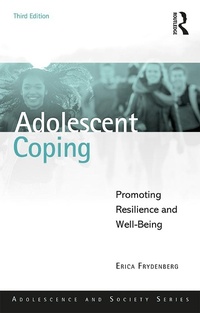
Adolescent Coping
Promoting Resilience and Well-Being
3rd Edition
Published on 12. June 2018
226 pages
978-1-351-67728-8 (ISBN)
Description

How do young people cope with the multitude of difficult situations and scenarios that are associated with growing up, like anxiety and depression, as well as illness, rejection and family breakdown? How can we facilitate and encourage, through a combination of health, well-being and positive mindset, healthy development during adolescence and beyond?
With a substantial focus on the positive aspects of coping, including an emphasis on developing resilience and the achievement of happiness, Erica Frydenberg presents the latest developments in the field of coping. Adolescent Coping highlights the ways in which coping can be measured and implemented in a wide range of circumstances and contexts, with suggestions for the development of coping skills and coping skills training, and it provides strong scholarly evidence for the concepts and constructs that it promotes as providing a pathway to resilience. The work is framed as an ongoing interaction between individuals and their environments as represented by the psychosocial ecological model of Bronfenbrenner.
The major theories of coping are articulated that take account of the transactional model, resources theories and proactive models of coping. Areas of recent interest such as neuroscience and epigenetics are included, alongside a new chapter, 'Cyberworld', which provides insights on new and relevant topics such as mindfulness and the impact of social media as they relate to coping in the contemporary context.
Adolescent Coping will be of interest to practitioners in psychology, social work, sociology, education and youth and community work as well as to students on courses in adolescent development in these fields.
With a substantial focus on the positive aspects of coping, including an emphasis on developing resilience and the achievement of happiness, Erica Frydenberg presents the latest developments in the field of coping. Adolescent Coping highlights the ways in which coping can be measured and implemented in a wide range of circumstances and contexts, with suggestions for the development of coping skills and coping skills training, and it provides strong scholarly evidence for the concepts and constructs that it promotes as providing a pathway to resilience. The work is framed as an ongoing interaction between individuals and their environments as represented by the psychosocial ecological model of Bronfenbrenner.
The major theories of coping are articulated that take account of the transactional model, resources theories and proactive models of coping. Areas of recent interest such as neuroscience and epigenetics are included, alongside a new chapter, 'Cyberworld', which provides insights on new and relevant topics such as mindfulness and the impact of social media as they relate to coping in the contemporary context.
Adolescent Coping will be of interest to practitioners in psychology, social work, sociology, education and youth and community work as well as to students on courses in adolescent development in these fields.
Reviews / Votes
It is never too soon to start acquiring the skills that promote happiness, well-being, and resilience. It is never too late to shift the vantage point and focus on strengths instead of vulnerabilities. This latest edition of "Adolescent Coping: Promoting Resilience and Well-being" makes these themes clear. Theoretically grounded and empirically complex - those are the most distinguishing features of Prof. Frydenberg's open-minded inquiries into the foundations of young people's successful coping with ordinary and extraordinary life challenges. This is not only a portfolio of knowledge, wisdom, and methods but also a survival kit for researchers, teachers, caregivers, and parents. Krys Kaniasty, Professor of Psychology, Indiana University of Pennsylvania, USA, and Institute of Psychology, Polish Academy of Sciences, PolandIn Adolescent Coping: Promoting Resilience and Well-being Dr Erica Frydenberg has brought together her vast experience as a psychologist, educator, researcher, and (grand) parent to provide an authoritative and up-to-date account of adolescent coping. Dr Frydenberg sheds vital light on the "classic" challenges that have faced all adolescents for centuries as they navigate to early adulthood. She also provides an important and most timely insight into the "modern" challenges facing adolescents-and how practitioners and families can best respond to these. Reflecting latest advances in psychology and education, this volume builds on previous editions by incorporating developments in positive psychology, neuroscience, and educational technology-while also traversing a diversity of adolescents and family structures that comprise our ever-changing society. Adolescent Coping is a valuable resource for scholars, practitioners, and families seeking to optimise the well-being of young people at a critical stage of human development. Andrew J. Martin, PhD, Scientia Professor and Professor of Educational Psychology, University of New South Wales, Australia
In recent years, constructs related to coping, individual resilience, emotional intelligence, mindfulness, happiness and wellbeing have permeated the psychological, educational and sociological literature. The data connecting such constructs to mental health, academic performance, identity, emerging themes in technological and disruptive social influences, and biological and developmental prequelae has been growing. In adolescence, such factors coalesce to determine the transition to adulthood. With this tome, and with a panoply of research and years of experience, the author has addressed important research and applied issues with great clarity. This mammoth achievement will help researchers and practitioners alike advance our understanding of coping in adolescence. Professor Michael Kyrios, Vice President, Flinders University and Executive Dean, College of Education, Psychology & Social Work, South Australia, Australia
More details
Series
Edition
3rd edition
Language
English
Place of publication
London
United Kingdom
Publishing group
Taylor & Francis Ltd
Target group
College/higher education
Professional and scholarly
Illustrations
5 Tables, black and white; 5 Halftones, black and white
ISBN-13
978-1-351-67728-8 (9781351677288)
Copyright in bibliographic data and cover images is held by Nielsen Book Services Limited or by the publishers or by their respective licensors: all rights reserved.
Schweitzer Classification
Other editions
Additional editions

Book
06/2018
3rd Edition
Routledge
€197.40
Shipment within 10-20 days
Book
06/2018
3rd Edition
Routledge
€68.60
Shipment within 10-20 days
Person
Erica Frydenberg is an educational, clinical and organisational psychologist who has practiced extensively in the Australian educational setting, before joining the staff of the University of Melbourne, where she is a Principal Research Fellow and Associate Professor in psychology in the Melbourne Graduate School of Education.
Content
Positive Psychology and Related Constructs
What Is Coping?
The Measurement of Coping
Coping: What we have learned
Family coping: Culture and Context
Wellbeing and Resilience
An Intersect: Ecology, Neuroscience and Epigenetics
Anxiety, Depression And Other Related Conditions
Coping with diverse conditions
Adolescent Risk
Learning to Cope
Technology and Social Media: The Good and the Bad
Final Thoughts
What Is Coping?
The Measurement of Coping
Coping: What we have learned
Family coping: Culture and Context
Wellbeing and Resilience
An Intersect: Ecology, Neuroscience and Epigenetics
Anxiety, Depression And Other Related Conditions
Coping with diverse conditions
Adolescent Risk
Learning to Cope
Technology and Social Media: The Good and the Bad
Final Thoughts
