


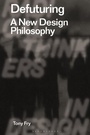
Defuturing
A New Design Philosophy
1st Edition
Published on 20. August 2020
288 pages
978-1-350-08955-6 (ISBN)
Description

"Once one understands the nature and magnitude of defuturing as the negation of world futures, how one has to account for the history and making of the material world - including design - dramatically changes. Defuturing as our condition forces the generation of a new philosophy of design."
With these thoughts this book presents a radically new understanding of the history, context and futures of designing.
First published in 1999, now reissued with a new preface by the author, Defuturing: A New Design Philosophy is a prescient and powerful account of what it means to comprehend that we live in world that is taking away futures for ourselves and non-human others. Arguing that designing is doubly implicated in this process, first in its roles in helping to create the unsustainable, but second, re-thought through the lens of defuturing, as a mode of acting in the world that can help contest the negation of the world, Defuturing transforms our comprehension of designing and of how futures can be constituted.
Working not through abstract theorizing but through the analysis of concrete examples, the book uses historical material on design to expose the archaeology of defuturing. Shattering the illusion that the future simply "is", Defuturing confronts designing with the challenge of remaking while offering the elements of a new practical reasoning of design acting.
With these thoughts this book presents a radically new understanding of the history, context and futures of designing.
First published in 1999, now reissued with a new preface by the author, Defuturing: A New Design Philosophy is a prescient and powerful account of what it means to comprehend that we live in world that is taking away futures for ourselves and non-human others. Arguing that designing is doubly implicated in this process, first in its roles in helping to create the unsustainable, but second, re-thought through the lens of defuturing, as a mode of acting in the world that can help contest the negation of the world, Defuturing transforms our comprehension of designing and of how futures can be constituted.
Working not through abstract theorizing but through the analysis of concrete examples, the book uses historical material on design to expose the archaeology of defuturing. Shattering the illusion that the future simply "is", Defuturing confronts designing with the challenge of remaking while offering the elements of a new practical reasoning of design acting.
More details
Series
Edition
1. Auflage
Language
English
Place of publication
London
United Kingdom
Publishing group
Bloomsbury Publishing PLC
Target group
College/higher education
File size
9,09 MB
ISBN-13
978-1-350-08955-6 (9781350089556)
Copyright in bibliographic data and cover images is held by Nielsen Book Services Limited or by the publishers or by their respective licensors: all rights reserved.
Schweitzer Classification
Other editions
Additional editions
Book
09/2020
Bloomsbury Visual Arts
€32.50
Shipment within 15-20 days
Person
Tony Fry is Principal of The Studio at the Edge of the World, Australia, Adjunct Professor at the University of Tasmania, Australia and Visiting Professor at Universidad de Ibagué, Colombia. Tony has held academic positions in Australia and internationally and is the author of fourteen books, including Design Futuring (2009); Design as Politics (2011), Becoming Human By Design (2012) and Remaking Cities (2017). His latest book is Unstaging War (2019).
Content
List of images
Tony Fry's Defuturing: A new design philosophy by Clive Dilnot
Preface to the 2020 edition
Preface to the original edition
INTRODUCTION
An introductory lexicographical review
Design
Sustain-ability and unsustainability
Defuturing
Relationality
Guided Reading
PART I: An opening
1. TECHNOLOGY, WARRING AND THE CRISIS OF HISTORY
Technology in flux
From structure and from techné
From war to warring
The crisis of the crisis of history
PART II: History, modernity and defuturing
2. MADE IN AMERICA: A WORLD PRODUCTION
America
Then and now
Productivism and a history of world making
3. DWELLING IN STREAMLINES AMERICA
Streamlining Design
The New York World's Fair
Utopia: A designing idea
4. TOTAL DESIGN: EUROPE
The Bauhaus, as told
The Vkhutemas postscript
PART III: One point: Four locations
5. DESIGN AND THE BODY OF COMPETITION
The body
Bodies of the body
The measure that measures the standards
Openings as endings
6. TIME AND CHINA
Time
The years of 1926
China: Four perspectives
7. TELEVISUAL IN-HUMAN DESIGN
The televisual
Perspectives and horizons
Ecology of the image
8. THE AUTONOMIC TECHNOCENTRICITY OF COMPUTERS
The reason machine
The force of design
Reiterations towards making decisions
CONCLUDING IMPRESSIONS
Bibliography
Index
Tony Fry's Defuturing: A new design philosophy by Clive Dilnot
Preface to the 2020 edition
Preface to the original edition
INTRODUCTION
An introductory lexicographical review
Design
Sustain-ability and unsustainability
Defuturing
Relationality
Guided Reading
PART I: An opening
1. TECHNOLOGY, WARRING AND THE CRISIS OF HISTORY
Technology in flux
From structure and from techné
From war to warring
The crisis of the crisis of history
PART II: History, modernity and defuturing
2. MADE IN AMERICA: A WORLD PRODUCTION
America
Then and now
Productivism and a history of world making
3. DWELLING IN STREAMLINES AMERICA
Streamlining Design
The New York World's Fair
Utopia: A designing idea
4. TOTAL DESIGN: EUROPE
The Bauhaus, as told
The Vkhutemas postscript
PART III: One point: Four locations
5. DESIGN AND THE BODY OF COMPETITION
The body
Bodies of the body
The measure that measures the standards
Openings as endings
6. TIME AND CHINA
Time
The years of 1926
China: Four perspectives
7. TELEVISUAL IN-HUMAN DESIGN
The televisual
Perspectives and horizons
Ecology of the image
8. THE AUTONOMIC TECHNOCENTRICITY OF COMPUTERS
The reason machine
The force of design
Reiterations towards making decisions
CONCLUDING IMPRESSIONS
Bibliography
Index
